

What if the very rules designed to limit your savings were actually the secret to unlocking your most comfortable retirement yet? It is a common feeling to view the annual changes to superannuation contribution limits with a sense of trepidation, especially when a simple oversight might lead to an unwelcome tax bill. You likely want to do the right thing for your future self, but the distinction between concessional and non-concessional caps can feel like a puzzle that is constantly shifting. We understand that your super represents years of hard work and personal sacrifice, and it is natural to want certainty in your planning.
This guide is designed to help you master these caps and thresholds so you can maximise your retirement savings while staying firmly within the lines of tax compliance. If you have ever wondered how the new $32,500 concessional cap applies to your salary sacrifice or how the $130,000 non-concessional limit fits into your strategy, you are in the right place. We will walk through the 2026-2027 thresholds together, covering everything from carry-forward rules for smaller balances to the bring-forward arrangements that could fast-track your goals. By the end, you will have a clear, calm roadmap for the financial year ahead.
Key Takeaways
- Understand the vital differences between before-tax and after-tax contributions so you can choose the most tax-effective path for your savings.
- Gain clarity on the 2026-27 superannuation contribution limits to avoid unexpected tax penalties and keep your retirement strategy on track.
- Explore how carry-forward and bring-forward arrangements allow you to make larger “catch-up” contributions when your personal circumstances change.
- Learn why your Total Super Balance is the key to unlocking specific contribution types and how to manage it as you approach the transfer balance cap.
- Discover how partnering with a trusted guide for your retirement planning can simplify these technical rules and provide long-term stability for your future.
Understanding Superannuation Contribution Limits: Why the Boundaries Matter
Think of superannuation contribution limits as the annual ceiling on how much you can add to your super fund. These boundaries aren’t just arbitrary rules; they serve a specific purpose in the Australian economy. By setting these caps, the government aims to prevent people from using super as an excessive tax shelter while still providing enough incentive for you to build a self-funded retirement. It’s a balancing act designed to ensure the system remains fair for everyone while rewarding those who take responsibility for their future financial security.
The system of Superannuation in Australia is built around two main “buckets” for your money. First, there are concessional contributions, which are made from before-tax income, such as your employer’s compulsory payments or salary sacrifice. Second, there are non-concessional contributions, which come from your after-tax savings. We know that keeping track of these different categories can feel overwhelming. It’s perfectly normal to feel a bit of pressure when trying to get the numbers exactly right, especially when you’re focused on protecting the wealth you’ve worked so hard to create.
The Importance of Staying Within the Caps
If you happen to exceed these limits, the consequences can be a bit of a headache. Essentially, any amount over the cap may be taxed at your marginal income tax rate rather than the lower 15% rate usually applied within super. Look at these caps not as restrictions, but as a guide for your stewardship. Staying within the superannuation contribution limits is one of the simplest ways to protect your long-term savings from unnecessary leakage to the tax office. With a thoughtful plan in place, these rules become manageable markers on your path to a comfortable lifestyle.
Financial Year Timing and “Receipt” Rules
One of the most common traps for the unwary is the timing of payments. For a contribution to count toward a specific year’s limit, your super fund must actually receive the money by June 30. Simply hitting “send” on your bank transfer isn’t enough. If you use BPay or an employer clearing house, processing delays can take several business days. To sleep soundly, it’s wise to organise your final contributions at least a week before the deadline to ensure they are safely tucked away in your account. In an Australian context, the financial year is the twelve-month period starting on 1 July and ending on 30 June the following year.
Concessional vs Non-Concessional Contributions: Navigating the Caps
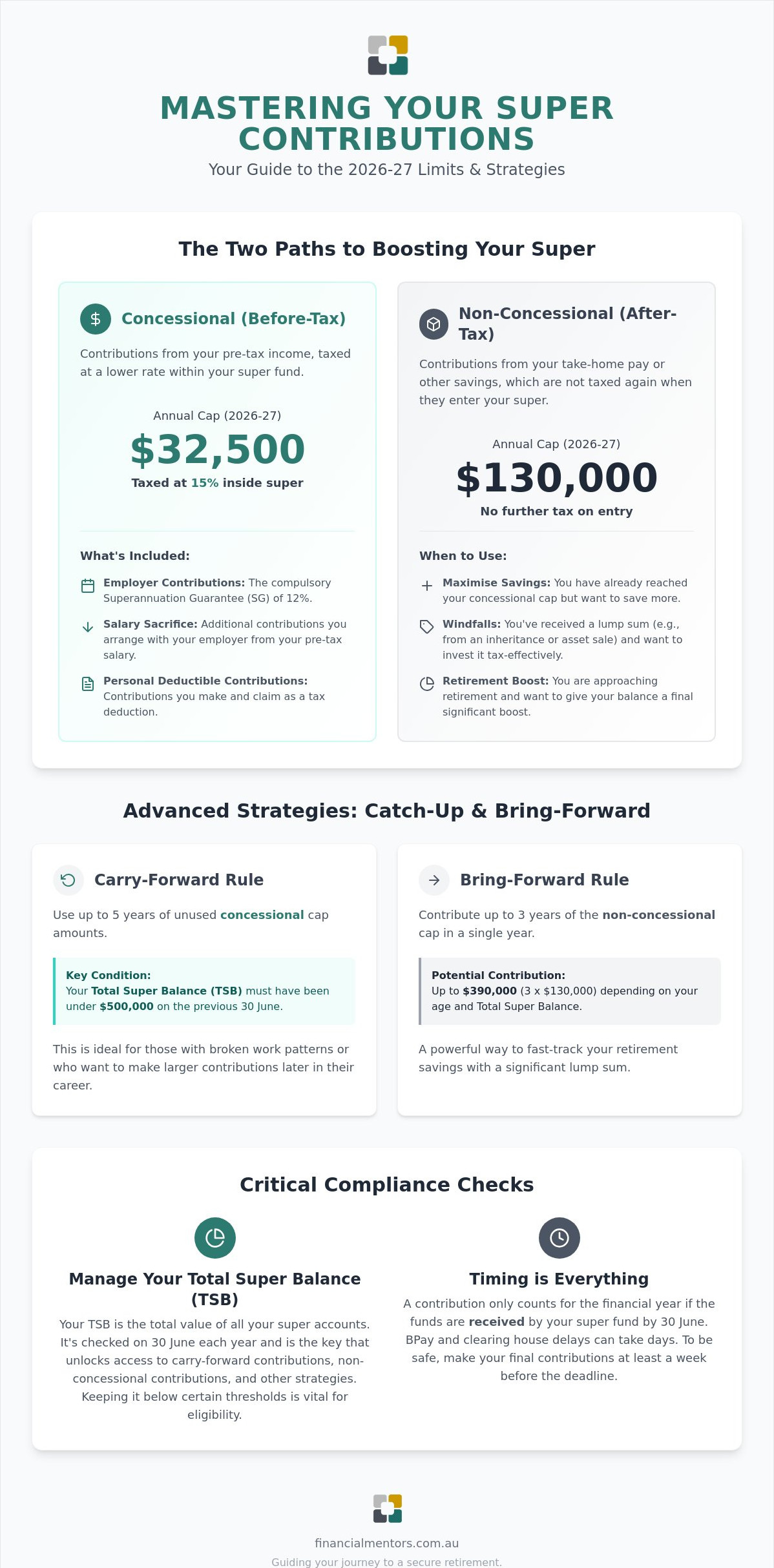
Choosing between before-tax and after-tax contributions is a bit like choosing the best route for a long road trip. Both paths lead to the same destination, a secure retirement, but they offer different tax benefits along the way. For the 2026-27 financial year, the superannuation contribution limits have been indexed to reflect changes in the economy. This means your concessional cap is now $32,500, while your non-concessional cap has increased to $130,000. It’s vital to remember that these limits apply to you as an individual. If you happen to have multiple super funds, your total contributions across all of them must stay within these single caps.
Maximising Concessional Contributions
Concessional contributions are often the most popular choice because they’re made from your “pre-tax” income, meaning they’re generally taxed at just 15% inside the fund. This is usually much lower than your personal income tax rate. Most people start with their employer’s Superannuation Guarantee (SG) payments, which currently stand at 12%. If you’re a high earner, you should be aware of the maximum super contribution base, as employers aren’t required to pay SG on earnings above this threshold. You might also consider salary sacrifice, which is a partnership between you and your employer to direct more of your pay into super before it hits your bank account. If you’re self-employed or have extra cash, you can also make personal deductible contributions and claim a tax deduction, provided you lodge the correct paperwork with your fund.
The Power of Non-Concessional Contributions
If you’ve already reached your concessional limit or have a lump sum from an inheritance or the sale of an asset, non-concessional contributions are a powerful tool. Because this money comes from your “after-tax” savings, you don’t pay any additional tax when the money enters your super fund. It’s a highly effective way to boost your balance quickly without worrying about entry taxes. This strategy is particularly useful for those looking to “catch up” on their savings in the years leading up to retirement. If you’re unsure which path best suits your unique goals, a personalised approach to retirement planning can help you find the right balance for your circumstances. By understanding how these two buckets work together, you can make informed choices that protect your wealth and build a more stable future.
Advanced Strategies: Carry-Forward and Bring-Forward Rules
Life doesn’t always move in a straight line. Perhaps you took time away from the workforce to raise a family, or maybe your early career was focused on building a business rather than personal savings. If you feel like you’ve started your wealth journey a little later than planned, then these advanced rules offer a genuine second chance to bridge the gap. They transform the standard superannuation contribution limits from rigid annual hurdles into a flexible “catch-up” opportunity that respects your unique life path. It’s about providing the space you need to secure your future, even if your contributions haven’t been consistent in the past.
The Carry-Forward Concessional Rule
If your Total Superannuation Balance (TSB) was less than $500,000 on 30 June of the previous financial year, you may be eligible to use the carry-forward rule. This allows you to tap into any unused portions of your concessional cap from the past five financial years. It’s a powerful way to make a larger contribution in a year when you have higher income or a surplus of cash. You can easily check your available unused capacity by logging into your myGov account and viewing your ATO linked services. Utilising these carry-forward caps can be a wise way to reduce the capital gains tax owed after selling a significant asset like an investment property.
Bring-Forward Non-Concessional Rule
For those with larger sums of after-tax money to invest, the bring-forward arrangement is a significant lever for growth. In the 2026-27 financial year, this rule allows you to contribute up to $390,000 in a single year by “bringing forward” two future years’ worth of the $130,000 non-concessional cap. However, this rule is strictly governed by your TSB as of 30 June 2026. To utilise the full three-year bring-forward amount, your balance must be less than $1.84 million. If your balance is between $1.84 million and $2 million, your ability to bring forward future caps is reduced or removed entirely. Because “triggering” this rule accidentally can have long-term implications for your contribution strategy, seeking professional guidance is a sensible step to ensure you don’t lock yourself out of future opportunities. This careful stewardship ensures your money is always working toward your long-term stability.
Strategic Stewardship: Managing Your Total Super Balance (TSB)
Your Total Superannuation Balance (TSB) is more than just a tally of your hard-earned savings; it’s the primary gatekeeper for your future superannuation contribution limits. Each year on 30 June, the ATO takes a snapshot of your balance to determine which rules apply to you for the following twelve months. If you’re approaching the $2.1 million general transfer balance cap, which was indexed on 1 July 2026, you might wonder if it’s still wise to keep adding to your fund. While reaching these levels is certainly a “high-class problem,” it doesn’t mean your planning should stop. In fact, this is precisely when careful stewardship becomes most critical to ensure you aren’t paying more tax than necessary.
Many people ask if the effort is still worth it when they’re nearing these thresholds. The answer is almost always yes, because the tax-effective environment inside super remains one of the most powerful tools for wealth preservation in Australia. Even if you can no longer make certain types of contributions because your TSB has passed the $2 million mark, the earnings on your existing balance are often taxed at a much lower rate than if those same assets were held personally. It’s about looking at the big picture and ensuring your overall strategy remains robust as your circumstances evolve.
Division 293 Tax: For High Earners
If your combined income and concessional contributions exceed $250,000, you’ll likely encounter Division 293 tax. This effectively adds an extra 15% tax to your concessional contributions, bringing the total tax on that money to 30%. We know it’s frustrating to feel penalised for your hard work, but we prefer to view this as a clear marker of your financial success. By using integrated wealth creation strategies, you can manage the impact of this tax while still taking advantage of the long-term growth super provides.
Spouse Contributions and Government Co-Contributions
Stewardship isn’t just about your individual balance; it’s about the collective security of your family unit. If your partner has a lower income or has taken a break from work, you might consider “contribution splitting” or making a spouse contribution. For the 2026-27 year, you could receive a tax offset of up to $540 if you contribute to your spouse’s super and their income is below $37,000. Similarly, the government co-contribution acts as a helping hand for lower-income earners, providing a boost of up to $500. These small, thoughtful steps can help balance your household’s total wealth and ensure both you and your partner enjoy a stable retirement.
Partnering for Peace of Mind: How Professional Advice Optimises Your Super
While the various superannuation contribution limits and thresholds we’ve explored might seem like a complex web of restrictions, they’re actually the boundaries of a high-performance wealth-creation roadmap. When you understand how to move within these rules, the opportunity for long-term growth is significant. However, we recognise that you have a life to lead, a family to enjoy, and perhaps a business to run. You shouldn’t have to spend your weekends deciphering tax legislation or worrying about whether you’ve accidentally triggered a bring-forward rule. This is where a partnership with a trusted guide provides the quiet confidence you need to move forward.
The return on investment for professional advice often extends far beyond simple percentage gains. By identifying tax-saving opportunities and avoiding costly penalties from exceeding caps, the value created can far outweigh the professional fees involved. It’s about more than just the numbers on a screen; it’s about the peace of mind that comes from knowing your future is being watched over by experts who care about your individual journey. We invite you to start a conversation about your unique circumstances, allowing us to help you build a retirement that reflects your hard work and aspirations.
Beyond the Numbers: A Personalised Roadmap
True financial security comes from seeing how every piece of your life fits together. We don’t just look at your super in isolation; we integrate your contribution strategy with your estate planning advice and your annual tax return preparation. This holistic approach ensures that every dollar is working toward the same goal. Having a partner who watches the shifting sands of government legislation means you’re never caught off guard by a change in superannuation contribution limits. Murray Frean has been providing this steady, reliable guidance since 2003, offering a level of stability that helps our clients feel secure through every market cycle. We take on the technical burden so you can focus on the milestones that matter most to your family.
Your Next Steps Toward Security
If you’re feeling uncertain about where you stand, a sensible first step is a “Super Health Check.” This simple process allows us to identify any unused carry-forward caps you might have from the last five years and ensure you aren’t leaving money on the table. Becoming a client at Financial Mentors Wealth Management is a methodical, calm process. We begin with a conversation to understand your goals, move into a detailed analysis of your current position, and then provide a clear, step-by-step plan for your future. Remember, it’s never too late to start organising your future. Whether you’re just starting to think about retirement or you’re already nearing the finish line, we’re here to walk beside you as a reliable partner through all of life’s ups and downs.
Taking the Next Step Toward Your Secure Future
Your journey toward a comfortable retirement doesn’t have to be a solo trek through a landscape of complex regulations. By understanding the 2026-27 superannuation contribution limits, you’ve already taken a vital step toward protecting your wealth and ensuring your future stability. Whether you’re utilising carry-forward rules for a second chance at savings or managing a larger balance through strategic stewardship, the key is to stay proactive. These rules are not just hurdles; they’re the framework for a well-planned life.
Since 2003, we’ve acted as a trusted guide for Australians seeking specialised retirement and estate planning expertise. Our human-centric approach ensures that your unique aspirations remain at the heart of every decision. If you’re ready to move from uncertainty to quiet confidence, book a consultation with Financial Mentors to organise your super strategy today. We’re here to help you build a roadmap that respects your hard work and secures the lifestyle you deserve. Your future self will thank you for the care you take today.
Frequently Asked Questions
How much can I contribute to super in the 2026-27 financial year?
In the 2026-27 financial year, you can generally contribute $32,500 as concessional (before-tax) contributions and $130,000 as non-concessional (after-tax) contributions. These superannuation contribution limits are indexed periodically, so it’s wise to check your specific eligibility based on your total super balance. If you have extra savings to invest, staying within these caps helps you build wealth while keeping your tax obligations as low as possible.
What happens if I exceed my concessional contribution cap?
If you exceed your concessional cap, the ATO will include the extra amount in your assessable income and tax it at your marginal rate. You’ll receive a 15% tax offset to account for the tax already paid by your fund, but you may also face an interest charge. We suggest monitoring your contributions throughout the year to avoid these unexpected costs and ensure your retirement planning remains on a steady, stress-free path.
Can I still use the carry-forward rule if my super balance is over $500,000?
No, you cannot use the carry-forward rule if your total super balance was $500,000 or more on 30 June of the previous financial year. This specific “catch-up” opportunity is designed for those with smaller balances who may have missed out on contributions in earlier years. If you’ve crossed that $500,000 threshold, you’ll simply be restricted to the standard annual concessional limit for the current year.
Is salary sacrifice included in the $32,500 concessional cap?
Yes, salary sacrifice is included in your concessional cap, which is $32,500 for the 2026-27 financial year. It’s a common misunderstanding to think salary sacrifice sits outside this limit, but it actually shares the same “bucket” as your employer’s compulsory contributions. If you’re planning to increase your salary sacrifice amounts, it’s a good idea to calculate your total projected employer payments first to ensure you don’t accidentally go over.
How do I check my current total superannuation balance?
The most reliable way to check your total superannuation balance is by logging into your myGov account and accessing the ATO linked services. Once there, you can view a consolidated summary of your balances across all your funds as they were reported on the last 30 June. Your super fund’s latest annual statement or their online member portal will also provide your current balance, though the ATO version is the one used for cap eligibility.
What is the bring-forward rule for non-concessional contributions?
The bring-forward rule allows you to contribute up to three years’ worth of non-concessional caps in a single year, totalling $390,000 for 2026-27. This is a powerful strategy if you’ve recently received a windfall or sold an asset, but your eligibility depends on your age and your total super balance. If your balance is already near $1.84 million, these rules become more restrictive, so careful planning is essential to manage your entry into a bring-forward period.
Can I claim a tax deduction for personal super contributions?
You can certainly claim a tax deduction for personal contributions, provided you lodge a “Notice of intent to claim” form with your super fund and receive an acknowledgement. This effectively turns an after-tax contribution into a concessional one, which can be a smart way to reduce your taxable income. Just remember that these deducted amounts will then count toward your superannuation contribution limits for concessional payments rather than your non-concessional cap.
Does the super guarantee paid by my employer count towards my limits?
Yes, every dollar of the 12% super guarantee paid by your employer counts toward your concessional contribution limit. Because these payments are mandatory, they often form the foundation of your cap, leaving you with the remaining “gap” to fill through salary sacrifice or personal deductible contributions. Keeping an eye on your employer’s payments ensures you know exactly how much room you have left to boost your retirement savings yourself.