

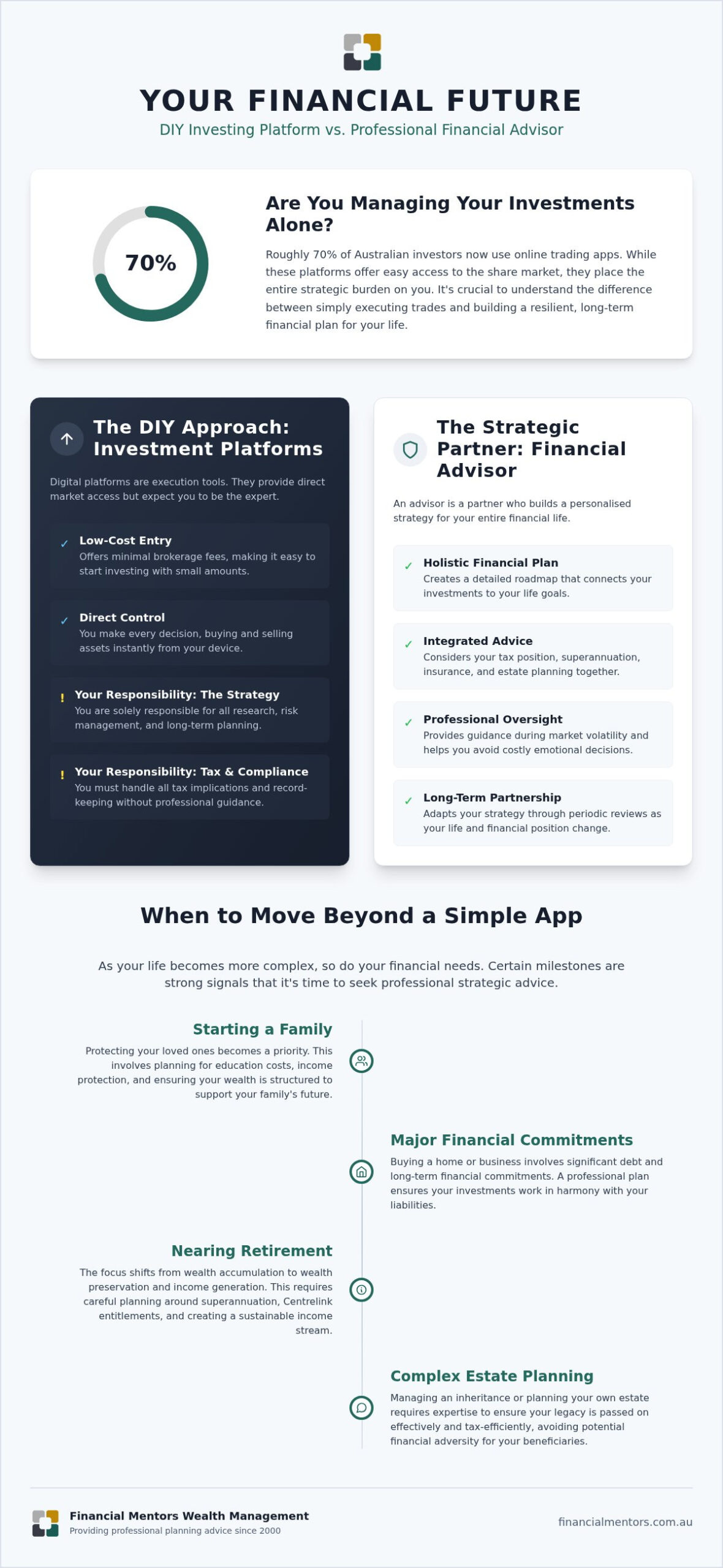
What if the lowest-cost way to invest actually becomes your most expensive mistake by the time you reach retirement? With roughly 70% of Australian investors now using online trading apps, it’s easy to feel like you should be managing every trade yourself. However, the choice between Australian investment platforms and a financial advisor isn’t just about brokerage fees or sleek app interfaces. It’s about who is looking at the big picture of your life. You might feel overwhelmed by conflicting online tips or worry that a simple tax error could derail your wealth management. We understand that anxiety, especially when you’re trying to figure out if your superannuation will truly last as long as you need it to.
We agree that having more control over your finances is a positive step toward independence. This guide will help you discover the practical differences between DIY digital investing and professional advice so you can decide which approach best protects your long-term goals. We will explore how different paths impact your tax position and estate planning, giving you a clear plan for wealth creation. Our goal at Financial Mentors Wealth Management is to provide the clarity you need to reduce financial stress and move forward with quiet confidence.
Key Takeaways
- Understand that investment platforms act as execution tools for the share market, while a financial advisor serves as a strategic partner for your entire financial life.
- Learn how professional wealth management integrates tax return preparation and estate planning to help you avoid costly mistakes.
- Identify the specific life milestones, such as starting a family or nearing retirement, that signal it’s time to move beyond simple digital trading.
- Discover the practical differences between investment platforms australia vs financial advisor to ensure your chosen path protects your long-term goals.
- Gain confidence in your financial position by understanding why a formal financial plan offers more security than an “execution-only” digital approach.
Choosing Between Investment Platforms and Professional Financial Advice
Australia’s financial landscape has changed rapidly. If you’ve spent any time on social media, you’ve likely seen ads for micro-investing apps that let you buy exchange-traded funds (ETFs) with just a few dollars. These investment platforms are digital gateways to the share market. They offer a simple, low-cost way to start, but they are execution-only services. This means they follow your instructions without asking if those instructions are actually beneficial for your future. They provide the tools, but you are entirely responsible for the strategy.
A financial advisor acts as a strategic partner for your whole financial life. When you compare investment platforms australia vs financial advisor, the core difference lies in the level of guidance. A professional provides essential context to your choices. To understand the legal and regulatory framework of this role, it helps to look at what a financial adviser does to protect your interests through the Best Interests Duty. This legal obligation ensures that the advice you receive is tailored specifically to your needs, rather than being a generic suggestion from an algorithm.
What are your goals for the next decade?
Are you looking for a quick win or are you building a legacy? It’s easy to get caught up in short-term trading when an app makes it feel like a game. However, if your medium-term goals include buying a home or starting a family, your strategy needs more depth. You should reflect on your current financial position. Are your financial commitments, such as rent or existing loans, balanced against your savings? Stewardship over your family’s future requires a steady hand. If you have people depending on you, the stakes of your investment choices become much higher. A professional approach ensures your long-term goals remain the priority.
The difference between ‘buying a product’ and ‘having a plan’
Platforms provide the “what”. You can buy an index fund or a specific share with two clicks. But they don’t explain the “how” or the “why” in relation to your life. A formal financial plan is a roadmap. It prepares you for financial adversity, such as a sudden job loss or a market downturn. If you only have a collection of products, you might panic when prices drop. If you have a plan, you have a reason to stay the course. This professional oversight brings a sense of peace that an app simply cannot replicate. In the debate of investment platforms australia vs financial advisor, remember that professional wealth management is about the destination, not just the vehicle. Taking that first step with a professional appointment is often the most effective way to secure your future.
The Digital Approach: What Australian Investment Platforms Offer You
The rise of digital wealth tools has made the share market more accessible than ever. For many younger Australians, these apps provide a low-cost entry point into wealth creation. To get a better sense of how these tools function, you can find investment platforms explained by ASIC’s Moneysmart website. These platforms operate on an execution-only basis. This means they are designed to follow your orders quickly and efficiently. However, they don’t provide the guidance needed to ensure those orders align with your broader financial commitments.
The appeal of low-cost brokerage
In 2026, the convenience of mobile-first investing is a significant draw for those starting their journey. Brokerage fees have dropped significantly; some platforms offer trades for as little as $3 or even $0 for specific transactions. Micro-investing apps in Australia typically allow you to start building a portfolio with as little as $1 or by rounding up your daily transaction amounts. This ease of use helps you build the habit of saving. When considering investment platforms australia vs financial advisor, it’s clear that platforms are excellent for simple execution. The challenge arises when you’re faced with thousands of ETFs, individual shares, or even digital assets via global fintech providers like Pallapay. This variety can lead to analysis paralysis, where the fear of picking the “wrong” asset prevents you from taking any action at all.
For those who navigate the digital asset space independently, security is a critical factor. Using a self-custody tool like Lumo Wallet allows you to keep your private keys on your own device, offering a level of personal control that is essential for any DIY investment strategy.
When comparing investment platforms australia vs financial advisor, the digital path requires you to be your own strategist and administrator. While digital tools handle the buying and selling, they often leave the heavy lifting of administration to you. You are responsible for tracking every dividend and franking credit for your annual dealings with the ATO. This can become a significant burden as your portfolio grows, especially when managing multiple assets across different apps.
DIY investing also tends to overlook the complex areas of estate planning and Centrelink entitlements. If you don’t have a professional looking at your whole situation, you might miss out on government benefits or leave your family with a complicated inheritance issue. Markets are naturally volatile. Without a mentor to provide perspective, many DIY investors feel the urge to sell during a downturn. This emotional reaction often leads to permanent losses. If you’re feeling the weight of managing these details alone, integrating your tax return preparation with a broader wealth strategy can provide the peace of mind you’re looking for. A professional approach ensures that your short-term trades don’t compromise your long-term goals.
The Advisor Advantage: Why Strategy Outperforms Simple Execution
While digital tools offer speed, they lack the wisdom of a long-term partnership. When comparing an investment platforms australia vs financial advisor, the most significant advantage is the “big picture” view. An advisor doesn’t just look at your share portfolio. They consider your debt levels, your insurance cover, and your overall financial position. This holistic approach ensures that your wealth isn’t just growing, but is also protected against financial adversity. If you’ve ever felt the urge to sell everything during a market dip, you’ll know that managing your own emotions is the hardest part of investing. A trusted guide helps you stay disciplined, preventing the costly mistakes that often occur when investors act on fear.
Staying ahead of Australian regulations is another area where professional guidance shines. By 2026, all financial advisors must meet higher education standards, ensuring you receive advice from a qualified expert. This expertise is vital for navigating changing tax thresholds and superannuation rules. For example, knowing that the concessional superannuation contributions cap for the 2026-2027 financial year is $32,500 allows you to maximise your retirement savings without triggering penalties. This level of detail is rarely found on a generic trading app.
Navigating complex life transitions
Life doesn’t stay still. You might be starting a family, buying a home, or perhaps you’ve recently received an inheritance. These transitions require more than just a brokerage account. Professional wealth creation strategies australia provide a structured way to manage these changes with confidence. An advisor ensures that your estate planning advice is integrated with your investments. This means your assets are structured to benefit your loved ones exactly as you intend, avoiding the complications that often arise with DIY setups. It’s about being prepared for whatever life brings next.
Tax efficiency and superannuation
Australian tax laws and superannuation rules are notoriously complex. For those seeking more control, a self-managed super fund can be a powerful tool for property or diversified investing, but it requires significant oversight. A mentor helps you navigate these rules while also optimising your position for Centrelink entitlements if you’re nearing retirement. You can consult an official guide on investment platforms to see the basic mechanics, but they won’t help you integrate your tax return preparation with your long-term goals. This joined-up thinking is what ultimately builds lasting stability and reduces the stress of your annual obligations.
Assessing Your Financial Position: When to Make the Switch
Deciding when to move from a DIY approach to professional guidance is a significant milestone in your wealth journey. Many Australians start with a simple app to build their initial savings. However, there comes a point where the complexity of your life begins to outpace the features of a digital tool. When evaluating investment platforms australia vs financial advisor, you should look for specific trigger events. Major life changes like marriage, divorce, or receiving a significant inheritance often require a level of nuance that an algorithm cannot provide. These moments change your financial position and increase the importance of getting every detail right.
You should also consider the concept of opportunity cost. Managing your own portfolio requires hours of research and administrative work. If you are spending your weekends tracking dividends instead of being with your family, the “free” platform might actually be costing you quite a lot. Professional advice is an investment in your future stability. It ensures that your strategy remains robust even when you are too busy to monitor the markets yourself. It’s about moving from a reactive mindset to a proactive one.
If your situation is becoming complex
As your financial commitments grow, so do the risks of making a costly mistake. If you find that you have less time to manage your investments, it is often a sign that you have outgrown your current setup. This is particularly true as you approach the end of your career. Using a retirement planning checklist australia can help you identify gaps in your strategy. Beyond just investments, a professional can help you manage financial risks through tailored income protection, ensuring that your lifestyle is secure if you are unable to work. If you are ready to move beyond the DIY stage, you can book an appointment to discuss how a professional plan can support your next steps.
The value of a periodic review
Your strategy should never be static. As you move from the phase of building wealth to the phase of preserving it, your priorities naturally shift. A periodic review with a mentor ensures that your plan stays aligned with your long-term goals. This accountability is vital for staying the course during market fluctuations. Industry research indicates that the cumulative benefit of professional financial advice, through structured asset allocation and emotional discipline, can result in a significantly higher net portfolio value over a 20-year period compared to unguided DIY investing. This steady, step-by-step approach provides the clarity needed to enjoy your success without the constant stress of managing it alone.
Taking the First Step Toward Your Long-term Goals
Deciding between investment platforms australia vs financial advisor is ultimately a choice about how you value your time and peace of mind. While digital tools are useful for simple execution, they cannot offer the perspective of a wise mentor who has guided others through similar life transitions. If you’re looking for more than just a place to buy shares, a professional relationship provides a steady hand. It’s about moving away from the stress of DIY management and toward a partnership that focuses on your long-term well-being. This approach ensures that your wealth management is handled with wisdom and care.
What to expect in your Step 01 meeting
The initial meeting is Step 01 of the process. It’s designed to be a supportive conversation where the primary goal is to listen to your story. Instead of jumping straight into numbers, the advisor focuses on your aspirations. If you’re planning to start a family or are worried about how an inheritance might affect your tax position, this is the time to share those details. This meeting helps identify unique financial risks and opportunities that an automated platform would likely overlook. It’s the beginning of a long-term partnership built on trust and mutual respect.
Your roadmap to financial stability
Once your goals are clear, the next stage involves creating a written financial plan. This document acts as your personal roadmap, outlining the exact steps needed to achieve your medium-term goals and beyond. A typical process includes:
- Goal Discovery: Defining what you want to achieve.
- Strategy Creation: Developing a plan that integrates tax return preparation and wealth creation.
- Implementation: Putting the roadmap into action with professional oversight.
- Periodic Review: Reassessing your goals as your life changes.
Having this plan in place allows you to transition from a state of confusion to one of quiet confidence. You no longer have to guess if your superannuation will last or if your estate planning is handled correctly. If financial adversity strikes, your mentor is there to help you navigate the challenge without making emotional decisions. You can imagine a future where your financial commitments are managed and you have a clear path forward. If you’re ready to take that step closer to your goals, booking an appointment for an initial consultation is the most practical way to start. It’s a chance to discuss your unique needs and see how a professional strategy compares to the DIY nature of investment platforms australia vs financial advisor.
Building Your Path to Financial Stability
Choosing the right direction for your wealth depends on where you are in your life journey. While digital tools offer a simple start, a professional partnership provides the depth required to protect your family’s future. When you’re weighing up investment platforms australia vs financial advisor, remember that a platform follows your orders; an advisor helps you set the direction. We’ve explored how professional wealth management handles the complexities of tax and estate planning that DIY apps often miss.
Since 2000, we’ve provided professional planning advice to help Australians navigate major transitions with quiet confidence. Our specialised expertise in retirement and estate planning ensures your long-term goals remain the priority. If you’re ready to move beyond simple tools and start building a genuine strategy, book your complementary initial consultation with Financial Mentors Wealth Management today. Our initial meeting is step 01 of our process. It’s a supportive conversation where we listen to your story and identify the best way to secure your future. We’re here to help you take that next step with confidence.
Frequently Asked Questions
Is it better to use an investment platform or a financial advisor if I only have A$10,000?
For a starting balance of A$10,000, an investment platform is often the most practical entry point due to low brokerage costs. However, the choice of investment platforms australia vs financial advisor depends on your life stage. If that money is the foundation for medium-term goals like buying a home, an initial appointment can help you build a strategy that protects your savings from common pitfalls and ensures you’re on the right path.
What are the typical fees for a financial advisor in Australia in 2026?
In 2026, the cost of professional advice reflects higher education standards and regulatory compliance. A comprehensive financial plan typically ranges from A$2,500 to A$8,000 depending on complexity. Single-issue advice often costs between A$1,500 and A$3,300. For an ongoing relationship, Australians pay an average of A$4,744 per year. These market rates ensure you receive tailored guidance that is legally bound to act in your best interests.
Can a financial advisor help me with my tax return preparation?
Yes, we integrate professional tax return preparation with your broader wealth creation strategies. This combined approach ensures that your investment choices and tax obligations work together efficiently. By having a mentor who understands both your portfolio and your tax position, you can avoid costly mistakes and gain confidence that your annual filings are accurate. It’s a key part of our supportive, human-centric partnership.
How do I know if my investment platform is providing enough diversification?
Diversification isn’t just about owning multiple shares; it’s about exposure to different asset classes like property, bonds, and international markets. Many digital tools offer ETFs that provide broad coverage, but they don’t assess how these fit your specific financial position. If your portfolio is heavily weighted in one sector, you may face higher financial risks. A professional review can help identify these gaps and suggest a more balanced roadmap.
What happens to my investments if I experience financial adversity?
If you experience unexpected events that impact your stability, a financial plan provides a framework for recovery. While a platform is just a tool for execution, a mentor helps you pivot your strategy to manage debt and protect your family. This might involve reviewing your income protection or adjusting your medium-term goals to ensure you stay afloat. Having a partner during these times significantly reduces the emotional stress of complex decision-making.
Do I need a financial advisor to set up a self-managed super fund?
You aren’t legally required to have an advisor for a self-managed super fund, but the compliance burden is significant. Managing your own super involves strict regulatory duties and complex tax rules. Professional guidance is vital if you’re using the fund for property investment or sophisticated wealth management. An advisor ensures your fund remains compliant while helping you navigate the administrative challenges of being your own trustee.
How often should I have a periodic review of my financial plan?
We recommend a periodic review at least once a year to keep your strategy aligned with your evolving life. Major transitions, such as starting a family or nearing retirement, are also critical times for a check-in. These sessions allow us to reassess your achievements and adjust for any changes in Australian law. Consistent reviews ensure your long-term goals remain achievable and your financial commitments stay balanced.
Can an advisor help me maximise my Centrelink entitlements?
A professional can certainly help you navigate the complex rules surrounding Centrelink entitlements. By understanding how the assets and income tests apply to your specific situation, an advisor can suggest strategies to optimise your eligibility. This is especially important for retirement planning, where small adjustments to your financial position can make a meaningful difference to your government benefits and overall peace of mind.