

After a partner’s death, an important early step is contacting banks, insurers, super funds and service providers, as well as reviewing the estate. The financial considerations for widows in Australia also include checking your income and expenses, reassessing your goals and finding out whether Centrelink support may apply.
These tasks can feel overwhelming while you’re grieving, and you don’t need to make every long-term decision straight away. Start by gathering key documents, listing regular bills and due dates, and notifying organisations connected to your household finances. Keep a record of calls and correspondence to stay organised as you work through each step.
This guide sets out a practical way to assess your finances and goals, check possible Centrelink entitlements, and notify relevant financial institutions and service providers. It also explains how financial planning and estate planning advice can help you consider your next steps.
Key Takeaways
- Take financial decisions one step at a time, and keep key documents and records of conversations together.
- Build a clear picture of your income, assets, debts and expenses before setting new financial goals.
- Review which Centrelink support may fit your circumstances and what eligibility factors apply.
- Make a list of the banks, insurers, super funds and service providers to notify, then keep track of each contact.
1. Emotional stress around financial decisions after a spouse’s death
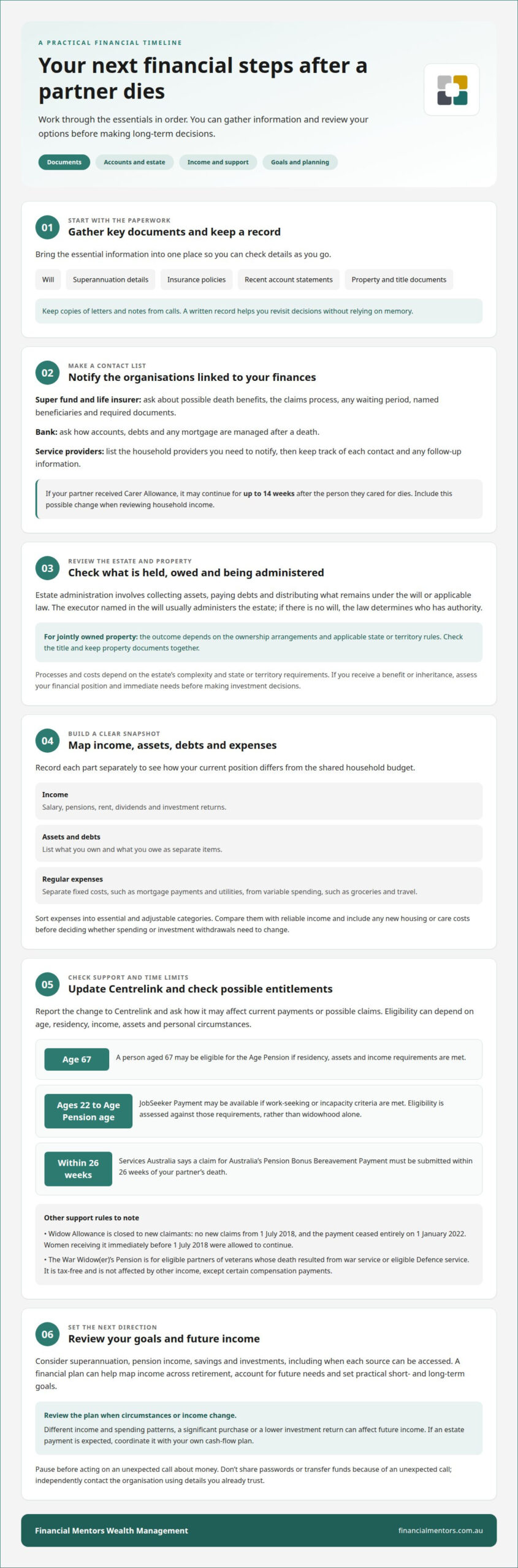
Grief can make routine financial decisions harder, especially when household income or responsibilities change. Begin by gathering the will, superannuation details, insurance policies and recent account statements. Keep copies of letters and notes from calls so you can revisit decisions without relying on memory.
Contact your partner’s superannuation fund and life insurer to ask about possible death benefits, the claims process and any waiting period. Check who is named as beneficiary and what documents each organisation requires. If you receive a benefit or inheritance, take time to assess your financial position and immediate needs before making investment decisions.
If your partner received Carer Allowance, it may continue for up to 14 weeks after the person they cared for dies. Include this possible change when reviewing household income. A revised financial plan can help you account for income, debts, children’s needs, investments and goals, including any increase in regular expenses.
For bank accounts, debts and a mortgage, contact the relevant bank to ask how the account or loan is managed after a death. Jointly owned property is dealt with according to its ownership arrangements and applicable state or territory rules. Check the title and keep property documents together.
Estate administration involves collecting assets, paying debts and distributing what remains under the will or applicable law. The executor named in the will usually administers the estate. If there is no will, the law determines who has authority. Processes and costs depend on the estate’s complexity and state or territory requirements.
Financial risks include scams and pressure to make quick investment decisions. Don’t share passwords or transfer money because of an unexpected call; pause and independently contact the organisation using details you already trust. If you’re considering a claim for Australia’s Pension Bonus Bereavement Payment, Services Australia says it must be submitted within 26 weeks of your partner’s death.
2. Assessing income, assets, expenses and financial goals
Start with a current snapshot of your household finances. List income, such as salary, pensions, rent, dividends and investment returns. Record assets, debts and regular expenses separately. For example, mortgage payments and utilities are usually fixed costs, while grocery and travel spending can vary. This shows how your position differs from the shared household budget you had with your partner.
Sort expenses into essential and adjustable categories, then compare them with reliable income. Include new costs, such as changes in housing or care needs, before deciding whether spending or investment withdrawals need to change. A financial plan can map income across retirement, account for future needs and set practical short- and long-term goals. Review it when your circumstances or income change.
Retirement planning should consider superannuation, pension income, savings and investments, as well as when each source can be accessed. An adviser can model different income and spending patterns to help you understand how a significant purchase or lower investment return could affect future income. If someone is administering the estate, coordinate expected payments with your own cash-flow plan.
For eligible war widows and war widowers, the Income Support Supplement is income- and assets-tested. The War Widow(er)’s Pension is tax-free and does not need to be declared in an Australian tax return. It is not affected by other income, except certain compensation payments. These payments have different rules, so record and budget for them separately.
Free financial counselling is available through community financial counselling services, while community legal centres may provide legal advice. For bereavement support, Lifeline can be called on 13 11 14. If you want help turning your figures into a retirement income strategy, financial planning advice can help you assess the options.
3. What Centrelink support can widows receive?
After a partner dies, financial assistance may include an existing Centrelink payment, the Age Pension, JobSeeker Payment or veterans’ support. Eligibility depends on factors such as age, residency, income, assets and personal circumstances. Contact Centrelink to report the change and ask how it affects your current entitlements or possible claims.
Services Australia says a person aged 67 may be eligible for the Age Pension if they meet residency, assets and income requirements. Becoming widowed can change your household income and assets, so provide Centrelink with updated details. If you receive the Disability Support Pension or another payment, ask how your changed circumstances affect its assessment and ongoing administration.
Widow Allowance is no longer available to new claimants. No new claims could be made from 1 July 2018, and the payment ceased entirely on 1 January 2022. Women receiving it immediately before 1 July 2018 were allowed to continue. If you’re unsure whether this applies to you, ask Centrelink about your existing payment.
JobSeeker Payment may be available if you’re aged 22 up to Age Pension age and meet the work-seeking or incapacity criteria. Your eligibility is assessed against those requirements, rather than widowhood alone. Ask Centrelink which information it needs about your current work, income and household situation when considering a claim.
The War Widow(er)’s Pension is paid under the Veterans’ Entitlements Act to eligible partners of veterans whose death resulted from war service or eligible Defence service. The Department of Veterans’ Affairs assesses eligibility based on the veteran’s service history, circumstances and accepted conditions. The pension is not affected by other income, except certain compensation payments.
For a bereavement payment, partners generally needed to receive a pension or income support payment for at least 12 months. Centrelink support can feel overwhelming to sort through alongside other responsibilities, so write down your questions before calling. This helps you clarify which payments may fit, what details to provide and what steps to take next.
4. Notifying financial institutions and service providers
Make a contact list of organisations connected to your partner’s finances and household, including banks, insurers, superannuation funds, Centrelink, utilities, phone providers and any property manager. Note how you contacted each organisation, the date, documents requested and next action. This record can make a difficult period easier to manage.
When notifying a bank, ask what it needs to update or manage accounts, loans and cards. If mortgage or credit card repayments have become difficult, explain your circumstances and ask about hardship assistance. Banks and other businesses may offer support, such as concessions or delayed payments, when customers tell them they are struggling to pay bills.
Tell insurers and superannuation funds about the death and ask about claim requirements, account administration and any relevant payment process. A death certificate may be needed when settling estate matters. Keep several copies of relevant documents, as banks, phone companies and other organisations may request certified copies. Record what each organisation receives.
For household services, contact electricity, gas, internet and phone providers to update account details and decide which services should continue. If you have an investment property, notify its property manager and discuss rent payments, maintenance and the estate’s contact person. Keep property-related correspondence with the relevant records.
Update Centrelink when your financial situation changes, as your payment details or eligibility may be affected. Use its official contact channel and record the date and outcome. If several notifications feel difficult to manage, prioritise essential banking and insurance, followed by regular household services and property matters.
Once notifications are underway, consider how estate administration and your ongoing financial position fit together. Arrange financial planning advice to help you consider the financial implications and plan your next steps.
Financial Mentors Wealth Management
Financial Mentors Wealth Management can help you make sense of financial decisions after your partner’s death and plan your next steps. If your income, assets or retirement plans have changed, Financial Planning and Retirement Planning can help you consider how your resources may support your goals. Wealth Creation Strategies can help you assess investment management options, while Estate Planning Advice can help you consider how your plans align with your wishes for your assets.
This support may be useful once immediate notifications are underway or when you’re ready to review your longer-term financial direction. Your circumstances and priorities can guide the advice, so you can move forward at a manageable pace. Contact Financial Mentors Wealth Management to discuss your situation.
Shape a financial future that reflects your priorities
Your next financial decisions can reflect what matters to you now and what you hope to make possible later. You might prioritise greater certainty around retirement income, more flexibility for family needs or a measured approach to investing. You don’t need to resolve every long-term question at once. Choose one priority to explore, then consider how it fits with your broader plans.
Thoughtful financial considerations for widows in Australia can help you make decisions that reflect your circumstances and future goals. Financial Mentors Wealth Management offers Financial Planning, Retirement Planning and Wealth Creation Strategies to help you consider your options and plan a direction that suits your needs.
When you’re ready to discuss what comes next, contact Financial Mentors Wealth Management. A conversation can help you clarify your priorities and identify a practical next step. You can move forward at a pace that feels right, with your future firmly in view.
Frequently Asked Questions
What other things should I be thinking about?
If your partner was a veteran, check whether dependent children may qualify for Department of Veterans’ Affairs support. This can include educational assistance when the death is accepted as service-related. War widows and war widowers may also qualify for energy or public transport concessions, depending on their circumstances and location. These options can be considered alongside household budgeting when planning for your family’s needs.
What Centrelink support can widows receive?
Centrelink support is separate from veterans’ assistance administered by the Department of Veterans’ Affairs. Eligible War Widow(er)’s Pension recipients receive a Veteran Card: All Conditions for healthcare coverage within Australia and may receive the Energy Supplement. If your partner served in the Australian Defence Force, consider whether DVA support is relevant to your circumstances alongside any Centrelink payment.
Who is eligible for the Australian Centrelink Bereavement Allowance or other bereavement payments?
Bereavement Allowance is not available for new claims. Other bereavement payments have separate eligibility rules, so distinguish one-off assistance from an ongoing pension when discussing options with Services Australia. Your partner’s payment history and any Pension Bonus Scheme registration may be relevant. Keep payment letters and scheme records together for eligibility discussions.
How much is the Centrelink lump-sum bereavement payment and how is it calculated?
The payment is generally calculated by subtracting the surviving partner’s new single rate from the couple’s previous payment. It is not a flat amount, because the result depends on those payment rates. Ask Services Australia to explain the calculation for your circumstances and how the payment fits with any ongoing income support.
What happens to superannuation when a spouse dies in Australia, and how can beneficiaries claim it?
The fund assesses a death benefit using its account records, beneficiary nomination and applicable fund rules. If you may be a beneficiary, ask the fund how it assessed the nomination and who it has identified as the claimant. Keep the fund’s written decision with your estate records, particularly if the outcome affects your financial planning.
How are life insurance and death benefits paid and taxed in Australia?
Payment arrangements depend on the policy or superannuation benefit and the person entitled to receive it. Tax treatment also depends on the benefit and recipient, so don’t assume life insurance and superannuation proceeds are treated the same way. Ask for a written payment statement explaining the amount, payee and any tax information provided, then keep it with your financial records for tax planning.