

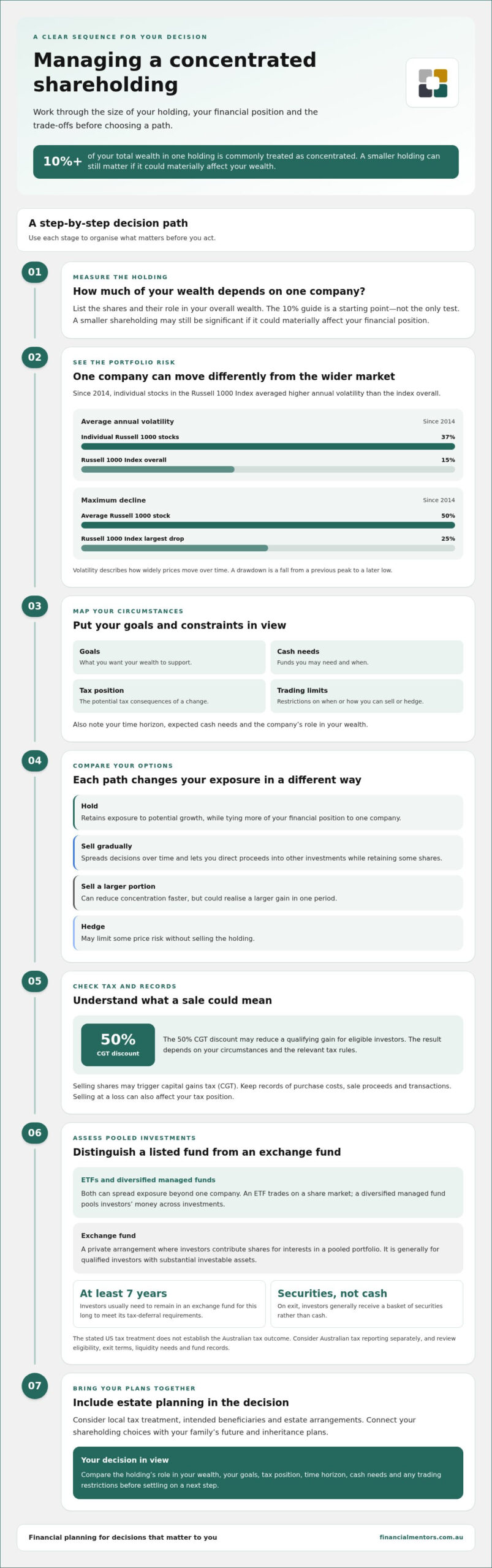
A single shareholding can carry more weight than its percentage suggests: a holding of 10% or more of your total wealth is commonly treated as concentrated, and a smaller one may also matter if it could materially affect your wealth. Managing concentrated stock positions starts with understanding how much your financial future depends on one company’s shares.
If you’re deciding whether to hold, reduce or protect a large shareholding, it’s worth understanding the trade-offs before acting. The right approach depends on your goals, tax position and any restrictions on when or how you can trade.
This article explains how concentrated positions affect portfolio risk, what exchange funds involve and how trading restrictions can shape your options. It also outlines practical ways to assess whether gradual selling or another strategy may suit your circumstances.
Key Takeaways
- A single holding representing 10% or more of your total wealth is commonly considered concentrated, but a smaller holding may still create meaningful risk.
- Exchange funds pool shares into a diversified investment, but they involve a long holding period and you may receive securities rather than cash when you exit.
- Compare the potential impact of a share-price fall with your wider portfolio, financial commitments and time horizon before deciding whether to reduce your holding.
- If trading restrictions apply, understand how they affect when you can sell or hedge shares and which strategies may fit your circumstances.
- Review your goals, tax position and estate plans together to identify a practical next step for your shareholding.
1. Exchange funds
How do exchange-traded funds and diversified managed funds compare with holding individual shares in Australia? An exchange-traded fund (ETF) trades on a share market, while a diversified managed fund pools investors’ money across investments. Both can spread exposure beyond one company, unlike a single-share holding. An exchange fund is different: it is a private arrangement in which investors contribute shares and receive interests in a pooled portfolio.
Exchange funds are generally associated with the United States, where eligible investors may be able to exchange concentrated shares for diversified fund interests without an immediate tax consequence. This tax deferral relates to the fund structure and applicable tax system; it does not establish the Australian tax outcome. If you’re an Australian tax resident, consider the transaction’s Australian tax reporting implications separately from the fund’s stated US treatment.
The trade-off is commitment. Investors usually need to remain in an exchange fund for at least seven years to meet its tax-deferral requirements. On exit, investors generally receive a basket of securities rather than cash. This can reduce dependence on one company, but it does not provide immediate cash for spending. Review the fund’s exit terms and the securities you could receive before deciding whether it suits your plans.
Eligibility is another practical limit. Exchange funds are described as options for qualified investors with substantial investable assets, rather than a routine substitute for an ASX-listed ETF or diversified managed fund. Each fund sets its own participation terms, portfolio rules and minimum commitment. Consider those terms alongside your shareholding, liquidity needs and investment time horizon. If flexibility or straightforward access to a diversified portfolio is important, an exchange-traded or managed fund may be easier to assess.
Before committing, organise your paperwork: record the shares contributed, keep the fund’s transaction and distribution statements, and document any securities received on exit. These records can help you and your tax adviser assess Australian reporting requirements. Don’t assume exchanging shares removes tax considerations simply because the structure describes a tax deferral.
For Australian investors, the key distinction is purpose. An ETF or diversified managed fund can provide pooled investment exposure, while an exchange fund is designed for eligible investors willing to contribute existing shares and accept a long lock-up. Compare diversification, access to cash, exit assets and tax reporting before choosing. The seven-year holding period may make an exchange fund unsuitable if your plans could change sooner.
2. What Is a Concentrated Stock Position?
A concentrated stock position is a shareholding large enough to shape your overall wealth and portfolio outcomes. To decide whether to keep, sell or hedge it, weigh your reliance on the company, your goals, tax position, time horizon and any trading restrictions.
Holding shares preserves exposure to potential growth, but ties more of your financial position to one company. Selling can reduce that exposure and free up funds for other goals, while a hedge may limit some price risk without selling the holding. Each approach changes your exposure differently, so compare the trade-offs before acting.
Gradual selling spreads decisions over time and lets you direct proceeds into other investments. It may suit you if you want to diversify while retaining some shares. The pace can depend on your cash needs, market outlook, the company’s role in your wealth and tax consequences. A larger sale may reduce concentration faster, but could realise a larger gain in one period.
In Australia, selling shares may trigger capital gains tax (CGT) on a capital gain. The 50% CGT discount may reduce a qualifying gain for eligible investors; the result depends on your circumstances and the relevant tax rules. Consider the purchase cost, sale proceeds and records supporting the calculation. Selling at a loss can also affect your tax position, so keep records of transactions and seek advice on how the rules apply.
Holding shares rather than selling can defer a tax event, but it does not remove investment risk or guarantee a more favourable tax result later. An exchange fund may let eligible investors exchange shares for pooled interests, subject to its eligibility and holding terms. As explained above, its lock-up can restrict access to your investment, so compare that commitment with your plans.
Estate considerations need an Australian lens. US exchange-fund materials may describe a step-up in basis for heirs, but don’t assume that treatment applies to Australian holdings or estates. Consider local tax treatment, intended beneficiaries and estate arrangements rather than relying on a foreign rule.
Start by listing the shares, their role in your wealth, your expected cash needs and any limits on trading. Then compare keeping, selling gradually, selling a larger portion or using a hedge. If a change could affect your family’s future or inheritance plans, connect investment decisions with your estate planning considerations.
3. Portfolio volatility and drawdown risks
A concentrated holding can make your portfolio move sharply when one company’s prospects change. Since 2014, individual stocks in the Russell 1000 Index averaged 37% annual volatility, compared with 15% for the index overall. Volatility describes how widely prices move over time. A company-specific setback can affect your shares even when the wider market is steadier.
Drawdown measures a fall from a previous peak to a later low. Since 2014, the average Russell 1000 stock had a maximum decline of 50%, while the index’s largest drop was 25%. After a fall of that size, your holding needs to double just to return to its former value.
Recovery is not assured. Nearly 40% of stocks that fell 50% from peak to trough over the past 10 years never fully recovered. That does not mean every individual company will follow the same path. It does show why a portfolio dependent on one business can face a different outcome from a broad index.
Goldman Sachs research found that, from 1986 to 2022, the median Russell 3000 stock had a 31% chance of losing more than 30% of its value in one year. The index had a 5% chance of the same loss. Goldman Sachs also found that 36% of Russell 3000 stocks suffered permanent impairment over that period. This meant losing more than 75% of value and failing to recover to 50% of the original value.
Concentration can link investment risk with income risk. For example, if your employer’s shares make up a large part of your portfolio, a company downturn could affect both your investment value and employment prospects. A share-price decline may also reduce the value of assets used as loan security. Consider how these exposures interact instead of reviewing each holding in isolation.
To assess your exposure, compare the holding’s value with your other investments, savings and financial commitments. Then consider how a steep decline could affect planned spending, retirement timing and your ability to keep holding the shares. Selling may reduce concentration but can have capital gains tax consequences. A hedge may change potential losses and gains without eliminating every risk.
Use a written review to record the holding’s role, the risks you can accept and the conditions that would prompt a change. Revisit it when your goals or circumstances shift. The Russell 1000 figures show why past index performance alone cannot describe the risk of an individual shareholding.
4. Restrictions on selling and hedging shares
Australian employee share scheme shares may come with plan-specific conditions. Before selling, read your scheme documents and employer trading policy, then identify any vesting, dealing or approval conditions that apply. Keep records of when you acquired the shares and any scheme statements, as these details can help you understand the tax treatment of a later sale.
Some executives also face trading windows or restrictions related to confidential company information. These limits can affect when a sale is possible, even if reducing your holding fits your financial plan. Map permitted trading periods against upcoming cash needs and planned expenses. Don’t assume you can sell as soon as shares become available under a scheme.
For managing concentrated stock positions, separate the decision to reduce exposure from the question of when a trade is permitted. Executives may use a 10b5-1 plan to set share amounts and price limits for trades over time. This is a United States trading-plan framework, not an Australian rule. It illustrates pre-arranged trading instructions, but Australian investors still need to follow their employer’s policies and applicable restrictions.
If selling is restricted, hedging may help manage some exposure while you retain the shares. A protective put gives you the right to sell shares at an agreed price, which can limit losses below that level. The option has a cost, and its protection depends on the contract terms. A covered call involves selling another investor the right to buy your shares at an agreed price. It may generate income, but can limit gains if the share price rises above that price.
An equity collar may help manage risk while you retain ownership of the shares. The put sets a floor, while the call sets a ceiling on potential gains. In a sample over-the-counter collar, the put floor is 85% of the current share price and the call ceiling is 110%. These levels illustrate one structure, not a recommendation for your holding. Contract terms affect protection, potential gains, costs and conditions.
Before choosing a hedge, write down what you want it to achieve. Are you aiming to limit a potential fall, create income or retain shares until a permitted sale period? Compare the strategy’s costs, duration and effect on future gains. An option can change your exposure, but it does not remove company risk or automatically free shares from trading restrictions.
A practical plan should include records and review points. Keep employer instructions, option contracts and transaction details together, then revisit them if restrictions change or a trading window opens. A hedge and a sale address different needs, so match your choice to immediate cash requirements and longer-term equity plans.
5. Defining a concentrated stock position
A concentrated stock position is commonly defined as one holding worth 10% or more of your total wealth. A smaller shareholding may also count if it could materially affect your finances, such as shares used as loan security.
There isn’t one percentage that fits every investor. A single holding above about 5% of your portfolio can create unwanted risk, while the 10% measure compares the holding with your total wealth. These are useful warning points, not automatic instructions to sell. Consider how a fall in that company’s share price could affect your plans and financial position.
For example, a shareholding may be a modest part of your investment portfolio but a much larger part of your overall wealth. That difference matters if you also hold property, cash, super or other investments. A company’s shares can still dominate your financial future if you rely on them for a home deposit, retirement income or loan security.
To assess concentration, take these steps:
- List your shares and their current value alongside other assets and debts.
- Calculate the holding as a share of your portfolio, then compare it with total wealth.
- Consider whether your income, employment or borrowing also depends on the same company.
- Review whether selling, holding or hedging fits your goals and access to cash.
If shares are held through super, identify which assets belong to you directly and which sit within a fund where you’re a member. This distinction can affect how you assess liquidity, access to funds and overall exposure. A figure based only on shares held outside super may not show the full picture of your wealth.
Your decision also involves potential capital gains and liquidity. Selling shares may create a tax consequence, while holding them leaves your wealth exposed to company-specific changes. Some investors may consider exchange funds, but eligibility rules and holding terms can affect access to capital. Compare each option with the purpose and timing of the money.
Use the 5% and 10% measures as prompts for a closer review, not as fixed limits. Write down how much of your wealth depends on the holding, what a sharp decline could change, and when you may need cash. Then compare possible actions against those needs. If you want to connect share decisions with your wider future plans, discuss your next financial steps.
Financial Mentors Wealth Management: Financial Planning
Financial Mentors Wealth Management can help you consider a concentrated shareholding in the context of your broader financial goals. With Financial Planning, you can assess how holding, selling or diversifying shares fits your cash needs, investment priorities and future plans. Retirement Planning and Wealth Creation Strategies can also connect portfolio decisions with the income and growth you’re working towards.
If your shares form part of your family’s future or inheritance plans, Estate Planning Advice can help you consider them in that wider context. Bringing these decisions together can clarify how one holding affects your financial position and what steps you may wish to take next.
To discuss your circumstances and explore your options, contact Financial Mentors Wealth Management.
Set a clear direction for your shares
Managing concentrated stock positions is not only about reducing exposure. It’s about choosing a path that supports the life you want your wealth to fund. Before making a change, decide what matters most: greater flexibility, a steadier plan for future income, or a clearer connection between your investments and family priorities.
A written set of decision points can help you stay consistent. Note what would prompt you to review the holding, how you would assess a proposed sale or hedge, and how the decision fits your wider financial plan. Revisit those points as your circumstances and goals change.
Financial Mentors Wealth Management offers Financial Planning, Retirement Planning and Wealth Creation Strategies to help you consider investment decisions alongside your future plans. If you’re ready to talk through your next step, contact Financial Mentors Wealth Management. A thoughtful plan can help you move forward with greater clarity.
Frequently Asked Questions
What Is a Concentrated Stock Position?
A concentrated position is a shareholding that can strongly influence your overall wealth and financial outcomes. To assess your exposure, compare the shares’ value with your investments and other assets, then consider any indirect exposure through funds or family trusts. This broader view makes managing concentrated stock positions part of your overall financial planning, rather than a decision based on one account statement alone.
What about when the owner isn’t allowed or doesn’t want to sell?
You can explore ways to reduce exposure without selling immediately. If employer rules restrict trading, identify the conditions and plan around permitted trading windows. If you prefer to keep the shares, directing new savings towards other investments may gradually change your portfolio mix. Hedging with options is another possibility, but understand the costs, contract terms and potential limits on future gains before choosing a strategy.
What are the main risks of holding a large position in one stock?
The main risk is that one company’s performance can have an outsized effect on your finances. A product failure, leadership change or loss of a major customer could affect its share price and dividend income. If you also work for that company, the same business conditions may affect your employment income. Consider how this combined exposure could influence planned spending, savings and ongoing financial commitments.
How can Australian investors diversify a concentrated share portfolio?
You can spread exposure by investing beyond one company, across industries, markets and asset types. An ASX-listed exchange-traded fund may provide access to a basket of investments, while diversified managed funds pool investments according to a stated approach. Review each fund’s holdings and how they fit your existing assets. Two funds may own similar companies, so check for overlap rather than assuming separate funds automatically provide broader diversification.
How can investors reduce a concentrated position gradually while managing tax?
Plan possible sales in stages and keep records for each parcel of shares, including purchase dates, costs and sale proceeds. These records can help you assess potential capital gains tax before placing trades. Compare which parcels to sell and how each sale fits your cash needs and wider financial plan. Managing concentrated stock positions over time can make decisions more deliberate, but staged selling does not automatically remove tax obligations.
How do limit orders, staged sales and rebalancing rules help manage concentrated shares?
A limit order sets the minimum price you’ll accept, but the trade may not occur if the market doesn’t reach it. Staged sales divide a planned reduction into separate trades. Rebalancing rules create a process for reviewing your portfolio when its mix changes. Together, these methods can support a consistent approach, but they don’t prevent price movements or override employer trading restrictions.
What are the risks and costs of using options or collars to hedge a concentrated stock position?
Options can involve a premium or other transaction costs, and their value depends on contract terms and market movements. A protective put can expire unused, while a covered call may limit gains if shares rise. A collar combines these approaches, setting a potential downside floor and upside ceiling. Before entering a contract, understand its expiry, conditions, costs and effect on your shares and available capital.