
Could international shares broaden your portfolio without making the investment decision any simpler? The vanguard international shares index fund aims to track the MSCI World ex-Australia Index before fees, expenses and tax. It provides exposure to companies in overseas markets. Its unhedged currency exposure means movements in foreign currencies can also affect returns in Australian dollars.
Fund names, index terms and product structures can be difficult to compare. This guide explains how the managed fund and the VGS exchange-traded fund differ, what an index does, and what to review in the current Product Disclosure Statement (PDS), including fees, distributions and risks. It also considers how international shares could fit alongside your other investments, goals and time horizon.
This website contains information that is general in nature and does not take into account your objectives, financial situation or needs. You need to consider your financial situation and needs before making any decisions based on this information. Murray Frean and Financial Mentors Wealth Management are authorised representative and credit representative of Financial Mentors AFSL Pty Ltd ABN 68 976 248 467, AFSL 96323. Phone 08 9429 8817 or email mfrean@financialmentors.com.au.
Key Takeaways
- The vanguard international shares index fund follows an index-based approach, but its returns are not guaranteed to match the index exactly.
- Compare international shares, Australian shares, diversified funds and cash by their role in your portfolio, risks and access needs.
- Start with your purpose and time horizon. Then review the current product documents and consider how the investment fits your financial commitments and existing holdings.
- Consider whether international exposure and currency movements suit your comfort with investment fluctuations.
- Think about how a fund decision connects with your wealth creation plans, retirement needs and other long-term goals.
What is the Vanguard International Shares Index Fund?
What does this fund offer, and what do the words in its name tell you? The vanguard international shares index fund is an Australian investment product designed to provide exposure to shares in overseas markets. “International shares” describes the broad investment area. “Index” signals that the fund aims to follow a selected share-market measure, rather than relying on a manager to choose shares with the aim of beating that market.
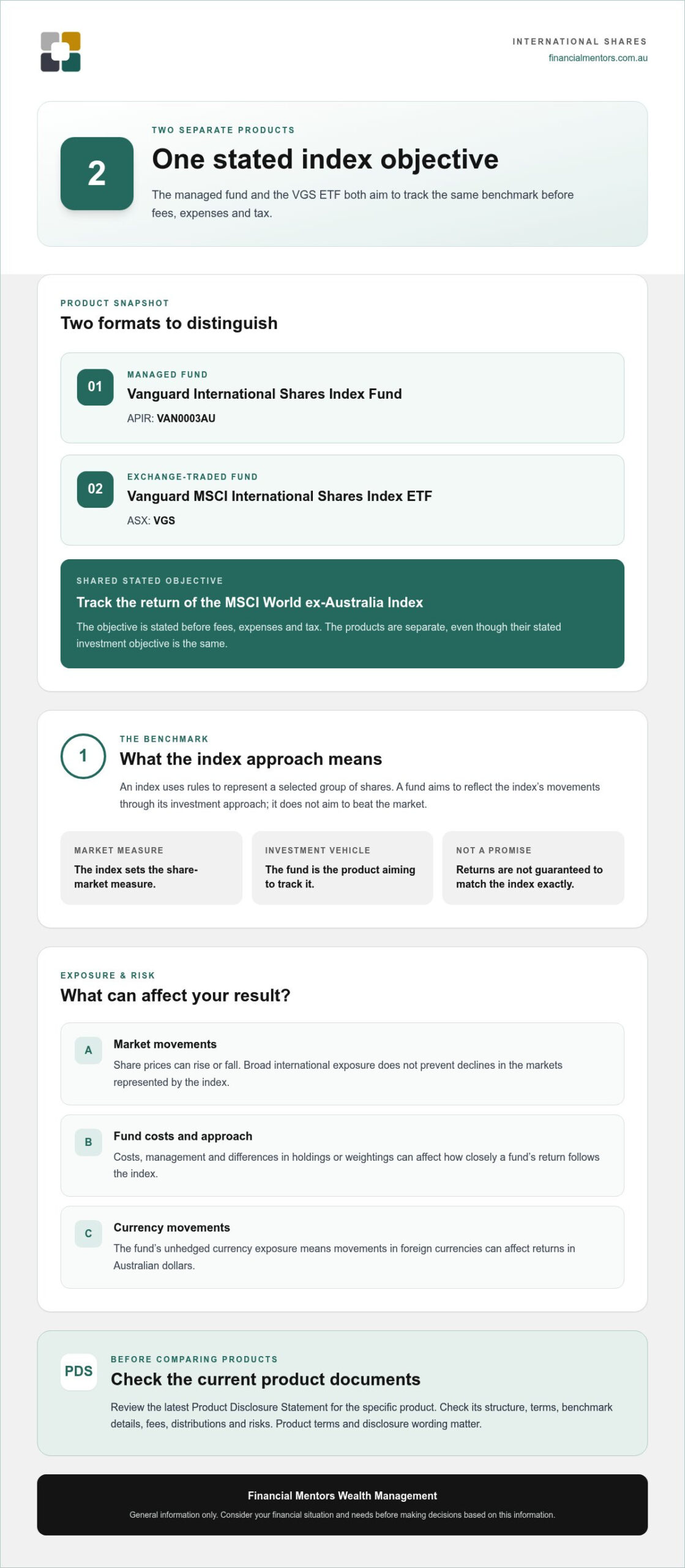
There are two related products to distinguish: the managed fund, Vanguard International Shares Index Fund (APIR: VAN0003AU), and the Vanguard MSCI International Shares Index ETF (ASX: VGS). Both have the stated objective of tracking the return of the MSCI World ex-Australia Index before fees, expenses and tax. This is an objective, not a promised return. Read the latest PDS for the product you are considering, since product terms and disclosure wording matter.
An index fund seeks to track the return of a selected market index. It does not promise a particular investment return or guarantee that its performance will match the index exactly. Your investment’s value can rise or fall. Market movements and product costs are among the factors that affect the result.
What does “international shares index” mean?
An index uses rules to represent a selected group of shares. Those rules determine which shares are included and how they are represented. A fund that tracks an index aims to reflect its movements through its investment approach. It does not promise to outperform the index.
The stated benchmark for this fund is the MSCI World ex-Australia Index. Check the latest official documents to understand the benchmark’s scope and how the fund seeks to track it. The name gives you a starting point, but the benchmark rules help explain the market exposure the product is intended to provide.
How does the fund gain exposure to shares?
Morningstar’s profile describes the ETF’s index exposure as being through the Vanguard International Shares Index Fund. This is Morningstar’s description, not independent verification of the product’s legal structure. The ETF and managed fund are separate products, even though their stated investment objective is the same.
Objective and structure answer different questions. The objective tells you what return the fund aims to track; the structure explains how the investment is organised. Read the current PDS for the specific product to understand its structure and terms. For general background on The Vanguard Group, see this Wikipedia page, provided with permission for information purposes only. Financial Mentors Wealth Management does not endorse external websites and is not responsible for the accuracy of their content. For product terms, rely on official fund documents.
As you compare the products, note each product name, benchmark and structure separately. This helps you distinguish the exposure the fund seeks to provide from a guarantee or recommendation. Then consider how that exposure could sit alongside your existing investments and personal goals.
How the index approach works, and what it does not promise
An index-tracking fund aims to follow the movements of a chosen index by gaining exposure to shares represented in it. Its return may not match the index exactly. Fund costs and the way it is managed can affect the difference. The current PDS explains the fund’s stated approach and tracking details.
The vanguard international shares index fund gives investors exposure to a broad group of international shares, rather than relying on the performance of one company. That breadth spreads exposure across multiple businesses, but it does not mean every company or market will move in the same direction. A broad index can still be affected by declines in the markets it represents.
What can change between an index and a fund?
An index sets rules for which shares it represents and how they are weighted. A fund’s holdings and weightings may differ from the index, so the two will not necessarily move in lockstep. The product’s investment method determines its approach. Check the current PDS for details.
The Morningstar profile summary describes exposure through an underlying fund and says individual security weightings may vary marginally from the index. The summary is undated and is a third-party description, not confirmation of current fund mechanics. Compare it with Vanguard’s current official documents before relying on details about holdings or weightings. Do not assume the summary reflects the latest portfolio.
These distinctions help when comparing products: the index is the market measure, while the fund is the investment vehicle aiming to track it. The objective and structure are related, but answer different questions. The PDS explains how the specific product is organised and how it seeks to meet its objective.
Why index exposure is not a return guarantee
Index investing does not remove market risk. Share prices can rise or fall, and international markets may move differently from Australian markets. The value of your investment can therefore fluctuate, even when the fund follows an index. A fall in one company may affect the fund differently from a wider market decline, depending on that company’s place in the index and the fund’s exposure.
Past performance, if you review it, describes a previous period only. It does not predict future results or show what you will earn. When comparing performance figures, check the dates, measurement period and whether the figures relate to the index or the fund. This helps you avoid treating unlike figures as directly comparable.
If you are considering how market exposure fits your circumstances, professional financial advice can help you weigh the decision alongside your wider goals and financial position.
How international shares compare with other portfolio choices
Comparing investments is about understanding the role each could play, not finding a universal winner. International shares add exposure to overseas companies, while Australian shares focus on the local market. Diversified funds may combine several asset types, and cash can suit money you need to access more readily. Each option has different risks and features, so assess it alongside your goals, financial position and time horizon.
The vanguard international shares index fund is one way to consider international share exposure. Before comparing it with alternatives, review what you already hold, including investments in superannuation. You may already have exposure to Australian or international shares through those investments.
International shares: These can provide exposure to companies in overseas markets. Their value can be affected by share-market movements and, for unhedged investments, exchange-rate changes. Consider whether this exposure complements your existing investments and suits your time horizon.
Australian shares: These provide exposure to companies listed in Australia. Their market and economic influences differ from those in overseas markets. If you hold Australian shares directly or through superannuation, review how much of your overall portfolio is already connected to this market.
Diversified funds: These may combine different asset types or markets in one fund. This can spread exposure, but the mix, investment approach, costs and risks depend on the specific fund. Read its current documents to understand what it holds and how it is managed.
Cash: Cash can be relevant for money you may need to access, depending on the account or product terms. It plays a different role from share investments, which can fluctuate in value. Consider your access needs and the purpose of the money before comparing options.
Diversification can spread exposure across investments, but it cannot remove investment risk or prevent losses. A fund with a broad range of holdings may still be affected by movements across the markets or asset types it invests in. The number of holdings alone does not establish whether a fund suits your circumstances.
Different approaches, different trade-offs
An index fund aims to track a selected index. An actively managed fund gives its investment manager discretion to select investments. A diversified fund describes a broader mix, not necessarily a particular management style. Compare each fund’s current disclosure documents for its objective, investment approach, holdings, risks and costs. Labels alone cannot establish which option suits you.
For example, if you are planning for a long-term goal, your comparison may focus on the investment’s role over time and how it fits your wider holdings. If you expect to need the money sooner, access and the potential for changes in value may matter more. Neither situation points automatically to one type of investment.
Start with your own plan: note your goals, time horizon, existing investments and access needs, then assess each option against them. This lets you consider the fund as one part of your broader financial picture, rather than making a decision based on a label or a single feature.
What to check before investing in an international shares fund
A structured review can help you move from product information to a decision that reflects your circumstances. Start by identifying why you are considering international shares and when you may need the money. Then review the product details and your broader financial position. The checklist below is general information, not a personal recommendation.
Read the Product Disclosure Statement and current fund information
Use the latest official Product Disclosure Statement (PDS) and fund information for the specific product you are considering. These documents explain what the fund aims to do and set out details that may affect your decision. If you are reviewing the vanguard international shares index fund, keep the managed fund and ETF documents separate because their terms may differ.
- Set your purpose and time horizon. Write down what the investment is intended to help you achieve and when you expect to use the money. Consider whether this fits your medium-term or long-term goals, and whether you could leave the investment in place if markets fluctuate.
- Confirm the objective and benchmark. Check the fund’s current objective, the index it aims to track and the scope of that index. Make sure you understand the exposure the fund is designed to provide rather than relying on its name alone.
- Review structure, risks and eligibility. Read how the product is organised, the risks described and any eligibility conditions. Check current fees, minimum investment requirements and access arrangements in the official documents. If you plan to invest through a platform, review its terms, charges and availability separately, as these can differ.
Match the decision to your goals and financial position
Product information is only one part of the decision. Your existing investments, financial commitments and comfort with changes in value also matter. Look at the full picture, including share exposure held through superannuation, savings you may need to access and how an investment fits with your retirement or other plans.
- Assess your financial position and risk tolerance. Consider whether a fall in value could affect your plans or ability to meet regular commitments. Think about how much of your overall investments would be exposed to international shares, including through other funds.
- Consider the wider plan. If this decision is part of wealth creation or retirement planning, consider how it fits with your other priorities and the timing of those goals. Professional financial advice can help you weigh these factors together before acting.
If you want support connecting an investment decision with your wider financial plan, arrange a financial advice discussion. Before deciding, record the questions you still need answered and the reasons behind your choice. This can help you revisit the decision if your goals or circumstances change.
How financial advice can place a fund decision in context
A fund decision can affect more than your investment mix. It may also need to fit alongside your plans for work, retirement, family and future spending. Professional financial advice can help you consider those priorities together and understand the role a decision may play in your broader plans.
When broader financial planning may help
Imagine you are nearing retirement and weighing up how to invest while planning for income after work. Your decision may depend on when you expect to draw on your savings, your other assets and your regular commitments. If you are still building wealth, your priorities and timeframe may be different. Advice should take your objectives, financial situation and needs into account, rather than focus on a fund name alone.
Financial Mentors Wealth Management provides professional financial advice and wealth management. The firm has provided professional planning advice since 2000. This support can help you bring separate questions into one conversation, such as how an investment relates to your retirement plans or other financial priorities. It does not mean that a particular fund is endorsed or that any outcome is assured.
A calm next step for Australian investors
If you want to consider investment choices in the context of your wider plans, you can explore financial planning support. Start by identifying what matters most to you, then bring questions about your goals, timing and financial commitments to an appointment.
The information on this website is general in nature and does not take into account your objectives, financial situation or needs. Consider your own circumstances before acting on it. With a considered plan, you can make choices that are better aligned with the future you are working towards.
Take your next step with a plan
Before acting, write down what you want your investments to support, when you may need the money and what questions remain about the vanguard international shares index fund. This gives you a practical starting point for deciding how the choice fits your priorities.
If you would like help thinking through your next steps, explore financial planning support. A considered decision can help you move towards the future you want, at a pace that feels right for you.
Frequently Asked Questions
Is the Vanguard International Shares Index Fund an ETF?
No. The Vanguard International Shares Index Fund is the managed fund, with APIR code VAN0003AU. The related Vanguard MSCI International Shares Index ETF is listed on the ASX as VGS. They are separate investment products with a stated aim to track the same index. Read the documents for the specific product you are considering. The structure you choose may affect how you buy, hold and access the investment.
What does the Vanguard International Shares Index Fund invest in?
The vanguard international shares index fund aims to track the MSCI World ex-Australia Index before fees, expenses and tax. The fund information reports that the ETF held about 1,219 securities across approximately 23 developed countries as at 30 September 2026. Holdings can change, so treat this as a dated snapshot rather than a current list. Review the latest portfolio information to see the fund’s present exposure.
What fees does the Vanguard International Shares Index Fund charge?
The October 2026 product information lists a management fee of 0.18% per annum for both the managed fund and VGS ETF, indirect costs of 0.00% per annum, and a buy/sell spread of 0.05% in each direction. Review the latest PDS and fund information before investing, as fees and costs affect the product you hold. If you use a platform, review its charges separately.
Does the Vanguard International Shares Index Fund pay distributions?
Yes. The product information states that distributions are made quarterly. This describes how often distributions are paid, not the amount you will receive or whether it will meet a particular income need. If you are considering the fund for income, review current distribution information and the PDS, then consider how variable investment income fits your cash-flow needs.
Is an international shares index fund suitable for beginners?
It may be accessible to a beginner, but an index-based approach does not make an investment suitable for everyone. Before investing, understand how share prices and currency movements can affect value, and consider whether you can manage those changes. You may also want to compare the fund’s structure and costs with other options. If you are unsure, consider professional financial advice in light of your circumstances.
Can I lose money in an international shares index fund?
Yes. The value can fall if share markets decline, and exchange-rate movements can also affect an unhedged fund’s value in Australian dollars. For example, your investment could be worth less than you paid for it when you need to sell. Consider whether you can tolerate that possibility and whether you may need access to the money during a period of market falls.
How do I check whether this fund is available through an investment platform?
Search the platform’s investment list using the exact product name or identifier: VAN0003AU for the managed fund, or VGS for the ETF. Check that the result matches the product you intend to hold. Then review the platform’s current access conditions, transaction charges and minimum investment requirements alongside the fund’s official documents. Platform availability and terms can differ, so confirm these details before placing an order.