

What if the retirement advantage you’re looking for comes not from one product, but from how your decisions work together? It’s understandable to wonder whether your savings and expected income will support the life you want, especially when superannuation, government benefits, tax and personal goals can all affect the picture.
A coordinated retirement plan can help you see how these pieces fit and where there may be choices to consider. This article explains what a retirement advantage can mean in practice, and how bringing your income, superannuation, Centrelink entitlements and long-term goals into one view may support the future you have in mind. Your circumstances and priorities are personal, so there’s no single approach that suits everyone.
You’ll explore the decisions that may shape your retirement income, how planning can connect with your wider financial position, and practical next steps to help you move forward at a pace that feels right. The aim is clarity, not pressure, so you can consider your options with greater confidence.
Key Takeaways
- The retirement advantage comes from coordinating decisions around the retirement you want, rather than relying on a single solution.
- Consider how your retirement priorities, expected income and financial commitments may affect one another.
- Compare income needs, flexibility and personal priorities to understand the trade-offs that may shape your choices.
- Start by clarifying your goals, reviewing your financial position and noting questions to revisit as your plans develop.
- Financial Mentors tailors retirement planning advice to your goals. The initial meeting is step one, with professional planning advice provided since 2000.
What does the retirement advantage mean for you in Australia?
Retirement can look different from one person to another. You might picture spending more time with family, travelling, pursuing interests or continuing to work part-time. Your health, responsibilities, savings and preferred lifestyle all shape what feels right for you. So, a useful retirement plan starts with your own goals, not a standard idea of what retirement should be.
The phrase “the retirement advantage” may also appear in search results as the name of a product or organisation. Here, it refers to an approach to Australian retirement planning, not a particular bank account. The focus is on understanding your choices and how decisions may fit together, rather than treating one product as the answer for everyone.
Is the retirement advantage one product or a planning approach?
A financial product can have a particular purpose, but it can’t define retirement success for every person. Your priorities influence how you think about income, savings and lifestyle, and those priorities may change over time. General information can help you understand common considerations. Personal recommendations, however, need to take your financial position and circumstances into account.
The retirement advantage is making informed, coordinated decisions that support the retirement you want.
What might a retirement advantage look like in your life?
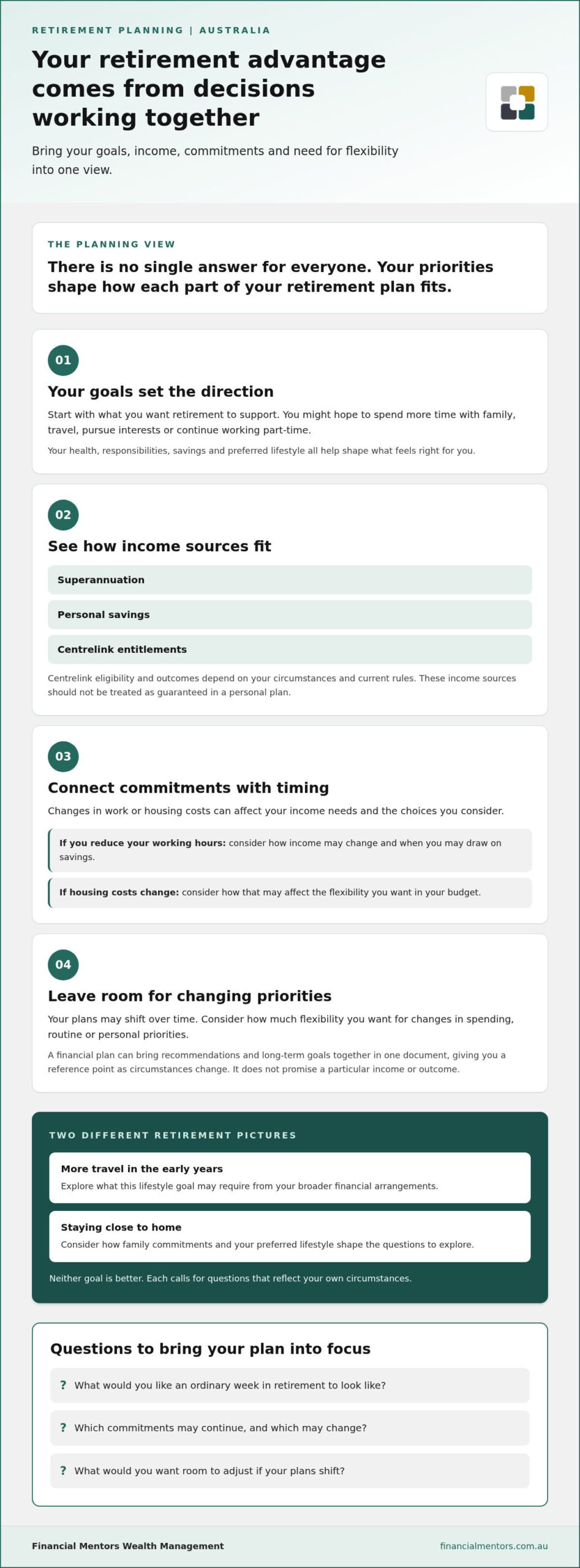
Imagine two people approaching retirement. One hopes to travel more in the early years; the other values staying close to home and keeping room in the budget for family commitments. Neither goal is better. Each calls for different questions about lifestyle, income and the choices available.
A clearer view of those choices can help you feel more prepared to adapt as your priorities shift. Confidence doesn’t mean knowing exactly what every year will bring. It can begin with understanding the options you may have and what each could mean for your plans.
That’s why the idea is less about finding a single “best” retirement solution and more about seeing how your goals relate to your circumstances. A plan can help bring those considerations into focus, so you can make decisions with a clearer sense of what matters most to you.
For example, if flexibility is a priority, you may want to consider how much room your plans leave for changes in spending or routine. If a particular lifestyle goal matters most, you can explore what it may require from your broader financial arrangements. These are starting points for reflection, not recommendations that apply to everyone.
Once you have a clearer picture of what you want retirement to look like, it becomes easier to identify the questions worth exploring next. The following sections look at how different parts of retirement planning may connect, and how to consider your options in light of your own goals.
How coordinated retirement decisions can support your long-term goals
Your retirement priorities, expected income and financial commitments are connected. If you plan to reduce your working hours, for example, you may need to think about how that affects income and when you draw on savings. If you expect housing costs to change, that could also shift how much flexibility you want in your budget. Looking at these factors together can help you see the choices behind your plan.
How can different income sources fit together?
Superannuation and personal savings may contribute to your retirement income, while Centrelink entitlements may be relevant depending on your circumstances. None should be treated as guaranteed income in a personal plan: eligibility and outcomes depend on individual details and current rules. Moneysmart Retirement Planning offers general information and tools to help you explore retirement planning considerations.
A financial plan can bring recommendations and your long-term goals together in one document. It can help you understand how the parts of your financial position relate to each other, and give you a reference point when circumstances or priorities change. It isn’t a promise that a particular income or outcome will follow; it’s a way to organise decisions around your situation.
Why do personal goals matter as much as balances?
A balance alone can’t show what you want your money to support. You may be considering a move to a different home, helping family, or keeping the option of part-time work. Each priority can affect how much income you may need, how much flexibility matters and when you might choose to make decisions.
Retirement decisions work best when they reflect your personal long-term goals, not just the size of your savings.
Try describing your plans in practical terms. What would you like an ordinary week to look like? Which commitments will continue, and which may change? What would you want room to adjust if your plans shift? These questions can help turn broad hopes into useful planning points, without assuming there is one ideal way to retire.
For another perspective on preparing for retirement, Is Your Planned Retirement Secure? Building the Foundation for Your Future explores how to think about the foundations of your plan. Together, these ideas can help you connect personal priorities with the financial decisions that may support them.
If you’d like to consider how your goals and financial position fit together, retirement planning advice can help you explore suitable next steps.
Retirement choices compared: income, flexibility and future priorities
Retirement planning involves trade-offs, not a contest between products. You may value a steady way to meet regular expenses, while also wanting access to savings for unexpected costs or changing plans. The right balance depends on your circumstances, priorities and comfort with financial risks.
What trade-offs should you consider when planning retirement income?
If predictable income matters most, you might focus on how regular expenses could be met. If ready access to money is a priority, you may also consider how much flexibility you want for less predictable costs. These aims can pull in different directions, so it helps to consider them alongside your wider financial position rather than in isolation.
A single account or investment cannot, by itself, make a complete retirement plan. It may have a role, but it won’t account for every part of your life, such as your ongoing commitments, changing goals or plans for your assets. Investment decisions also involve financial risks, and their suitability depends on individual circumstances. The retirement advantage is found in considering the whole picture, not assuming one option will meet every need.
| Planning consideration | What to weigh up | Questions to consider |
|---|---|---|
| Income needs | How you may cover regular expenses and other expected costs. | Which expenses are essential, and which may vary? |
| Flexibility | How much access you want to funds as circumstances change. | Would you value more choice over when and how money is available? |
| Future priorities | How your plans may affect the timing and shape of financial decisions. | What might change, and what would you like to preserve? |
The table is a prompt for discussion, not a ranking or recommendation. Your answers may change over time, and a choice that suits one person may not suit another.
How might tax, superannuation and estate planning connect?
Tax, superannuation and estate planning can each influence decisions about retirement and the way your assets are managed. A decision in one area may have implications for another, so it can be useful to view them together. The details depend on your circumstances and the rules in force when you act. Avoid relying on general information as a personal recommendation, particularly where tax or superannuation decisions are involved.
Thinking about how your retirement choices connect with your wishes for managing and passing on assets can also be helpful. The article Beyond the Will: Estate Planning Advice in Australia explores related considerations.
Rather than asking which product is best, consider what each decision is intended to do for you. A personalised financial plan can help bring income needs, flexibility and future priorities into the same conversation, so you can weigh the trade-offs in context.
Practical steps to build your retirement advantage
You don’t need to resolve every retirement question at once. A calm, step-by-step review can help you work out what matters, what you already know and where you’d like more clarity. These steps can guide your thinking, but they can’t guarantee a particular income, investment performance or Centrelink entitlements.
- Clarify your goals. Think about the lifestyle you want, when you hope to retire and which priorities matter most to you.
- Review your financial position. Consider your assets, liabilities, income and expenses, including regular financial commitments.
- Identify your questions. Note decisions you’re weighing up or areas you’d like explained, such as how different income sources may fit your plans.
- Revisit your progress. Return to your goals and plan as circumstances change, and consider whether your next steps still suit you.
What should you reflect on before an appointment?
Before an appointment, consider what you want retirement to look like in practice. You might reflect on timing, housing, work, family commitments and the level of flexibility you’d like. A financial position is a snapshot of your assets, liabilities, income and expenses. You don’t need to prepare a perfect set of figures; a general understanding can help you explain your situation and identify what you’d like to explore.
It can also help to note what feels uncertain. Perhaps you’re unsure how a change in work could affect your plans, or how to balance current spending with future priorities. These questions give the conversation a useful starting point. You can focus on the decisions that matter to you, rather than feeling you need to arrive with every answer already worked out.
When could a periodic review be useful?
A periodic review is a regular reassessment of your objectives, achievements and ongoing needs. It may be useful after a change in work, family circumstances or health, or when your retirement timing or priorities shift. Revisiting your financial plan can help you consider whether it still reflects your situation and whether new questions have emerged.
There’s no need to wait for a major life change to reflect on your direction. A review can also help you check whether the goals you set still feel relevant. For a related planning resource, The Ultimate Retirement Planning Checklist Australia (2026 Edition) can help you consider topics to think through as you prepare.
Each step can make your next decision clearer, while leaving room to adjust as life unfolds. If you’d like guidance that considers your goals and financial position, arrange a retirement planning appointment.
How Financial Mentors can help you plan for retirement
Retirement planning is personal. Your priorities, financial position and preferred pace of change may differ from another person’s, so advice should start with your circumstances rather than a preset solution. Financial Mentors Wealth Management provides tailored retirement planning advice to help you consider how your goals connect with your wider financial decisions.
What can you expect from the first meeting?
You can use the conversation to talk through what you want retirement to look like, what’s on your mind and the decisions you’re weighing up. Discussing your financial position and priorities can help identify which topics may need more attention. You don’t need to arrive with every answer or have your plans fully settled.
You might want to talk about when you hope to retire, what you’d like your income to support, or how you’re thinking about work and family. The discussion can help clarify which questions matter most to you and what potential next steps may be relevant. Any advice can then be shaped around your goals and circumstances, rather than a recommendation assumed to suit everyone.
It’s also an opportunity to raise areas you find difficult to assess alone. You can explain what you already understand, where you feel uncertain and what you’d like to be clearer about. That gives the conversation a practical focus and helps you consider your options at a pace that feels comfortable.
How can advice support your next decisions?
Once your priorities are clearer, tailored advice can help organise the options you may wish to consider. Financial planning and retirement planning can be considered alongside relevant wealth management or estate planning advice, where these areas connect with your goals. The aim is to help you understand how decisions relate, not to assume that one strategy suits everyone.
For example, if your plans include supporting family or changing your work arrangements, those priorities may shape the questions you ask about retirement income and future commitments. If you’re also thinking about how your assets should be managed over time, estate planning advice may be part of the broader discussion. Recommendations depend on your circumstances.
A conversation can help you identify what matters now, what you’d like to understand better and which decisions you may want to consider next. You can take time to reflect on the discussion before deciding how to proceed.
If you’re ready to talk through your retirement priorities, arrange an initial appointment with Financial Mentors Wealth Management.
Take a considered step towards retirement
Your next step doesn’t need to answer every question about the future. It can be as simple as deciding what you most want clarity on, whether that’s how your plans could support a particular lifestyle or which choices deserve attention first. A clear question can make a complex decision feel more manageable.
The retirement advantage isn’t about rushing towards a fixed destination. It’s about making choices with your priorities in view, while allowing room for life and circumstances to change. As you think ahead, consider what would help you feel more prepared to make your next decision.
A conversation about your retirement goals can help you explore that question and consider a practical way forward. Arrange an initial appointment to discuss your priorities and take a considered step towards the retirement you want.
Frequently Asked Questions
Is the retirement advantage a specific account in Australia?
Not necessarily. The phrase may refer to a named product or organisation, as well as the broader benefits of planning for retirement. In this article, the retirement advantage means a general approach to Australian retirement planning. If you’re considering an account, look at its features and how they suit your circumstances and goals, rather than assuming its name represents a complete retirement strategy.
Can you receive Centrelink entitlements and superannuation at the same time?
Yes, some people may receive income from superannuation while also qualifying for Centrelink entitlements. Whether you’re eligible, and the amount payable, depends on your personal circumstances and the rules in force at the time. Consider how these income sources may interact as part of your overall retirement income picture. For current eligibility information, check official government guidance or seek personalised financial advice before making decisions.
Does owning your home affect retirement planning?
Yes, your housing situation can shape retirement choices, regular expenses and the financial resources available to you. For example, staying in your home, moving to a smaller property or making changes to your home may involve different costs and priorities. Include your housing plans and likely future expenses when reviewing your financial position and income needs. The effect of home ownership on specific assessments depends on current rules and your circumstances.
Can you keep working after you retire?
Yes, retirement doesn’t have to mean stopping work completely. You might choose part-time work, occasional work or a gradual transition away from full-time employment. Consider how working fits your preferred lifestyle and the time you want for other activities. The effect on your income, superannuation or Centrelink entitlements depends on your situation and current rules, so seek advice before making a work decision with significant financial effects.
How often should you review your retirement plan?
There’s no single review schedule that suits everyone. Revisit your plan when a change in work, family circumstances, health or financial commitments could affect your goals or choices. A periodic review can help you reassess what you set out to do, what has changed and what you may need to consider next. The timing can be guided by your circumstances, rather than a fixed interval that may not suit you.
What information should you bring to a retirement planning appointment?
A useful starting point is a general picture of your goals, income, expenses, assets and debts, along with any existing superannuation or investment arrangements. You don’t need to treat these as compulsory documents or have every detail ready. Sharing what you know, and the questions you’d like to discuss, can help the conversation reflect your financial position. The adviser can guide the discussion around your circumstances.