

What if a dividend could affect your tax position and Centrelink entitlements in ways that aren’t obvious from the payment alone? If you’re looking for franking credits explained for retirees, you may be wondering whether a dividend includes a credit and how both should appear in your tax return. The answer depends in part on who owns the investment and your wider financial position.
This guide explains the basic tax-credit mechanism in plain English, including how dividends and franking credits are reported. You’ll also learn which records to gather, what to compare and why investment ownership matters when considering Centrelink entitlements. The aim is to help you understand the questions to consider, rather than assume the same outcome applies to everyone.
As you review your retirement plans, consider tax matters alongside your wider goals. The sections ahead cover the basics and show how retirement planning and tax return preparation can help you make informed decisions about your circumstances.
Key Takeaways
- Understand the credit shown on a dividend statement and note which investment received it.
- Check how dividend income and attached credits are recorded in your tax return, and keep the supporting statements with your tax records.
- Compare investments held personally with those owned through superannuation, as their tax treatment may differ.
- Review how investment income may relate to your Centrelink entitlements alongside your wider financial position.
- Gather dividend statements, tax records and ownership details before reviewing your retirement plans.
Franking credits explained for retirees: what the credit attached to a dividend means
When a dividend arrives, you might ask: “Is this the amount I receive, or does the franking credit add to it?” The key distinction is that the dividend is the payment, while the credit records tax information linked to company profits.
A franking credit is a tax credit attached to a franked dividend, representing company tax already paid on the profits distributed to shareholders. It’s part of Australia’s dividend imputation system, which links company tax with the tax treatment of shareholders. For background on the system, see Dividend imputation and franking credits explained.
A company may pay tax on its profits before distributing some of what remains to shareholders as dividends. If it attaches a franking credit, the dividend statement shows information about that credit alongside the payment. Not every dividend carries one: a statement may show a fully franked, partly franked or unfranked dividend.
What is the difference between a franked dividend and a franking credit?
The dividend is the money paid to you as a shareholder. The franking credit is not an extra cash payment from the company. It’s tax information about company tax paid on profits linked to the dividend.
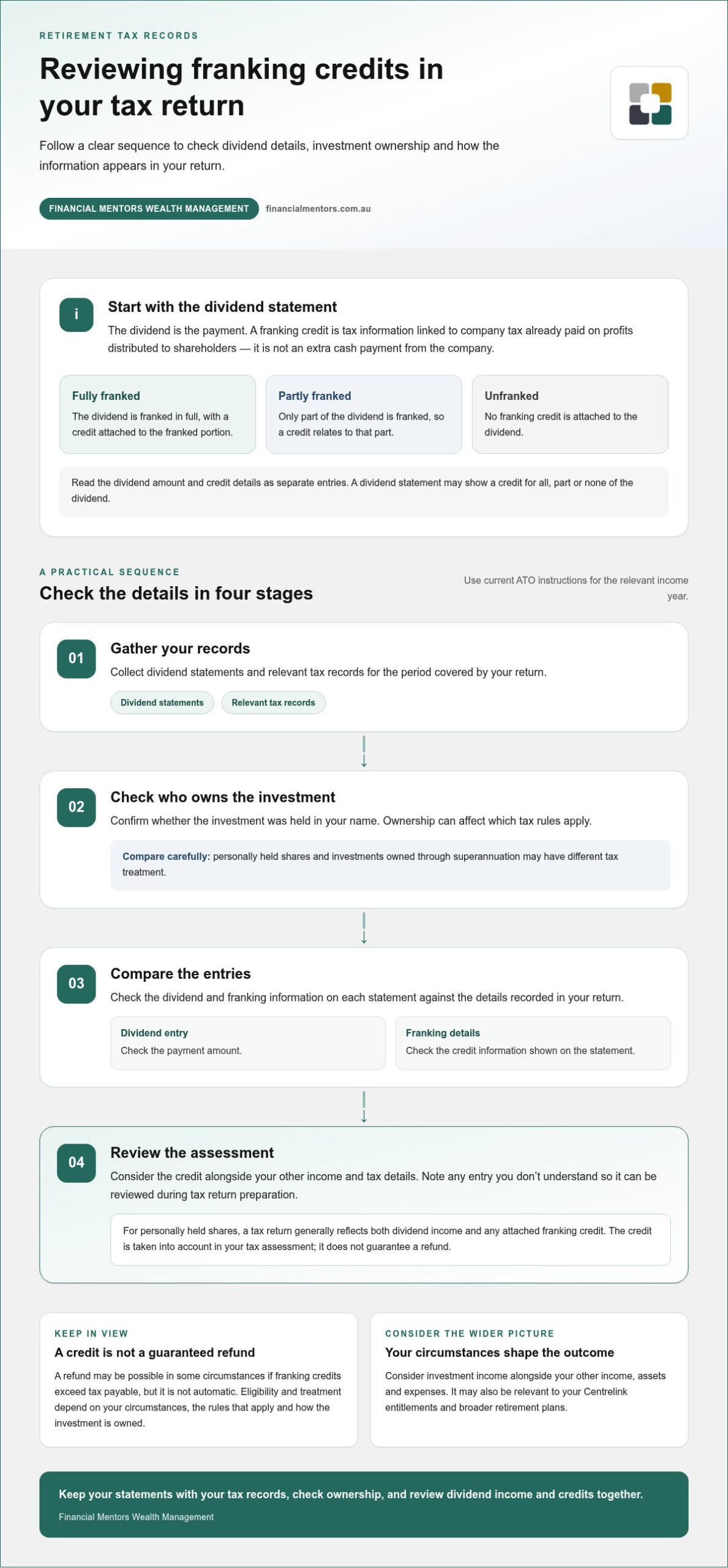
- Fully franked: the dividend is franked in full, with a credit attached to the franked portion.
- Partly franked: only part of the dividend is franked, so a credit relates to that part.
- Unfranked: no franking credit is attached to the dividend.
For example, a company’s statement might show a dividend with a credit attached to the whole amount, only part of it, or none. Read the dividend and credit details as separate entries. This helps you identify what was paid and what tax information is associated with it before reviewing your tax records.
Why might franking credits matter during retirement?
If you hold shares that pay dividends, those payments may form part of your investment income. A franking credit can be relevant when your tax position is assessed, but its effect depends on your circumstances and the tax rules that apply. It doesn’t automatically mean you’ll receive a refund or have more money available for retirement spending.
Consider the dividend alongside your other income, assets and expenses. This gives you a clearer view of your financial position and how investment income fits with your retirement plans. Keep the dividend statement so you can refer to the payment and credit details when reviewing your tax records or discussing your plans as part of retirement planning.
How franking credits are treated in an individual tax return
If you hold shares personally, your tax return generally needs to reflect both the dividend income and any franking credit attached to it. Working with an experienced advisory firm such as Stewart Private Accounting can help ensure these figures are accurately integrated into your annual return. The credit is taken into account in your tax assessment, but it doesn’t simply reduce the dividend amount or guarantee a refund. Your overall taxable income, other tax offsets and the rules for the relevant income year all matter.
That’s why franking credits explained for retirees should include more than the credit itself. A dividend may sit alongside other income and deductions in your tax return, and the outcome depends on your individual circumstances. For general background on how credits may be relevant to Australian investors, read Vanguard’s explanation of franking credits for retirees. Use current Australian Taxation Office (ATO) instructions when preparing or reviewing your return.
What information should you find on a dividend statement?
Start with the dividend statement or other information provided by the company or investment issuer. Check the dividend amount and any franking details, then keep the statement with your tax records. These documents help you compare the information in your return with what the issuer reported. If an entry is unclear or appears inconsistent, note the issue for review rather than guessing.
For an individual return, use this practical sequence and follow the ATO’s current instructions for the relevant income year:
- Gather your records. Collect dividend statements and relevant tax records for the period covered by your return.
- Check ownership. Confirm whether the investment was held in your name, as ownership can affect which tax rules apply.
- Compare the entries. Check the dividend and franking information on each statement against the details recorded in your return.
- Review the assessment. Consider the credit alongside your other income and tax details. Make a note of any entry you don’t understand so it can be reviewed during tax return preparation.
Can excess franking credits be refunded?
A refund may be possible in some circumstances if franking credits exceed the tax payable, but it isn’t automatic. Eligibility and treatment depend on the rules that apply to you and how the investment is owned. A statement showing a credit alone doesn’t confirm that you’ll receive a refund. Check current ATO guidance before drawing conclusions or making a retirement decision based on a possible payment.
Good records make it easier to review your return and broader plans. Financial Mentors Wealth Management offers tax return preparation and retirement planning, helping clients consider tax questions in the context of their wider financial position. Learn more about financial and retirement planning advice.
Personal shares, superannuation and Centrelink: what retirees should compare
The same company dividend can raise different questions depending on who owns the investment. Shares held in your name are not the same as shares held within a superannuation fund. The fund’s tax position and reporting arrangements may affect how its investment income and franking credits are handled. Before drawing conclusions, identify the legal owner and check the rules that apply to that owner.
This distinction also matters if you receive or plan to claim Centrelink entitlements. Tax treatment and Services Australia’s income and asset assessments are separate questions. A tax outcome, including whether a credit affects your tax assessment, doesn’t by itself tell you whether an entitlement will change. Review current Services Australia guidance for your circumstances, and don’t infer an outcome from the dividend statement alone.
| Ownership type | Records to check | Guidance source |
|---|---|---|
| Shares held in your name | Dividend statements, share ownership records and personal tax records | ATO guidance for individual tax treatment; Services Australia guidance for any entitlement assessment. Verify current rules. |
| Investments held through superannuation | Fund statements and reports showing investment income, ownership and any franking details | ATO guidance relevant to the fund and its circumstances; Services Australia guidance for any entitlement assessment. Verify current rules. |
Do franking credits affect Centrelink entitlements?
They may be relevant to information used in an assessment, but don’t assume your tax return and Centrelink assessment use the same approach. Services Australia applies its own rules to assess eligibility, and the treatment of your investments depends on your situation and current guidance. If you receive payments or are preparing a claim, review the applicable Services Australia information and consider your full financial position before making changes based on an assumed effect.
Why does the investment ownership structure matter?
For personally held shares, the relevant tax information relates to you as the shareholder. With superannuation investments, the fund owns the assets and its tax reporting may differ from an individual return. The fund type and circumstances can matter, so don’t assume a credit shown in fund records will be treated exactly like one attached to shares you own personally.
Use the table as a starting point, not a verdict. If you’re gathering information for a periodic review, keep records for each ownership category separate and note which questions still need checking. Refer to current ATO material for tax distinctions between personal investments and superannuation, and Services Australia guidance for Centrelink assessments. The details can help you consider how investment income fits within your retirement plans without presuming that one ownership structure is always more beneficial.
A practical checklist for reviewing franking credits in retirement
A little organisation can make it easier to review dividend information and see how it fits with your retirement plans. Keep documents grouped by financial year, and separate personal investments from investments held through superannuation. This gives you a clear starting point for tax time and conversations about your income needs and long-term goals.
What records can help you prepare for tax time?
Start with dividend statements and relevant investment records, such as documents showing who owns each investment. Keep copies of your tax return and assessment with the records for the same year. These documents can help you check entries and support a review, but they don’t determine your tax result. Follow current ATO instructions for what you need to keep and report.
Use this checklist to organise your information:
- Collect dividend statements. Keep statements and issuer information for the relevant financial year together.
- Note investment ownership. Record whether each investment is held personally or through superannuation, and file related records in the right place.
- Compare your return with the documents. Check that entries match the information available to you, and note any differences or unclear items.
- Write down questions. Keep a short list of anything you don’t understand so it can be addressed during tax return preparation.
- Keep the wider picture in view. Consider dividend income alongside your other income, regular spending needs and financial commitments.
If you’re looking for franking credits explained for retirees, remember that well-kept records help you review the information, not predict the outcome. Tax treatment depends on your circumstances and current rules. Use the checklist to connect tax details with practical planning questions about your retirement income and goals.
When may a periodic review be useful?
A periodic review can help you revisit investment income if your retirement circumstances or financial commitments change. For example, a shift in regular expenses or a change in how you receive income may prompt you to review your records and plans. Compare what you receive with your expected spending needs, then consider whether your approach still supports your goals.
Retirement planning can bring these questions together, including how investment income fits with your wider financial position. If you’d like support connecting tax return preparation with your retirement plans, explore retirement planning and tax return preparation.
Bring franking credits into your wider retirement plan
Dividend income and tax questions are easier to consider when you place them alongside your wider retirement goals. A credit may be relevant to your tax position, but it’s only one part of the picture. Your other income, regular spending, financial commitments, investment ownership and plans for the years ahead all help shape the questions worth considering.
There isn’t one investment choice or ownership structure that suits everyone. Use what you’ve learned about franking credits to prepare for a discussion about your circumstances. The aim is to understand how the records and rules apply to you, rather than assume a particular tax outcome or make a change based on the credit alone.
What questions could you bring to an advice appointment?
A little preparation can help you make good use of an advice appointment. Bring your dividend statements and relevant tax records, then note what you’d like to clarify. You could ask:
- How does dividend income fit alongside my other retirement income and planned spending?
- Which documents and tax questions are relevant to my circumstances and investment ownership?
- How should I think about Centrelink entitlements alongside my income and assets?
- Would a periodic review be useful if my circumstances or financial commitments change?
These questions can connect individual tax details with your broader financial position. Advice should reflect your situation and current rules, rather than a general assumption about what a credit will mean.
How can tax return preparation connect with retirement planning?
Tax records can offer useful context for a broader retirement planning conversation. Reviewing them alongside income needs and long-term goals may help you see which details need attention and where you want more clarity. Tax return preparation and retirement planning can sit together while addressing separate questions: how information is reported, and how your wider plan supports the future you want.
Financial Mentors offers retirement planning and tax return preparation to clients, so tax matters can be considered in the context of wider goals without promising a particular refund or result. The complementary initial meeting is step 01 of the firm’s process. Bring your questions and the records you’ve gathered to help guide the conversation.
Discuss your retirement planning needs and take a considered next step towards understanding how your investment income fits into your plans.
Take a considered next step towards retirement clarity
Your retirement plans can change as your priorities shift. Write down what you want your next stage of life to make possible, then identify one practical question that could help you move towards it. This gives your planning a personal focus beyond any single investment or tax detail.
If this guide to franking credits for retirees has helped clarify one part of your financial picture, use that understanding as a prompt to review your priorities. Consider what you want more confidence about, whether that’s managing day-to-day finances, making room for future plans or keeping your records organised. A small, considered step can help you feel more prepared for decisions ahead.
Keep your goals visible and revisit them as your circumstances evolve. With a clearer sense of what matters to you, you can approach future retirement decisions with greater confidence and a stronger connection to the life you want to build.
Frequently Asked Questions
What are franking credits in simple terms?
A franking credit is a tax credit linked to tax a company has paid on its profits before distributing a franked dividend. Think of it as information about tax already paid, rather than extra cash added to your dividend payment. The precise tax effect depends on your circumstances and current rules. That’s the basic idea behind franking credits explained for retirees, although individual outcomes can differ.
Can retirees receive a refund of franking credits?
Some retirees may receive a refund, but it isn’t automatic. The outcome depends on the person’s tax position, how the investment is owned and the rules that apply for that income year. A dividend statement showing a credit doesn’t establish that you’re eligible for a refund. Before including an expected refund in your retirement budget, check current Australian Taxation Office guidance or have your tax return reviewed as part of tax return preparation.
Do franking credits count as income for Centrelink?
Centrelink assessments follow Services Australia rules, which are separate from the way credits are handled in your tax return. Don’t assume the amount shown on a dividend statement translates directly into income for an assessment, or that a tax outcome means your Centrelink entitlements will change. Your investments and circumstances matter. Check current Services Australia guidance for your payment type before making financial decisions based on an assumed assessment.
Are franking credits treated differently in superannuation?
They can be treated differently because a superannuation fund is the investment owner, rather than you as an individual shareholder. The fund’s circumstances and applicable tax rules affect how investment income and credits are handled. For example, a credit recorded in a fund statement doesn’t necessarily have the same personal tax effect as one on shares held in your name. Check the fund’s reporting and current ATO guidance before drawing conclusions.
Do I need to include franking credits in my tax return?
If you own shares personally and receive a franked dividend, the dividend and related credit may need to be accounted for in your return under the rules for that income year. Check your dividend information against the Australian Taxation Office’s current return instructions. If an investment is held by a superannuation fund, its reporting may be handled through the fund instead. Ownership is a useful first detail to clarify.
What documents do I need to claim franking credits?
Keep the dividend statements and investment records that show who owns the shares and what was paid or credited. Your tax return and assessment for the relevant year can also help when reviewing how the information was reported. The Australian Taxation Office’s current instructions set out what records apply to your circumstances. Organising documents by financial year makes it easier to find the right statement if an entry needs review.
Can franking credits reduce the tax payable on other income?
A franking credit may be applied when working out your overall tax position, so it can affect the amount of tax payable on your taxable income. The result depends on the full tax assessment and rules for the income year, not the credit in isolation. Don’t assume it will cancel tax on a particular income source or create a refund. Review the calculation using current ATO guidance and your complete tax information.