

Could a Division 293 tax assessment be a reason to review your super strategy, rather than abandon concessional contributions? If you’re unsure why the ATO says you owe extra tax or whether its figures are right, that uncertainty is understandable. With Division 293 tax explained in plain English, you can see what triggered the assessment and consider your next step with more confidence.
For 2026-27, the threshold is A$250,000 when Division 293 income and concessional contributions are combined. The tax adds 15% to affected concessional contributions. The calculation considers your Division 293 income, including certain add-backs, alongside those contributions. The ATO issues an assessment once your tax return and super contribution information are available. Check the income figures, contributions and financial year shown so you can understand how the amount was calculated.
This article explains when the tax may apply, how the calculation works and what to check if an assessment arrives. You’ll also learn about paying the amount yourself or electing to release it from super, including the relevant deadlines. Understanding the tax in context can help you weigh contributions against your long-term goals and retirement plan, rather than make a rushed change.
Key Takeaways
- Understand which income and super contribution details can affect a Division 293 assessment.
- Compare employer contributions, salary sacrifice and personal deductible contributions to see how each may feature in your super picture.
- Check your assessment against the income and contribution records for the financial year it covers.
- Consider your response options in light of your cash flow and broader financial position.
- Use a tax assessment as a prompt to review how your super contributions fit with your retirement plans and long-term goals.
What Is Division 293 Tax, and Who May Need to Pay It?
A Division 293 assessment can be confusing, especially if you expected your super contributions to be taxed under the usual rules. To understand why it may apply, look at your income and concessional contributions together, not just your salary. This is the starting point for working out what information may affect the result.
Division 293 tax is an extra tax that may apply to some concessional super contributions if your income and contributions reach the relevant threshold. Concessional contributions are generally amounts paid into super before tax, such as employer contributions, salary sacrifice and personal contributions you claim as a tax deduction. The tax applies to certain contributions, not your entire salary or super balance.
For the 2026-27 financial year, the threshold is A$250,000. The ATO considers your Division 293 income together with your concessional contributions. If their combined amount is above the threshold, you may have a liability. Division 293 tax is separate from the income tax you pay on your salary. It is also distinct from the usual tax treatment of concessional contributions in super: Division 293 can add a further 15% tax to affected contributions.
This tax sits within Australia’s wider super system, where contributions and investment earnings are subject to specific rules. For a broad overview, see Superannuation in Australia. For your assessment, the relevant income year and the details reported to the ATO matter.
Which income and super contributions may be relevant?
Division 293 income starts with your taxable income, then includes certain additions. These can include reportable fringe benefits, net financial investment losses and net rental property losses. As a result, the ATO’s figure may differ from the salary on your payslip. Relevant concessional contributions may include employer contributions, salary sacrifice and deductible personal contributions. If you used unused concessional cap amounts from earlier years, those carry-forward contributions are also included in the Division 293 calculation.
Why can two people with similar salaries receive different outcomes?
People with similar salaries can have different Division 293 outcomes because their other income components and concessional contributions may differ. A bonus or investment loss, for example, can affect the income figure used in the test. Employer contributions and extra concessional contributions can also change the combined amount. The ATO assesses the information for each financial year, so an outcome in one year doesn’t automatically mean the same result in another.
Threshold test: For 2026-27, Division 293 may apply if your Division 293 income plus concessional contributions exceeds A$250,000. Salary alone doesn’t determine the result.
That’s the core of having Division 293 tax explained: it’s a contribution-related tax test, not a simple salary cut-off. If you receive an assessment, compare its income and contribution figures with the records for that financial year. Reviewing each component can help you understand the ATO’s calculation before deciding what to do next.
How Is Division 293 Tax Calculated?
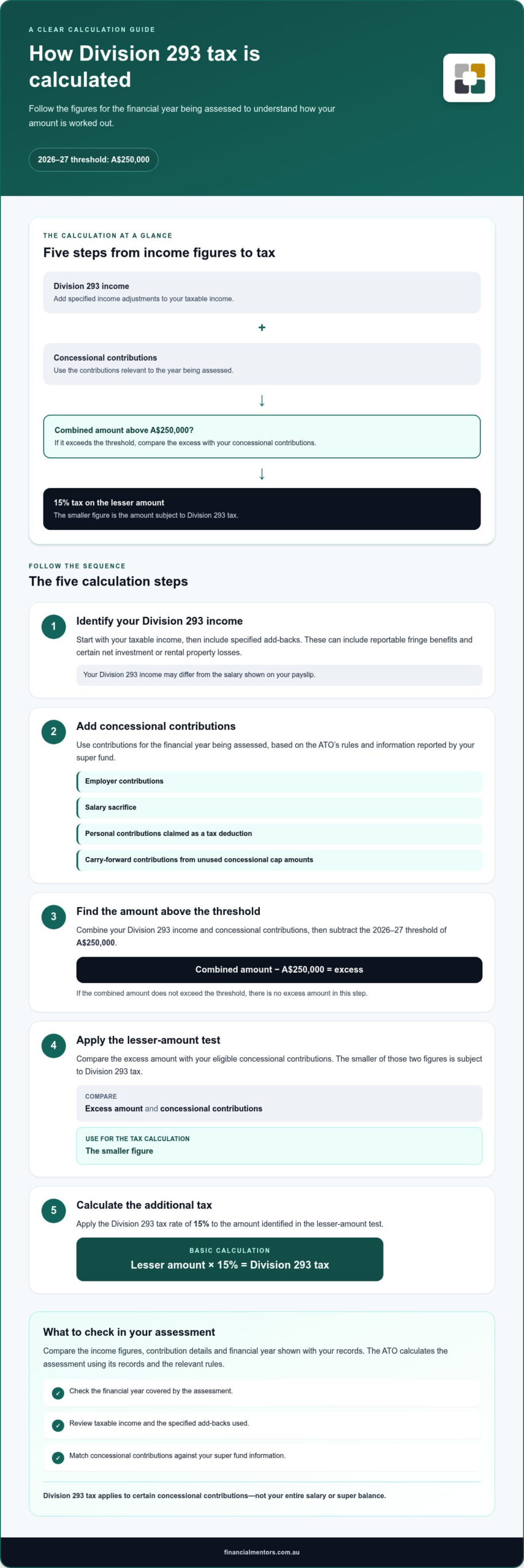
The calculation compares your Division 293 income and concessional contributions with the threshold for the relevant financial year. For 2026-27, the threshold is A$250,000 and the Division 293 tax rate is 15%. The ATO applies that rate to the lesser of your eligible concessional contributions or the amount by which your combined income and contributions exceed the threshold.
Follow these steps to understand the basic calculation:
- Identify your Division 293 income. This starts with taxable income and includes specified add-backs, such as reportable fringe benefits and certain net investment or rental property losses.
- Add your concessional contributions. Use the contributions relevant to the financial year being assessed, based on the ATO’s rules and information reported by your super fund.
- Work out the amount above the threshold. Subtract A$250,000 from the combined total. If the total doesn’t exceed the threshold, this step produces no excess amount.
- Apply the lesser-amount test. Compare the excess amount with your concessional contributions. The smaller figure is the amount subject to Division 293 tax.
- Calculate the tax. Apply the 15% Division 293 rate to that amount. The ATO calculates your assessment using its records and the relevant rules.
What counts as concessional super contributions?
Concessional contributions are generally super contributions made from before-tax income or claimed as a tax deduction. They can include employer contributions, salary sacrifice amounts and personal contributions for which you claim a deduction. Not every payment into super is concessional. For example, after-tax contributions you don’t claim as a deduction are generally treated differently. Check the contribution categories and reporting for the relevant year, particularly if your fund records include adjustments.
How does the additional tax affect the contribution’s tax treatment?
Concessional contributions are generally taxed in super at 15%, subject to applicable rules. Division 293 tax is an additional 15% on the portion captured by its calculation. For affected contributions, this can bring the combined tax on those contributions to 30%. Division 293 tax is an additional personal tax assessment, separate from the contributions tax generally applied within your super fund. The Vanguard explanation of Division 293 tax also illustrates how the calculation can work.
Hypothetical example: Assume your Division 293 income is A$240,000 and your concessional contributions are A$25,000 for 2026-27. Together, they total A$265,000, which is A$15,000 above the threshold. The lesser of A$25,000 in contributions and A$15,000 above the threshold is A$15,000. At 15%, the illustrative Division 293 tax is A$2,250. This example shows the method only. Your assessment depends on your own figures and the ATO’s calculation.
For a clearer view of how an assessment fits with your tax, super and future plans, a tailored financial planning review can help you consider the figures in context.
How Do Common Super Contribution Situations Compare?
Different contribution types can affect your concessional contribution total, which is one part of the Division 293 calculation. The table below compares common situations and what to review. It’s a guide, not a prediction. Your assessment depends on your income, contributions and circumstances for that financial year.
| Contribution type | How it may feature | What to review |
|---|---|---|
| Employer contributions | Employer contributions, including compulsory contributions, are generally concessional contributions. | Check the amounts recorded by your fund for the financial year. These count towards your total concessional contributions. |
| Salary sacrifice | Amounts you arrange with your employer to contribute to super from your before-tax salary are generally concessional contributions. | Include these alongside employer contributions when reviewing your total. Salary sacrifice may change the calculation even if your base salary stays the same. |
| Personal deductible contributions | A personal contribution may be concessional if you claim it as a tax deduction and meet the relevant requirements. | Check the amount claimed as a deduction and how it was reported. Personal contributions you don’t claim as a deduction are generally treated differently. |
If your combined Division 293 income and concessional contributions are close to the 2026-27 threshold of A$250,000, a change in income or contributions could affect whether you exceed the threshold and the amount assessed. If you’re clearly above it, the tax may still apply only to the amount determined by the calculation, rather than to all your contributions. An assessment doesn’t automatically mean concessional contributions are unsuitable. The tax is one factor to weigh against the value of saving for retirement and your other priorities.
What if your income changes from year to year?
Your assessment is based on the income and contributions for a particular financial year. A bonus, a change in work arrangements or a different contribution level can alter the calculation, so one year’s outcome doesn’t guarantee the same result next year. Before adjusting contributions, consider the effect on your cash flow, financial position and retirement objectives, as well as the possible tax outcome.
What should you consider before changing contributions?
Look at the whole picture before changing your contribution pattern. Consider your retirement objectives, current cash flow, contribution limits and how much you want to build in super. For 2026-27, the concessional contributions cap is A$32,500, with carry-forward rules potentially affecting your available cap. Your circumstances determine whether a change suits you. Reviewing your planned retirement foundations can help connect today’s decision to your long-term goals.
Having Division 293 tax explained can help you assess the trade-offs, but the most suitable contribution approach depends on your individual circumstances. A decision based only on one assessment may overlook how contributions support your broader financial plan.
What Should You Do After Receiving a Division 293 Assessment?
An assessment can be difficult to interpret at first. Take it one step at a time: read the notice, check the figures against your records, then consider how to respond. An unfamiliar amount doesn’t necessarily mean the calculation is wrong. Differences may reflect income items or contributions that aren’t obvious from your salary information alone.
First checks to make: confirm the financial year, review the income and concessional contribution figures, and check the assessed amount and payment instructions.
Which details should you check against your records?
Start with the year named on the notice, then compare the ATO’s figures with the information for that same year. Check your tax return and income records alongside your super fund’s contribution statements. Look for differences in amounts or missing information, including salary sacrifice or personal contributions claimed as a deduction. A discrepancy is a reason to investigate, not proof of an error. Reporting dates, adjustments or the way an amount is classified may explain it.
If something still doesn’t match, keep the notice and relevant records together and follow the notice’s instructions. Check the ATO’s current Division 293 guidance for details specific to your assessment, including how to query information or respond. Use the financial year shown on the notice when checking rules and records, since figures from a different year may not provide a like-for-like comparison.
How might you manage the payment?
You can pay the liability directly to the ATO. Alternatively, you can elect for money to be released from your super fund to pay the debt. The ATO’s current guidance states that the election must be made within 60 days of the assessment notice. The payment due date is 21 days after the notice is issued, including when you choose the super-release option. Interest may accrue if the amount isn’t paid by the due date, so read the notice carefully and allow time to act.
Paying from super may help preserve cash outside super, but it reduces your retirement savings. Consider that impact alongside your available cash flow, other financial commitments and long-term plans. Before making an election or arranging payment, check the current ATO instructions and deadlines. Your notice explains the amount assessed and the steps that apply to your case.
Having Division 293 tax explained can make the notice easier to work through, but the right response also depends on how the tax, super and your wider financial position fit together. A tailored review can help you understand those connections before making a decision. Arrange a financial planning review to consider your assessment alongside your broader plans.
How Can Division 293 Fit Into Your Long-Term Financial Plan?
A Division 293 assessment is one part of your financial picture, not a complete measure of whether your super strategy is working for you. Rather than making a lasting change in response to one notice, consider how your income, contributions, cash flow and retirement objectives fit together. A contribution decision that makes sense this year may need a fresh look if your circumstances change.
Retirement planning can bring these factors into the same discussion. Review how much you’re contributing, what you need to keep available for current financial commitments, and what you hope to fund in retirement. Tax return preparation can help organise and understand relevant income information, while financial planning can place those figures alongside your broader goals. Neither guarantees a particular tax result, but together they can support a more informed decision.
When may an individual review be useful?
A review may help if your income has changed, you’ve made substantial contributions or you’re uncertain about your retirement plans. Tailored advice can take account of your financial position and long-term goals, rather than treating the assessment in isolation. It can also help you identify which questions to resolve before changing contributions or setting a new retirement direction.
Tax and planning information can be useful at different stages. For instance, tax return preparation in Australia can sit alongside a broader review of your income, super and future plans. The aim is to understand how the pieces relate to your circumstances, not to assume that a specific contribution choice will reduce your tax or produce a particular outcome.
What can you prepare for an advice appointment?
A little preparation can help you focus on the decisions that matter. Gather the records for the relevant financial year and note anything you’re unsure about. You could bring:
- Your Division 293 notice of assessment and any related ATO correspondence.
- Income details and your tax return information for the year being assessed.
- Super fund records showing contributions, including salary sacrifice or personal contributions.
- A short list of questions and upcoming decisions, such as whether to change contributions or when to retire.
It may also help to note what you want your retirement to look like and any changes in work, family or financial commitments that could affect your plans. The initial meeting is step 01 of the firm’s process. It provides a starting point to discuss your circumstances and what you’d like to work towards.
With Division 293 tax explained, you can place the assessment in context and consider a measured next step. If you’re ready to connect your super decisions with your future objectives, explore financial planning and retirement advice.
Make your next super decision with confidence
A tax assessment can be a useful prompt to check whether your super decisions still fit the life you’re building. Rather than treating one year’s outcome as a permanent rule, set a regular time to review your contributions, cash flow and retirement priorities. If your income or plans change, revisit the assumptions behind your approach before making adjustments.
Having Division 293 tax explained gives you a clearer basis for that conversation, but the next step is personal: what do you want your retirement savings to support? A considered plan can help you weigh tax alongside your wider financial position. Financial Mentors Wealth Management has provided professional planning advice since 2000, with guidance shaped around individual goals and circumstances.
If you’re ready to bring your super decisions into a broader view of your future, explore financial planning and retirement advice. Take a considered next step towards your long-term goals with a financial planning appointment.
Frequently Asked Questions
Is Division 293 tax the same as excess contributions tax?
No. Division 293 tax and excess contributions rules are separate. Division 293 is assessed when the relevant income and concessional contribution test is met. Excess contributions rules relate to contributions exceeding applicable caps and may have separate tax consequences. One assessment doesn’t automatically mean you’ve exceeded a contribution cap. If both issues appear relevant, check the ATO’s notices and records separately, as resolving one doesn’t necessarily resolve the other.
Can Division 293 tax apply if your income changes from year to year?
Yes. Division 293 is assessed using the income and contributions relevant to each financial year, so a change can affect the result. For example, a bonus in one year may affect that year’s income calculation, while a different contribution amount may alter another year’s assessment. A previous liability doesn’t mean you’ll owe the tax every year. Keep records by financial year so you can compare each notice with the information it covers.
Does Division 293 tax apply to defined benefit super?
Yes, defined benefit fund members can be subject to Division 293 tax. The ATO may include a notional contribution amount for the defined benefit interest in its calculation, rather than relying only on a simple cash contribution figure. The liability is typically deferred until you take a benefit from the fund. If your notice relates to defined benefit super, read its specific explanation and compare it with your fund information before deciding what action to take.
Can you claim a tax deduction for Division 293 tax?
Generally, you can’t claim Division 293 tax as a deduction in your income tax return. It’s a tax liability, not a personal super contribution for which you can claim a deduction. If you’re unsure how a payment or super release should be recorded in your circumstances, check the ATO’s guidance or seek tax advice. Keep the assessment and payment records with your tax documents so they’re available when you prepare your return.
Can Division 293 tax relate to contributions made in an earlier financial year?
An assessment may arrive after the financial year it covers, but it relates to the income and contributions assessed for the year stated on the notice. Carry-forward contributions can also create confusion: these are concessional contributions made in the current year using unused cap amounts from earlier years. They’re included in the Division 293 calculation for the year they’re contributed, not reassigned to the earlier years when cap space accrued.
What happens if your employer’s super contributions are included in the assessment?
Employer contributions can form part of your concessional contributions, so their inclusion doesn’t by itself indicate a mistake. Compare the amount on the assessment with your fund statements and payroll records for the same financial year. Check whether reported amounts align and whether any corrections or adjustments appear in your records. If figures still differ, follow the ATO notice instructions and seek clarification before assuming the assessment is incorrect.