

What if a retirement income portfolio could provide regular income without relying on a single source? If you’re unsure how to turn savings into income, or concerned that market changes could affect your withdrawals, you’re not alone. Choosing retirement income portfolio strategies australia-wide means considering how superannuation, investments and Centrelink entitlements may work together.
A suitable approach depends on your circumstances, including your income needs, financial commitments, other assets and comfort with investment risk. There isn’t one portfolio structure that suits everyone. The balance between regular cash flow and flexibility may also change over time.
This guide explains common ways to structure and review a retirement income portfolio, along with the trade-offs to consider. You’ll learn which personal details can shape your strategy, how super and Centrelink may fit into the picture, and what to revisit as your needs change. A tailored financial plan and periodic review can help connect these decisions with your goals.
Key Takeaways
- A retirement income portfolio brings together assets and income sources to support your spending while leaving flexibility for future choices.
- Cash, defensive investments and growth assets can play different roles. Consider their trade-offs when balancing income needs and investment risk.
- Compare income-focused, total-return and bucket-style retirement income portfolio strategies australia-wide by looking at their aims, potential benefits and trade-offs.
- Start by clarifying your spending needs and mapping your income sources. Then assess risks and consider how superannuation, tax and Centrelink may affect your options.
- A written financial plan can connect portfolio decisions with your goals and provide a basis for periodic review as your circumstances change.
What retirement income portfolio strategies mean for Australians
A retirement income portfolio brings together your assets and income sources to help fund your spending in retirement. It may include superannuation, personal investments and, if you’re eligible, Age Pension income. The right mix depends on your goals, financial position, time horizon and the financial risks you’re comfortable with. This guide to retirement income portfolio strategies australia covers broad approaches, not individual financial product recommendations.
Two aims need to work together. You need income for regular costs, while keeping options open for future expenses, changing circumstances or personal goals. A strategy focused only on current income may leave less flexibility. A strategy that gives priority to flexibility still needs to support your planned spending. The right balance is personal and may shift over time.
What does an income portfolio need to do?
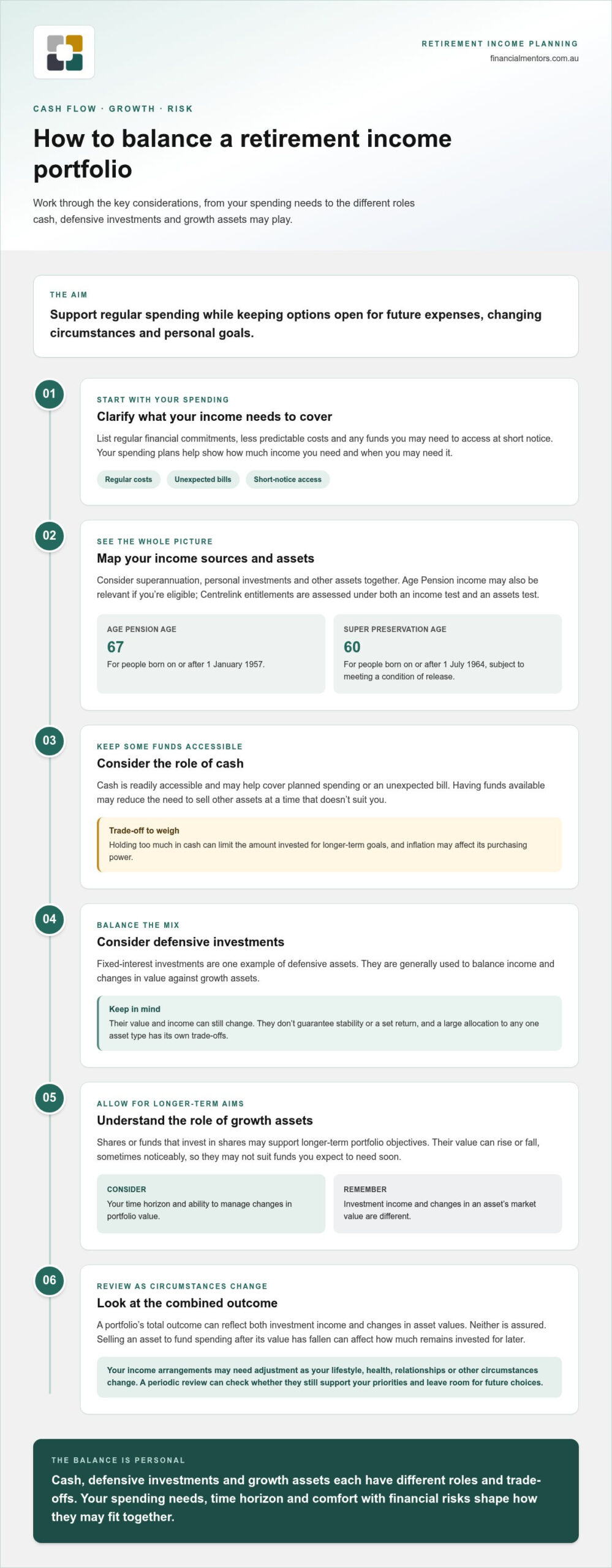
Your spending plans help determine how much income you need and when you need it. List regular financial commitments, such as household expenses, alongside less predictable costs. Note which funds you may need to access at short notice. These details can help you decide how to arrange your assets and income sources.
Your needs may change as your lifestyle, health, relationships or other circumstances change. A plan that suits you at retirement may need adjustment later. A periodic review can help you check whether your income arrangements still support your priorities and leave room for future choices.
Which Australian income sources may fit into the picture?
Superannuation can be one part of your retirement income, alongside personal investments and other assets. For background on the system and how it works, read Superannuation in Australia. As you prepare for retirement, consider how income planning fits with your wider retirement plans.
You may also receive Age Pension income, depending on your circumstances and the current eligibility rules. Centrelink entitlements are assessed under both an income test and an assets test. Your eligibility or payment amount can change if your circumstances change. The Age Pension age is 67 for people born on or after 1 January 1957. This differs from superannuation preservation age, which is 60 for people born on or after 1 July 1964, subject to meeting a condition of release.
Looking at these sources together can help you understand how much income may be available, when you can access it and where gaps or choices remain. This broader view is a useful starting point for comparing approaches.
How retirement income portfolios balance cash flow, growth and risk
Once you’ve mapped your income sources and spending needs, consider how different assets might support them. Cash, defensive investments and growth assets can each serve a different purpose. They also come with trade-offs. The balance depends on how much access to funds you need, your long-term goals and your comfort with financial risks. These are broad portfolio building blocks, not recommendations for particular investments.
What role can cash and defensive assets play?
Cash is readily accessible and can help cover planned spending or an unexpected bill. Keeping some funds available may reduce the need to sell other assets at a time that doesn’t suit you. But holding too much in cash can limit the amount invested for longer-term goals, and inflation may affect its purchasing power.
Defensive assets, such as fixed-interest investments, are generally used to balance income and changes in value against growth assets. Their value and income can still change, so they don’t guarantee stability or a set return. A large allocation to any one asset type can bring its own trade-offs.
Why might a portfolio include growth assets?
Growth assets, which can include shares or funds that invest in shares, may support longer-term portfolio objectives. Their value can rise or fall, sometimes noticeably, so they may not suit funds you expect to need soon. Their role depends on your time horizon and ability to manage changes in portfolio value.
Investment income and changes in an asset’s value are different. An investment may generate income while its market value moves independently. A portfolio’s total outcome can reflect both, and neither is assured. For example, selling an asset to fund spending after its value has fallen can affect how much remains invested for later. That doesn’t mean growth assets should always be avoided. It means their possible role needs to be considered alongside your income needs and tolerance for ups and downs.
The central question behind retirement income portfolio strategies australia is how to balance accessible funds, income and longer-term aims without depending too heavily on one source or asset type. Your circumstances can guide that balance. A tailored retirement planning discussion can help connect portfolio choices with your goals.
Comparing retirement income portfolio strategies and their trade-offs
These approaches offer different ways to organise retirement income. They aren’t a ranking of what you should choose. Each has potential benefits and trade-offs, and none removes investment risk or guarantees a particular income. Compare them against your spending needs, time horizon and preferences. A strategy that suits one retiree may not suit another.
Income-focused and total-return approaches
An income-focused approach gives priority to income generated by investments. This may make cash-flow planning more direct, but the income can change and is not guaranteed. Focusing mainly on income may also limit your choices about how the portfolio is invested.
A total-return approach considers investment income and changes in asset values together. You may fund spending from income, by selling some assets, or through a combination of both. This can give you flexibility in how withdrawals are managed, but selling assets when their value has fallen may reduce the amount left invested. Neither approach is automatically better. The fit depends on how you value regular cash flow, choice and flexibility.
How does a bucket-style approach differ?
A bucket-style approach groups assets by purpose or by the time horizon they are intended to support. For example, one group may be set aside for nearer-term spending, while another is intended for needs further ahead. This structure can make it easier to see which funds are planned for different uses, but it still relies on appropriate assets and ongoing management.
| Approach | Intended focus | Possible benefit | Key trade-off |
|---|---|---|---|
| Income-focused | Income generated by investments | May help organise cash-flow planning around investment income | Income can vary and isn’t guaranteed; a focus on income may narrow investment choices |
| Total-return | Income and changes in asset values | Offers flexibility in how spending is funded | Selling assets after a fall in value can affect what remains invested |
| Bucket-style | Grouping assets by purpose or time horizon | Can make planned uses for different funds easier to understand | Requires decisions about groupings, transfers and regular review |
Labels are only a starting point. A bucket structure doesn’t prevent the assets inside it from changing in value, and an income-focused label doesn’t mean every payment will remain steady. When comparing retirement income portfolio strategies australia, consider how each approach handles your expected spending, access to funds and comfort with financial risks. Your priorities can guide the comparison, while a periodic review can help you adjust as your circumstances change.
How to assess and review your retirement income portfolio
Assess retirement income portfolio strategies australia by working through your needs in a clear order. Start with the income you may need, then map your sources, consider risks and compare approaches. Keep a record of the assumptions behind your decisions so you can revisit them if your circumstances change.
What information should you gather first?
Begin with a snapshot of your financial position. You can make a useful starting point with broad estimates of your:
- assets and liabilities
- income sources, including relevant superannuation details
- regular expenses and financial commitments
- expected changes as you move into or through retirement
Next, consider what you want your income to support. Which regular costs matter most? Are there one-off expenses you may need to plan for? Which long-term goals do you want to keep in view? Your answers help distinguish essential spending from areas where you may have more flexibility.
Then assess financial risks that could affect your plans, such as investment value changes or unexpected costs. Compare portfolio approaches against your income needs, time horizon and preferences. Consider how superannuation, tax and Centrelink entitlements fit your circumstances too. Relevant rules and settings can change, so verify current information before making decisions. Centrelink eligibility and payments depend on individual circumstances and the rules in force at the time.
When should you review your strategy?
A periodic review means reassessing your objectives, what you’ve achieved and what you need now. Set a time to revisit your plan, and review it sooner if your health, family circumstances or financial commitments change. Update your assumptions, including expected spending, income and relevant tax, superannuation or Centrelink settings.
Keep the review practical. Ask whether your income sources still match your spending plans, whether you can access funds when needed and whether your chosen approach remains comfortable for you. A written record can help you see what has changed and why you made particular decisions.
If you’re preparing for retirement more broadly, explore a retirement planning checklist to organise the topics you may need to consider. For tailored retirement planning advice that connects your portfolio choices with your goals, discuss your retirement income plan.
Turning a retirement income strategy into a personal financial plan
Comparing broad approaches can help you understand your options. A written financial plan takes the next step by connecting those choices with your income needs, assets, superannuation and personal goals. It can also set out the assumptions behind your strategy, giving you a reference for future decisions and reviews.
There’s no single plan for every retiree. Your financial position, priorities and comfort with financial risks all affect which options may suit you. Tailored retirement planning advice can help you consider these factors together, rather than treating your portfolio as a decision in isolation. It can’t guarantee an income, investment returns or Centrelink eligibility.
What can a tailored retirement planning process cover?
A planning conversation may explore your goals, current financial position, expected retirement spending and available income sources. It can also consider relevant financial risks and how your assets and superannuation fit your plans.
Retirement planning can sit within broader financial planning, alongside estate planning advice and other matters that affect your future. A written financial plan can bring recommendations together, while a periodic review gives you a way to revisit them as your needs or circumstances change.
What is a practical next step?
Before an appointment, write down the questions you want answered and gather relevant financial details. Note your main goals, expected income sources, regular financial commitments and any decisions you’re unsure about. A retirement planning checklist can help you organise discussion topics and identify gaps in your preparation.
At Financial Mentors Wealth Management, the initial meeting is step 01 of the process. It provides a starting point to discuss your circumstances and what you want your retirement income strategy to support. Use the conversation to clarify which areas need closer attention and what information may help with the next steps.
The aim is to connect portfolio choices with your life, not simply select an approach by label. If you’d value support assessing retirement income portfolio strategies australia in the context of your goals, Financial Mentors Wealth Management provides tailored retirement planning advice. The firm has provided professional planning advice since 2000, with recommendations shaped around individual circumstances.
Build a retirement income plan around your priorities
A retirement income portfolio needs to do more than provide cash flow. The balance between accessible funds, growth and financial risks should reflect your goals and circumstances, and may need to change over time. Comparing retirement income portfolio strategies australia can help you understand the trade-offs. A written financial plan can connect your choices with your income needs, superannuation and personal priorities.
Review your plans as your health, goals or financial commitments change. Financial Mentors provides tailored retirement planning advice to help you consider how different options fit your situation. The initial meeting is step 01 of the process and a starting point to discuss what matters to you.
Explore retirement planning advice and take a considered step towards a retirement income plan shaped around your future.
Frequently Asked Questions
What is a retirement income portfolio?
A retirement income portfolio is the mix of assets and income sources you arrange to help fund your spending in retirement. It may include superannuation, personal investments and, if you’re eligible, Age Pension income. The aim is to support your planned spending while leaving room for future needs and choices. How you structure it depends on your financial position, goals, time horizon and comfort with investment risk.
How do I create a retirement income portfolio in Australia?
Start by setting out your expected spending, assets, liabilities, income sources and financial commitments. Then consider how superannuation, personal investments and possible Centrelink entitlements fit your plans. Compare broad approaches by their cash-flow aims, flexibility and trade-offs rather than assuming one is best. Assess retirement income portfolio strategies australia against your circumstances, including current tax and eligibility rules. Tailored advice can help you consider these factors together.
Is a dividend-focused strategy suitable for retirement income?
A dividend-focused approach may suit some investors, but dividends aren’t guaranteed and can change. Share prices can also rise or fall, so dividend income alone may not meet your spending needs or provide the flexibility you want. Consider how the approach fits your wider assets, income requirements and tolerance for investment risk. It can be useful to compare it with strategies that draw on both investment income and asset sales.
How much should I keep in cash during retirement?
There isn’t one cash amount that suits every retiree. Consider your regular spending, upcoming one-off costs, other income sources and how quickly you may need to access funds. Cash can help meet near-term needs, but keeping more than you expect to use may affect how much is available for other purposes. Set an amount based on your circumstances, then review it if your spending or income changes.
Can the Age Pension form part of a retirement income strategy?
Yes, the Age Pension may form part of your retirement income if you meet the eligibility requirements. Centrelink assesses eligibility using both an income test and an assets test, and the test that results in the lower payment applies. The Age Pension age is 67 for people born on or after 1 January 1957. Rules and personal circumstances matter, so check current requirements before including a possible payment in your plans.
What happens to a retirement portfolio when markets fall?
When markets fall, the value of investments such as shares may decline, reducing the portfolio’s value. The effect on your plans depends on your asset mix, income sources and whether you need to sell investments to fund spending. A written plan can help you consider your options against your needs before making changes. A market fall does not require the same response for every retiree.
How often should I review my retirement income portfolio?
Review your portfolio regularly, and revisit it sooner if your health, family circumstances, goals or financial commitments change. A periodic review means reassessing your objectives, what you’ve achieved and your ongoing needs. Check whether your income sources and spending plans still align, and update relevant assumptions. Tax, superannuation and Centrelink settings can change, so verify current information when reviewing decisions that depend on them.