

What if achieving financial peace of mind starts with a clearer picture, rather than having every future expense or change figured out? When income, expenses and financial commitments are hard to track, it’s natural to wonder whether you’re moving in the right direction. A practical first step is to understand where you stand today.
You don’t need perfect circumstances to make steady progress. A clearer view of your financial position can help you decide what matters most, prepare for unexpected events and break long-term goals into manageable next steps. Your priorities may change as your life does, so your plan should be able to change with them.
This article explains how to map your income, expenses, assets and commitments, then use that information to build a plan around your goals. You’ll also learn how to prepare for financial adversity and make periodic reviews part of your approach. Tailored financial planning advice can help you shape a written financial plan around your circumstances and track and adjust your progress.
Key Takeaways
- Achieving financial peace of mind can begin with clearer choices, even if your circumstances aren’t perfect.
- Build a useful snapshot by listing your income, regular expenses, assets, liabilities and financial commitments.
- Choose one priority and a manageable next step, then set a date to review your progress.
- A written financial plan can connect your personal priorities with practical actions as life changes.
- If you’d value tailored guidance, the initial meeting is step 01, and the initial consultation is complementary.
What does achieving financial peace of mind mean in everyday life?
Money uncertainty can arise at any income level and life stage. You might be starting a family, managing a mortgage, changing careers or approaching retirement. The concern is often not simply how much money you have, but whether your everyday choices fit your priorities and whether you feel prepared for change.
Financial peace of mind means having enough clarity about your finances to make considered decisions and feel better prepared for what may come. It isn’t the same as being wealthy, knowing exactly what the future holds or living without unexpected expenses. It’s a greater sense of direction, built by bringing practical organisation and personal reassurance together. Achieving financial peace of mind can mean knowing what you need to cover, what you’re working towards and which choices are available to you.
Which parts of your financial life shape your sense of security?
Your financial position reflects how money comes in and goes out, alongside your savings, debts, assets and financial commitments. Looking at these parts together can make your day-to-day finances easier to understand. For example, noting which costs are regular and when payments are due can help you assess whether a new expense fits your budget or whether a goal needs a different timeframe.
Understanding the basics of budgeting, debt and investing can support understanding your financial position. But the numbers alone don’t define security. Your priorities matter too. You may value having a savings buffer, reducing debt, planning for a home or setting aside money for your family. What feels manageable and reassuring depends on your circumstances.
Why peace of mind is a process, not a finish line
Your financial plan may need to shift as work, health, family circumstances or goals change. A decision that suited you a few years ago may no longer fit. That doesn’t mean you have failed or need to start over. It means you can adjust your plan to reflect what matters now, while keeping your next steps practical.
A periodic review gives you a chance to recognise progress, revisit priorities and notice changing needs. You might find that a regular expense has changed or a goal needs a new timeframe. Planning can help you make informed choices, but it can’t remove every financial risk or guarantee a particular outcome. The aim is to stay engaged and respond thoughtfully as life unfolds.
How understanding your financial position can reduce money uncertainty
A vague worry such as “Can I afford this?” can be hard to act on. A clear snapshot gives you specific questions about what comes in, what goes out, what you owe and what you’re building towards. It won’t answer every question at once, but it can show you where to focus next.
Your household’s financial position is its income, expenses, assets, liabilities and ongoing financial commitments, viewed together. Seeing these elements side by side can help you identify whether a concern relates to day-to-day spending, debt, savings or another priority. This practical understanding can support achieving financial peace of mind whatever your income or starting point.
Create a straightforward snapshot of your finances
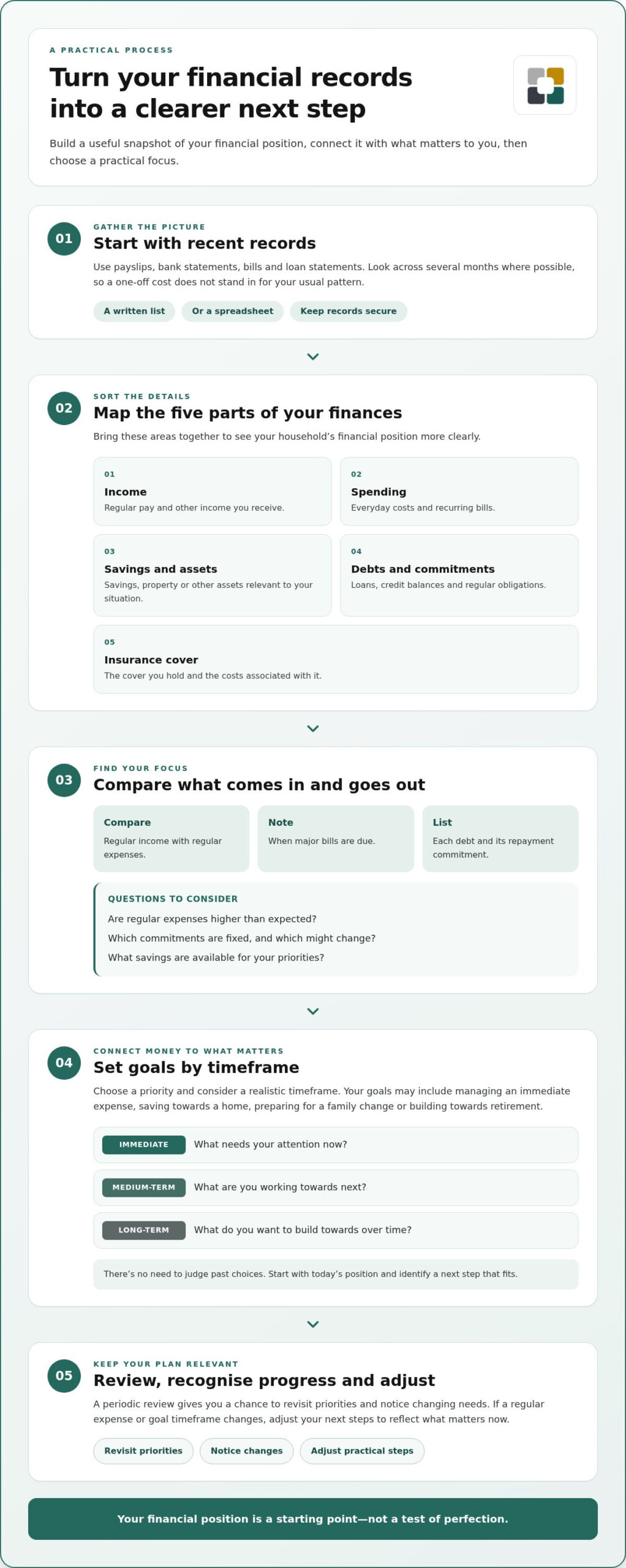
Start with recent records such as payslips, bank statements, bills and loan statements. Look across several months where possible, so a one-off expense or unusually high bill doesn’t stand in for your usual pattern. A simple written list or spreadsheet is enough to get started. Keep sensitive records in a secure place, especially if you store them digitally.
- Income: regular pay and other income you receive.
- Spending: everyday costs and recurring bills.
- Savings and assets: savings, property or other assets relevant to your situation.
- Debts and commitments: loans, credit balances and regular obligations.
- Insurance cover: the cover you hold and the costs associated with it.
Once you’ve gathered the information, compare regular income with regular expenses, note when major bills are due and list each debt with its repayment commitment. Then ask: Are regular expenses higher than expected? Which commitments are fixed, and which might change? What savings are available for your priorities? Your answers can help you decide what to review first.
Connect the numbers with your priorities
Numbers become more useful when you connect them to what you want money to make possible. Is your focus managing an immediate expense, saving towards a home, preparing for a family change or building towards retirement? Separate immediate needs from medium-term goals and long-term goals, then consider what timeframe is realistic for each. There’s no need to judge past choices. The purpose is to understand today’s position and identify a next step that fits.
If several goals compete for your income, tailored financial planning advice can help you consider your priorities together.
Does achieving financial peace of mind require perfect finances?
No. You don’t need a high income, substantial savings or every decision settled before you can start planning. Financial planning can be useful at different life stages, whether you’re managing everyday expenses, preparing for a change at work or thinking about retirement. Your first step can be as simple as organising what you know and identifying what you’d like to understand better.
It’s understandable to wait for a quieter period or more certainty. Yet work, family circumstances and costs can change, so there may never be a moment when every detail feels settled. Begin with the information available now, then update it as your circumstances shift. A starting point is just that, not a permanent judgement about your finances.
Common beliefs that can delay a useful first step
Planning isn’t only for wealthy people or those nearing retirement. If your priorities include managing regular commitments, saving for a home or preparing for a family change, a basic plan can help you compare those choices. You can also explore general money-management information through the Australian Government’s Moneysmart website.
You don’t have to solve every issue at once. If a detail is unclear, write it down as a question to revisit rather than letting it stop you from acting. A simple budget or list of goals can be updated as you learn more.
What a financial plan can and cannot do
A financial plan is a written document outlining strategies and recommendations to help achieve your financial goals. It can organise decisions, show how different priorities relate and give you a basis for reviewing progress. Recommendations should reflect your personal circumstances and priorities, rather than assume one approach suits everyone.
A plan can support more informed choices, but it can’t make every outcome predictable or remove financial risks. You can organise your own records, set priorities and make straightforward changes yourself. If decisions span several goals, or you’re unsure how one choice may affect another, tailored financial advice may help you consider the options. Self-directed steps can get you started, while advice can add guidance where your situation calls for it.
If you’d like support turning your priorities into a written plan, explore tailored financial planning. Your plan can develop with you, rather than waiting for perfect finances before you begin.
How to take practical steps towards financial peace of mind
You don’t need to change everything at once. A steady process can help you turn a concern into an action, then check whether that action still fits as life changes. Start with one priority and work through these steps:
- Name your priority. What would you most like to address right now: spending, savings, debt, insurance or a future goal?
- Choose one manageable action. If you want to save, review your regular spending and decide what amount feels realistic to set aside. If debt is your focus, list the balances and repayment commitments so you can consider your next move.
- Set a review date. Choose a date to check what has changed and whether your action is helping you move towards your goal.
If preparing for retirement is your priority, use a retirement planning checklist to organise the questions you want to work through. For another goal, such as saving towards a home or making room for a new family commitment, define what progress would look like for you. A specific next step is easier to revisit than a broad intention to “get finances in order”.
Build review into your routine
A review date gives you a prompt to revisit spending, savings, debts and financial risks. Check whether regular costs have changed, whether your savings approach remains workable and whether any debt commitments need closer attention. Keep the review proportionate: the purpose is to notice changes and decide whether an adjustment is needed, not to judge yourself for plans that have shifted.
Some changes may call for an earlier review. A new job, a change in health, starting a family, a property purchase or approaching retirement can all affect your income, commitments and priorities. If you’re considering how your assets should be managed as part of your legacy, estate planning advice may help you understand relevant financial considerations.
Consistent, manageable actions give you a clearer way to track progress, while a periodic review helps keep your plan connected to your circumstances. If you’d like guidance shaping those steps around your priorities, explore tailored financial planning advice.
When can financial advice support your peace of mind?
Some financial decisions are connected. Choosing how much to save, for example, may affect your plans for retirement, a home or your family. If several priorities are competing for attention, or a major life change is approaching, tailored financial advice may help you see how the choices relate to your financial position.
Professional advice can help turn personal priorities into a written financial plan, with recommendations shaped around your circumstances. This may be useful when you’re preparing for retirement, adjusting to a change in family circumstances or considering how to build wealth over time. Financial planning, retirement and estate planning advice, and tax return preparation can each address different parts of your financial life. If you’re exploring investments alongside future goals, ask how wealth creation strategies may fit your priorities and circumstances.
Situations where a conversation may help
You may be managing a career change while planning for retirement, or thinking about how a new family commitment affects saving and spending. These decisions can involve different timeframes and trade-offs. A financial adviser can consider your goals alongside your income, expenses, assets and commitments, helping you understand which options may suit your individual position. Advice should be relevant to you, not based on assumptions about what everyone needs.
Financial Mentors Wealth Management has provided professional planning advice since 2000. A conversation can help you explain what matters, raise questions and consider how tailored advice could support your next steps. You don’t need to have every detail settled before discussing your circumstances.
What to expect from the first step
The initial meeting is step 01 in the process, and the initial consultation is complementary. Prepare by noting the goals you’d like to discuss, any decisions you’re weighing up and the questions you want answered. A current snapshot of your finances may help you explain your situation, but you can also begin with the concerns or priorities you have now.
From there, the discussion can help clarify what you want to work towards and whether a written financial plan may be appropriate. Achieving financial peace of mind doesn’t mean having every answer at once. It can begin with a considered conversation about your circumstances and the choices ahead.
Start with an initial meeting to discuss your priorities and take a considered first step.
Take a steady step towards your financial future
Achieving financial peace of mind doesn’t require perfect finances or certainty about what lies ahead. It can start with understanding your financial position, choosing one priority and setting a time to review your progress. As your circumstances and goals change, you can adjust your approach.
If decisions about retirement, family, building wealth or other priorities feel connected, tailored advice may help you consider them together and shape a written financial plan around your circumstances. Financial Mentors Wealth Management has provided professional planning advice since 2000. The initial meeting is step 01 in the process, and the initial consultation is complementary.
Bring your questions and the goals you’d like to discuss. Start with an initial meeting and take a considered first step towards greater confidence in your financial future.
Frequently Asked Questions
How can I start achieving financial peace of mind?
Start achieving financial peace of mind by getting a clear view of your current finances and choosing one priority to work on. List your income, regular expenses, savings, debts and financial commitments. Then select a manageable action, such as reviewing a recurring cost or setting a savings goal, and choose a date to check your progress. You can adjust your next steps as your circumstances or priorities change.
Does financial peace of mind mean being debt-free?
No. Financial peace of mind doesn’t necessarily mean having no debt. It can mean understanding what you owe, knowing when repayments are due and having a plan that fits your income and priorities. If you have several debts, list their balances, repayments and relevant terms. This can help you identify useful questions and consider your options. A financial adviser may help if you’re unsure how debt affects your other goals.
Can financial planning help if I do not have much money?
Yes. You don’t need a high income or perfect circumstances to begin organising your finances. A simple record of what you earn, spend and owe can help you decide what to focus on first. You might start by checking regular expenses or setting a realistic goal, even if progress is gradual. Tailored financial planning can also help you consider your priorities in the context of your individual financial position.
What should I include in a financial plan?
A financial plan is a written document outlining strategies and recommendations to achieve your financial goals. It can reflect your income, expenses, assets, liabilities, savings, debts and financial commitments, alongside your priorities and timeframes. You may also consider relevant insurance cover and financial risks. The details should suit your circumstances, such as preparing for retirement, saving for a home or planning for a family change, rather than follow a standard template.
How often should I review my financial plan?
Set a regular date for a periodic review, then bring it forward if your circumstances change. A new job, a change in health, starting a family or approaching retirement may affect your goals, income or commitments. During a review, check your progress and consider whether your spending, savings, debts and next steps still fit. The right timing depends on your plan and situation, so choose a routine you can maintain.
When should I speak with a financial adviser?
Consider speaking with a financial adviser when decisions involve several goals, a major life change or questions you’re unsure how to resolve. Advice may help connect choices about retirement, building wealth or estate planning with your financial position. Financial Mentors Wealth Management has provided professional planning advice since 2000. The initial meeting is step 01 in its process, and the initial consultation is complementary, giving you an opportunity to discuss your questions and priorities.