

Have you ever felt a flicker of doubt when discussing your hard-earned savings, wondering if the advice you’re receiving is truly for your benefit? It’s a natural reaction to a complex industry, especially when you’re trying to decode various qualifications and acronyms. In Australia, the rigorous financial planning standards serve as a vital safeguard, transforming what could be a confusing transaction into a partnership based on trust and transparency. These regulations aren’t just bureaucratic hurdles; they’re your personal shield, ensuring that every recommendation is ethical, professional, and tailored to your unique life goals.
We understand that the fear of being sold an inappropriate product can make it difficult to take that first step toward your future. If you’ve felt hesitant or even a little cynical about the financial sector, your feelings are completely valid. This article will show you how Australia’s legal protections, such as the Code of Ethics and strict registration requirements, work to protect your wealth. You’ll discover how to easily verify an adviser’s credentials on the ASIC register and learn why ongoing education is mandatory for those who guide your journey. By the end, you’ll have the clarity and peace of mind you need to move forward with quiet confidence.
Key Takeaways
- Understand how modern financial planning standards act as a protective shield, ensuring your adviser provides a professional service focused on your goals rather than a simple product sales pitch.
- Discover the rigorous educational and exam requirements that ensure your chosen planner has the deep technical knowledge needed to manage your wealth and life transitions.
- Learn about the “Best Interests Duty” within the Code of Ethics, which legally obliges your adviser to prioritise your financial well-being above any other consideration.
- Find out how to use the ASIC Financial Advisers Register as a simple, public tool to verify a professional’s credentials and history before you start your planning journey.
- See how a standards-based approach creates a secure foundation for your retirement and wealth creation, giving you the confidence to focus on what truly matters to you.
What Are Financial Planning Standards and Why Do They Exist?
Think of financial planning standards as the invisible backbone of every conversation you have with an adviser. They aren’t just dry legal requirements; they represent a fundamental shift in how your money is managed. For a long time, the industry struggled with a reputation for being sales-heavy. You might remember the days when “advice” often felt like a push toward a specific product. That changed with the landmark 2017 reforms. These laws were designed to turn a sales-based industry into a respected profession, much like medicine or law. Today, the Australian Securities and Investments Commission (ASIC) oversees these rules to ensure that every Australian receives advice that is transparent, ethical, and truly helpful.
The Evolution of Professionalism in Australian Finance
The journey toward higher standards has been steady and deliberate. We’ve seen the responsibility for these rules move from the former FASEA body to the Federal Treasury, ensuring that the government remains directly involved in protecting consumers. A major part of this evolution involves education. It’s no longer enough to complete a quick certificate. Advisers are now required to hold approved university degrees, ensuring they have the technical depth to handle complex wealth creation strategies. Many professionals also seek the Certified Financial Planner (CFP) designation, which is a globally recognised mark of excellence. By 2026, a Relevant Provider is defined as an individual who has met the new mandatory qualification standards and is registered to provide personal financial advice to retail clients.
How These Standards Protect Your Financial Future
How does this actually help you on a Tuesday morning? One of the biggest wins for consumers was the removal of most conflicted remuneration, which is a fancy way of saying commissions. If your adviser recommends a strategy, it’s because they believe it’s right for you, not because they’re getting a kickback from a bank. This shift ensures your roadmap is personalised rather than a “cookie-cutter” solution. When financial planning standards are high, the risk of financial malpractice drops significantly. You’re no longer just a number in a system; you’re a partner in a professional relationship. These standards ensure that your adviser is looking ahead, future-proofing your life milestones, and acting as a steady guide through the ups and downs of the market.
The Four Pillars of the Financial Adviser Standards
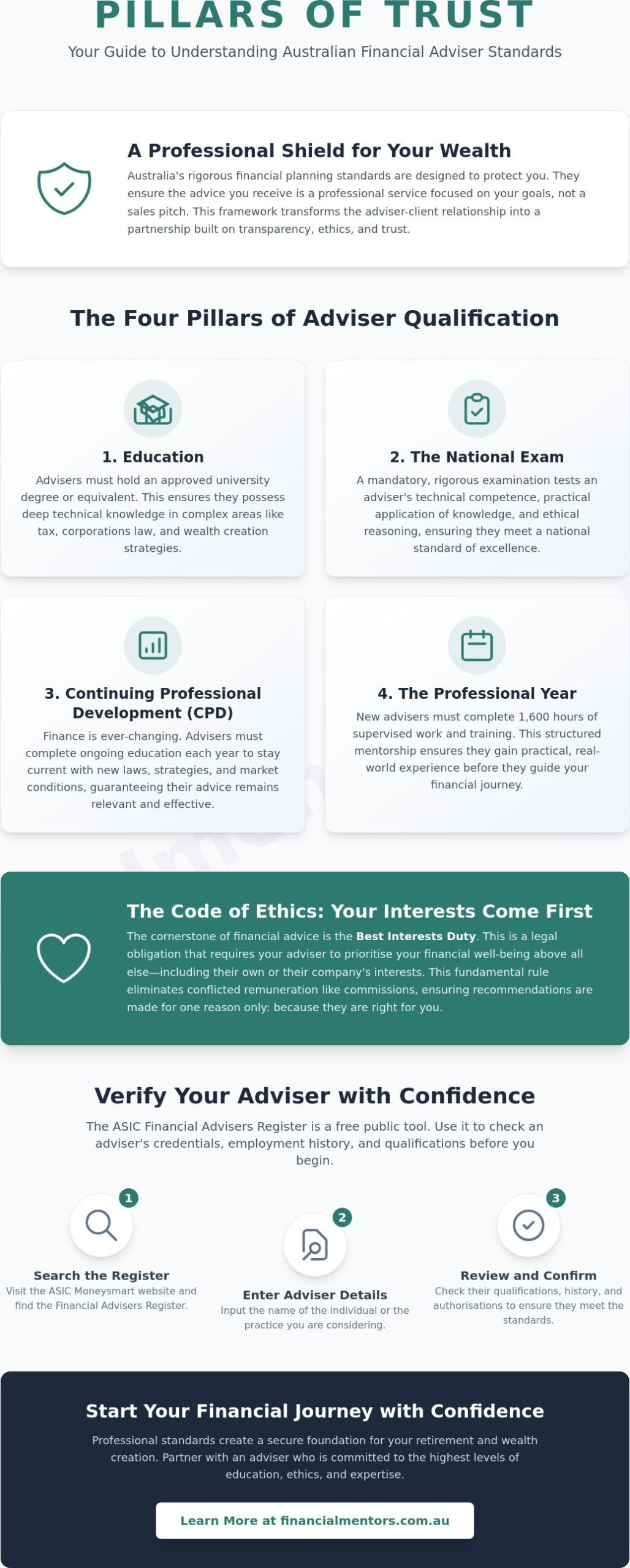
What does it actually take to become a trusted guide for your wealth? In Australia, the framework of financial planning standards is built on four sturdy pillars designed to ensure your adviser is more than just a number-cruncher. These pillars act as a filter, allowing only those with the right heart and the right head to manage your financial future. They include:
- Education: The requirement for an approved university degree or equivalent qualification.
- The National Exam: A rigorous test of technical competence and ethical reasoning.
- Continuing Professional Development (CPD): A mandatory commitment to lifelong learning.
- The Professional Year: 1,600 hours of supervised, on-the-job training for all new entrants.
These requirements ensure that by the time an adviser sits across the table from you, they’ve proven their dedication to the craft. If you’re curious about how these benchmarks apply to your own situation, speaking with a professional at Financial Mentors can help clarify the path forward.
Why Education Matters: More Than Just a Degree
Think of your financial planner as a surgeon for your life’s savings. Just as you’d expect a medical professional to master anatomy and biology, an adviser must master tax law, corporations law, and behavioural finance. This deeper education allows for more creative wealth strategies that a less-qualified person might miss. It isn’t just about passing a unit; it’s about understanding how a change in legislation might impact your retirement ten years from now. These high benchmarks align with global best practices, such as the Statement on Standards in Personal Financial Planning Services, ensuring Australian advice remains world-class.
Continuing Education: Why Your Adviser Never Stops Learning
The world of finance moves quickly, and a degree from a decade ago isn’t enough to protect your wealth today. That’s why every registered adviser must complete 40 hours of CPD each year. This isn’t just a “tick-a-box” exercise. The hours are strictly divided into categories: five hours for technical skills, five for client care, five for regulatory compliance, and nine for professionalism and ethics. For those providing tax advice, an extra five hours must focus specifically on tax law. This constant cycle of renewal keeps your adviser updated on changing superannuation rates and deeming thresholds, ensuring the guidance you receive is always fresh and relevant. It’s about maintaining technical excellence so you can focus on enjoying your life milestones.
The Code of Ethics: Putting Your Interests Above All Else
The Financial Planners and Advisers Code of Ethics 2019 isn’t just a document gathering dust on a shelf. It’s a living set of promises that dictates every move your adviser makes. In the past, you might have worried about hidden agendas or being sold a product that didn’t quite fit. Today, the financial planning standards in Australia require a higher level of care known as the “Best Interests Duty.” In plain English, this means if a recommendation isn’t the absolute best option for your specific circumstances, your adviser simply can’t suggest it. It’s about putting your needs ahead of their own, every single time.
Transparency is another cornerstone of this ethical framework. You should never feel surprised by a bill or confused about why a certain strategy was chosen. Under the requirement for “Informed Consent,” your adviser must explain their fees and advice in a way that you fully understand and agree to before anything proceeds. Standard 6 of the Code takes this even further. It requires advisers to look beyond the immediate future and consider the long-term impact of their advice on your life. Will this strategy still serve you when you’re starting a family or approaching retirement? This forward-looking approach ensures your plan grows with you.
Managing Conflicts of Interest: A New Era of Trust
Trust is hard to build but easy to break, especially when money is involved. To protect that trust, the industry has moved toward a professional fee-for-service model. This means the old days of volume-based payments and “kickbacks” for selling certain products are gone. If a potential conflict of interest does exist, your adviser is legally bound to disclose it to you immediately. This level of honesty aligns with international benchmarks like the CFP Board’s Code of Ethics, which sets a high bar for professional conduct globally. When you know exactly how your adviser is paid, you can feel confident that their focus remains entirely on your success.
The Emotional Value of Ethical Advice
Money is rarely just about the numbers; it’s about the security, freedom, and peace of mind those numbers provide. Knowing your adviser is legally and ethically bound to act in your favour can significantly reduce the stress of complex decision-making. An ethical framework allows for a relationship built on empathy and validation. Your aspirations are unique, and a true mentor takes the time to acknowledge your challenges without judgment. This isn’t just a corporate service; it’s a partnership. When financial planning standards are followed, your adviser becomes a steady companion through all of life’s transitions, helping you stay on track with quiet confidence.
Verifying Your Adviser: How to Use the Financial Advisers Register
You’ve learned about the high hurdles advisers must jump to prove their competence. Now, how do you see the results for yourself? The Australian Securities and Investments Commission (ASIC) maintains a public tool called the Financial Advisers Register (FAR). This isn’t just a list of names; it’s a transparent record that allows you to confirm your adviser meets the current financial planning standards. Taking five minutes to check this register can provide immense peace of mind before you share the details of your life’s work.
To start your search, simply visit the ASIC MoneySmart website and navigate to the Financial Advisers Register. You can search for an individual by their full name. Once you find their profile, look for the “Relevant Provider” status. As of 2026, this status confirms the adviser has met the mandatory education and exam requirements. You can also see their employment history, what qualifications they hold, and whether they’ve been a member of any professional bodies. Most importantly, the register will clearly state if an adviser has been banned or disqualified from providing advice, acting as your first line of defence against malpractice.
Decoding the Register: What the Information Means
When you’re looking at a profile, pay close attention to the “Advice Areas.” This section lists exactly what the person is authorised to talk to you about, such as superannuation, retirement planning, or wealth creation strategies. It’s also vital to check their Australian Financial Services Licence (AFSL) details. Every adviser must either hold a licence or be an authorised representative of a licensee. You can also verify their commitment to learning; the register indicates whether they have complied with their annual 40-hour Continuing Professional Development (CPD) requirements. This ensures the person you’re trusting is staying current with the latest tax and super laws.
Questions to Ask During Your First Appointment
While the register provides the facts, your first meeting is about building a relationship. Don’t be afraid to ask direct questions to see how they integrate financial planning standards into their daily work. You might ask:
- “Can you tell me about your professional journey and the qualifications you’ve earned?”
- “How do you ensure you’re meeting the Code of Ethics and the Best Interests Duty in your daily practice?”
- “What is your approach to ongoing professional development to stay ahead of market changes?”
If you’re looking for a partner who prioritises transparency and professional excellence, you can connect with the team at Financial Mentors Wealth Management to discuss your future. A true mentor will always be happy to discuss their credentials and show you how they put your interests first.
The Financial Mentors Wealth Management Approach: Standards as a Foundation for Growth
At Financial Mentors Wealth Management, we believe that high financial planning standards shouldn’t be the finish line; they’re the starting point. While the law requires every adviser to meet certain benchmarks, we see these regulations as the foundation upon which we build a relationship of trust. If you’ve ever felt like just another file in a cabinet, you’ll find our approach refreshing. We integrate these ethical and technical requirements into every wealth roadmap we create, ensuring that your advice is not only legally sound but deeply personal. Our commitment to your security is solidified by our own licence, Financial Mentors AFSL Pty Ltd, which provides the regulatory framework needed to protect your interests through every life transition.
Strategic wealth management is rarely a standalone task. It’s often intertwined with other areas of your life, such as your annual tax obligations. By combining strategic advice with professional tax return preparation, we create a synergy that looks at your entire financial picture. This holistic view allows us to identify opportunities for growth that might be missed if these services were handled in isolation. It’s about steady, methodical progress toward the future you’ve imagined for yourself and your family. We view ourselves as your lifelong financial guides, staying by your side as the market and your personal circumstances evolve.
A Personalised Roadmap Built on Professionalism
Our focus on retirement planning and estate planning advice allows us to delve deep into specialised fields that require both technical mastery and emotional intelligence. Have you considered how your legacy might look for the next generation? Our “wise mentor” philosophy is designed to align with the highest ethical standards while acknowledging the emotional nuances of major life changes. We don’t just provide a plan; we provide a partnership. This approach ensures your peace of mind is the priority, allowing you to move forward with the quiet confidence that comes from being truly prepared for whatever comes next.
Your Next Steps Toward a Secure Future
It’s completely normal to feel a little overwhelmed when you first look at the road ahead. If you’re unsure where to begin, remember that even the most complex journey starts with a single, simple conversation. A professional consultation is a powerful tool for clarifying your goals and stripping away the confusion of industry jargon. It’s an opportunity to see how financial planning standards work in your favour to create a stable, future-proof strategy. We invite you to organise a conversation with a Financial Mentors Wealth Management guide today and discover the difference that professional, ethical mentorship can make in your life.
Embracing Clarity for Your Wealth Journey
Choosing to seek advice is a significant milestone in your life’s story. It’s about more than just numbers; it’s about the peace of mind that comes from knowing your aspirations are protected by world-class financial planning standards. By understanding the ethical duties and rigorous qualifications required of today’s professionals, you’ve taken a vital step toward reclaiming control over your financial future. You now know how to verify credentials and why the Best Interests Duty acts as your ultimate safeguard during every consultation.
At Financial Mentors Wealth Management, we’ve been operating under our own registered AFSL since 2003, dedicated to acting as a steady guide through every transition. Whether you’re looking for specialists in retirement and estate planning or need integrated tax and wealth management strategies, we’re here to help you move forward with quiet confidence. If you’re ready to see how professional mentorship can transform your outlook, we invite you to secure your legacy with a trusted mentor—explore our financial planning services. Your unique goals deserve careful, personalised attention, and the right partnership can make all the difference. We look forward to walking this path with you.
Common Questions About Financial Planning Standards
What are the current educational requirements for financial planners in Australia?
Financial planners must hold an approved university degree or an equivalent qualification to meet current financial planning standards. Existing advisers have until 1 January 2026 to reach this benchmark. In addition to a degree, they must pass a rigorous National Exam and complete a supervised Professional Year before they can provide personal advice to clients.
How do I check if a financial advisor is qualified and licensed?
You can verify an adviser’s credentials by searching the ASIC Financial Advisers Register (FAR) on the MoneySmart website. This public record shows their qualifications, employment history, and whether they have “Relevant Provider” status. It’s a simple way to ensure the person you’re trusting is properly licensed and has no history of being banned or disqualified.
What is the Financial Planners and Advisers Code of Ethics?
The Financial Planners and Advisers Code of Ethics 2019 is a set of twelve standards that go beyond basic legal requirements. It mandates that advisers act with honesty, fairness, and integrity while always prioritising your best interests. This code ensures that every piece of advice you receive is designed to improve your financial well-being rather than benefit the adviser.
Why did the financial planning standards change in Australia?
Australia’s financial planning standards changed to transform the industry from a sales-driven sector into a recognised profession. Following the 2017 reforms, the goal was to eliminate conflicts of interest and ensure Australians could access high-quality, ethical advice. These changes provide a protective shield for your wealth by mandating higher education and transparency.
Can a financial planner still receive commissions on investment products?
Generally, financial planners can no longer receive volume-based commissions or “kickbacks” for recommending specific investment products. The industry has shifted to a professional fee-for-service model where you pay for the advice itself. This ensures that recommendations are based on your life goals rather than the financial gain of the adviser.
What happens if a financial advisor breaches the professional standards?
If an adviser breaches these standards, ASIC has the power to take formal enforcement action, which can include banning or disqualifying them from the industry. These actions are recorded on the public Financial Advisers Register. This system holds professionals accountable and ensures that only those who uphold the highest ethical values continue to practice.
Is there a difference between a financial planner and a financial advisor in terms of standards?
Under Australian law, there is no practical difference between the terms “financial planner” and “financial adviser” when they are providing personal advice. Both must be registered as a “Relevant Provider” on the ASIC register. Regardless of the title they use, they are both bound by the same strict educational, ethical, and professional requirements.
How much does it cost to work with a professional who meets these standards?
The cost of professional advice depends on the complexity of your situation and the specific strategies you need, such as retirement planning or wealth creation. Most professionals now use a transparent fee-for-service structure, which will be clearly explained to you before any work begins. This ensures you only pay for the value and expertise you receive without hidden surprises.