
What if the “magic million” you have been told you need for a comfortable retirement is actually a myth that is causing you unnecessary stress? It is easy to feel overwhelmed by headlines about the rising cost of living in 2026 or the complexity of Centrelink asset tests. You might worry that your superannuation balance will not be enough to sustain the lifestyle you have worked so hard for. This anxiety is completely understandable, but a don’t panic retirement is more achievable than you might think when you look at the full picture of Australian retirement.
If you feel like you are falling behind, then understanding how your superannuation works in tandem with the Age Pension can provide immediate peace of mind. You do not need a seven-figure nest egg to live well; in fact, many Australian couples find their “sweet spot” with a balance closer to $460,000. In this article, we will explore why a modest balance is often more than enough and how you can strategically align your assets to maximise your government entitlements. We will guide you through the latest 2026 thresholds and show you how to build a secure, confident future without the constant fear of running out of funds.
Key Takeaways
- Understand why the “million-dollar myth” is misleading and how a modest super balance can still support a high quality of life.
- Identify the Australian retirement “sweet spot” where your personal savings and the Age Pension work together to maximise your fortnightly income.
- Learn how to navigate the 2026 Centrelink asset and income tests to ensure you are receiving every dollar of support you are entitled to.
- Discover how to create a practical roadmap to organise your assets and achieve a don’t panic retirement with confidence and clarity.
- Explore the value of a long-term advisory relationship in future-proofing your lifestyle against inflation and shifting market conditions.
What Does ‘Don’t Panic Retirement’ Mean for Australians in 2026?
Shifting from decades of “saving mode” into “spending mode” is one of the most significant emotional hurdles you will ever face. It feels counterintuitive, and perhaps even a little frightening, to watch your balance decrease after years of diligent growth. We understand that this transition requires a mental gear change. For professionals stepping away from senior roles, executive coaching services can help bridge the gap between a high-pressure career and a fulfilling retirement. A don’t panic retirement is built on the fundamental understanding that your wealth is a practical tool for living, not just a static number on a digital screen. In 2026, while the cost of living remains a conversation at every dinner table, the focus for savvy retirees has shifted back to sustainable income streams rather than just the size of the initial pot.
The Myth of the Magic Million
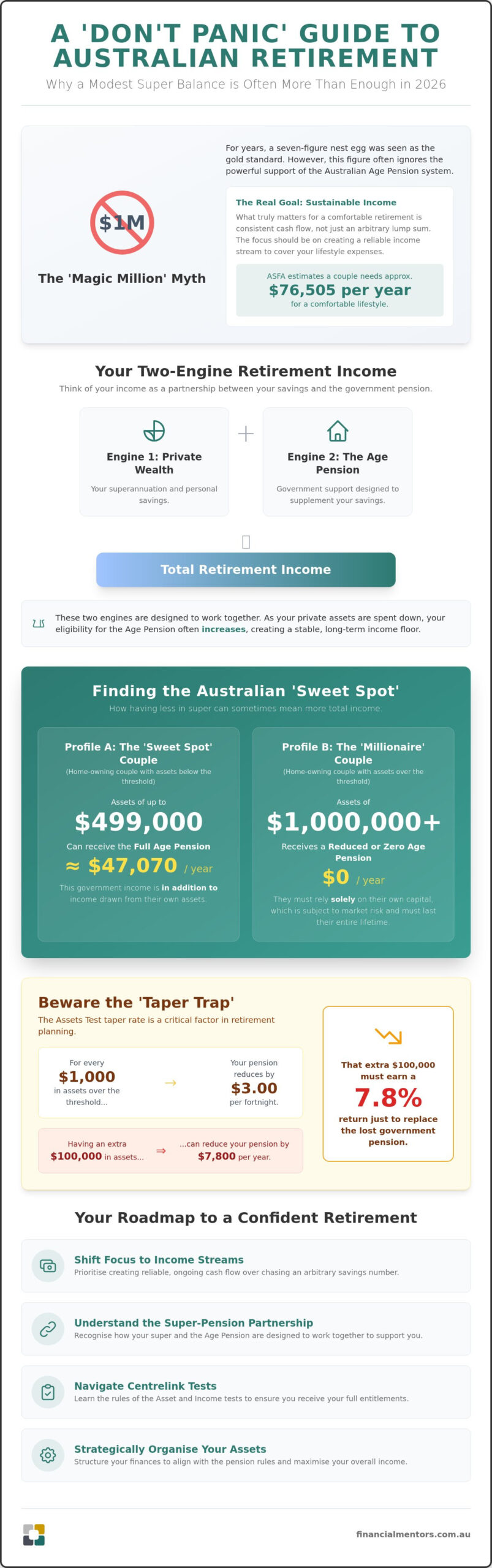
For years, the “magic million” has been held up as the gold standard for a secure future. This figure often feels out of reach for the average worker, but it is frequently irrelevant to your actual needs. Where did this number come from? It was largely a marketing tool that ignored the nuances of the Australian welfare system. The Association of Superannuation Funds of Australia (ASFA) estimates that a couple currently needs approximately $76,505 per year for a comfortable lifestyle. If you focus solely on a seven-figure lump sum, you might miss the fact that consistent income is what actually pays the bills. By prioritising cash flow over an arbitrary balance, you can immediately reduce the anxiety associated with leaving the workforce. You might find that your current savings, when managed wisely, are already enough to meet your personal goals.
Your Two-Engine Income Stream
Think of your retirement income as a twin-engine jet. The first engine is your private wealth, which includes your personal savings and your balance within the Australian superannuation system. The second engine is the Age Pension. Our system was designed for these two components to work in partnership, not for one to replace the other entirely. These two engines balance each other beautifully through a natural “tapering” effect. As your private assets are spent down over time, your eligibility for the Age Pension typically increases.
In 2026, the maximum Age Pension for a couple has reached approximately $47,070 per year. When you consider that a home-owning couple can hold up to $499,000 in assets and still receive the full pension rate, the “don’t panic retirement” philosophy starts to make perfect sense. This dual-income approach provides a built-in safety net that private savings alone cannot match. It ensures that even if market conditions fluctuate, your baseline lifestyle remains protected by a government-backed supplement that is indexed to keep pace with inflation.
The Australian ‘Sweet Spot’: Maximising Super and the Age Pension
Have you ever wondered why some retirees with smaller super balances seem to enjoy a higher total income than those with much larger nest eggs? This counter-intuitive reality is the cornerstone of a don’t panic retirement strategy. In Australia, your total income isn’t just determined by what you have saved. Instead, it’s the result of a delicate dance between your private assets and the Age Pension. Understanding how these two forces interact allows you to find your financial “sweet spot,” where you can enjoy the fruits of your labour without disqualifying yourself from valuable government support.
Centrelink applies two tests to determine your pension eligibility: the Assets Test and the Income Test. Whichever test results in the lower pension amount is the one that is applied. For most Australians, the Assets Test is the primary hurdle. The Australian Taxation Office provides foundational rules for planning for retirement, but the real strategy lies in managing your wealth so you don’t fall into the “taper trap.” If you are feeling unsure about how your specific assets will be assessed, talking to a specialist in retirement planning can help clarify your position and reduce the stress of the unknown.
Understanding the Assets Test Taper Rate
The taper rate is a critical concept for anyone retiring in 2026. For every $1,000 you own above the full pension threshold, your pension reduces by $3 per fortnight. This means that if a home-owning couple has $100,000 more than the $499,000 threshold, their pension drops by $7,800 per year. To break even, that extra $100,000 would need to earn a 7.8% return just to replace the lost pension. Because of this, having $500,000 in super can sometimes provide a more stable lifestyle than having $800,000, as the lower balance qualifies you for a much higher pension payment.
Account-Based Pensions vs. Lump Sums
Moving from the “accumulation” phase to the “pension” phase is a major milestone. By starting an account-based pension, you can receive regular payments while your remaining balance stays invested. In Australia, these income streams are typically tax-free for those over 60, making them an incredibly efficient way to fund your life. This structure helps ensure your super lasts as long as you do, providing a steady flow of cash that complements your Age Pension payments. It’s about creating a predictable rhythm for your finances.
For a home-owning couple in 2026, the asset test ‘sweet spot’ is generally considered to be around $460,000, as this balance allows for significant private drawdowns while maintaining high levels of government support.
Addressing the Risks: What If Things Go Wrong?
It’s one thing to look at a spreadsheet and feel confident, but it’s another thing entirely to face a sudden market dip or a rise in the cost of living. We know that the “what ifs” can keep you awake at night. However, a don’t panic retirement isn’t about ignoring these risks; it’s about having a robust strategy to absorb them. It acknowledges that life isn’t a straight line and provides buffers for when the path gets a little bumpy. By understanding the built-in protections of the Australian system, you can replace fear with a sense of quiet control.
One of the most significant fears for 2026 is inflation. If the price of essentials continues to climb, will your savings hold their value? This is where our unique system shows its strength. The Age Pension is indexed twice a year to ensure it keeps pace with the cost of living. This means that even if your private investments have a quiet year, your government-backed income engine is designed to adjust upward. The Age Pension acts as a natural hedge against market volatility because as your private assets decrease in value during a market downturn, your pension payments typically increase via the assets test to provide a stable income floor.
Managing Market Volatility
One way to protect yourself from sequencing risk, which is the danger of a market drop early in your retirement, is through a “bucket strategy.” This involves keeping two or three years’ worth of living expenses in cash or very conservative investments. If the share market takes a tumble, you don’t have to sell your growth assets at a loss; you simply draw from your cash bucket until the market recovers. A diversified wealth management approach ensures you aren’t over-exposed to any single sector. Regular reviews with a professional advisor help you rebalance these buckets and stay on track as your needs change.
Planning for Aged Care and Longevity
There is a growing movement toward a “Don’t Die Broke” mindset. This isn’t about being reckless; it’s about finding the right balance between enjoying your active years and setting aside enough for the “third act.” Supporting your physical health is just as vital as financial planning for this stage of life, and Livelovelife Chiropractic offers gentle care to help you maintain the vitality needed for an active lifestyle. Many Australians worry about their family home being “taken” by the government for aged care costs. While the home is generally exempt from the Age Pension asset test, it is treated differently for aged care assessments, often with a specific cap on its value. Strategic planning can help you navigate these rules while ensuring your estate planning advice is implemented to protect your legacy from unnecessary tax burdens.
A Practical Roadmap to Organise Your Retirement
If you are ready to move from theory to action, where should you begin? A don’t panic retirement is built on a clear, methodical process that organises your world and provides a sense of order. By taking small, deliberate steps today, you can replace a vague sense of worry with a concrete plan that is easy to follow. This roadmap is designed to help you transition smoothly into your next chapter while ensuring no stone is left unturned.
Your first step is a thorough audit of your current assets. This includes your superannuation, bank balances, and personal items like cars or home contents. It’s helpful to remember that Centrelink values your personal assets at their second-hand resale price, not their replacement cost. Once you have a clear list, you can define your lifestyle costs. Are you aiming for a “modest” lifestyle, or do you have your sights set on a “comfortable” one? Knowing these numbers allows you to evaluate your eligibility for benefits like the Commonwealth Seniors Health Card, which can significantly reduce your medical and utility expenses even if you don’t qualify for the full Age Pension.
The final steps involve structuring your super into an income-producing account-based pension and reviewing your long-term obligations. This is the stage where you ensure your assets are working as hard as possible for you. If you are feeling overwhelmed by the paperwork or the technical rules, seeking professional estate planning advice can help you protect your legacy and ensure your wishes are carried out exactly as you intend.
The Role of Downsizing and Gifting
If you find that your family home is larger than you need, downsizing can be a powerful financial tool. Current rules allow you to contribute up to $300,000 per person into your super from the sale of your primary residence. This is an excellent way to move wealth from a non-income-producing asset into your super engine. You might also consider helping your family through gifting, but you must be mindful of Centrelink’s limits. You can generally gift up to $10,000 in a single financial year, or $30,000 over a rolling five-year period, without affecting your pension eligibility. For those looking to stay close to family, a “Granny Flat” interest can be a strategic way to transfer assets while securing your long-term housing needs.
Simplifying Your Tax and Compliance
Many Australians believe that retirement means the end of tax returns, but this isn’t always the case. While your pension income might be tax-free, you may still be entitled to significant refunds, such as those for franking credits attached to share dividends. Professional tax return preparation can identify these “lost” credits and ensure you are not missing out on extra cash flow. Staying on top of your compliance also means your wealth management strategy remains sharp and responsive to any changes in legislation that may occur as we move through 2026 and beyond.
Why Partnering with a Financial Mentor Changes the Narrative
Reading about the “sweet spot” or the latest pension rules is a wonderful first step toward clarity, but implementing these strategies requires a steady hand. While a one-off book or a helpful article can offer valuable insight, they are static tools in a dynamic world. A don’t panic retirement is not a “set and forget” destination; it is an ongoing journey of stewardship. Life has a way of shifting your priorities, whether through a change in your health, a new addition to the family, or an unexpected turn in the economy. In these moments, the value of a trusted guide becomes clear, moving you from a place of quiet anxiety to one of lasting confidence.
If you have ever felt overwhelmed by the sheer volume of paperwork or the technical language used by Centrelink, you are not alone. Our role is to act as your professional partner, sitting across the table to simplify the complex. We believe that financial planning should feel like a supportive consultation rather than a cold, clinical transaction. By choosing to work with a mentor, you gain access to a bespoke roadmap that is designed to evolve alongside you. This partnership ensures that as the 2026 economic landscape changes, your plan remains resilient and focused on the life outcomes that matter most to you.
Tailored Strategic Advice
Your personal “sweet spot” is as unique as your fingerprint. It isn’t just a number on a balance sheet; it’s a reflection of your health, your family commitments, and your specific goals for the future. If you have unique aspirations, such as regular travel or supporting your grandchildren’s education, then a generic strategy will never be enough. We focus on integrating estate planning advice with your daily income needs, ensuring that your wealth provides for you today while protecting your legacy for tomorrow. This holistic approach means we are constantly monitoring the 2026 landscape for our clients, identifying opportunities to optimise your position before legislation changes catch you by surprise.
Your Next Steps to Peace of Mind
Achieving financial peace of mind starts with a simple conversation. It is often beneficial to start this dialogue well before you reach the Age Pension age of 67, as early preparation allows for more flexibility in how you structure your assets. If you are ready to review your retirement readiness and discover how the “don’t panic” philosophy applies to your specific circumstances, we invite you to reach out for a professional consultation. We can help you organise your affairs, maximise your entitlements, and build a future that feels secure and full of possibility. You don’t have to walk this path alone. Take the first step today and secure your future with Financial Mentors Wealth Management.
Step Into Your Future with Confidence
You have seen how the Australian retirement system is designed to support you, even if your super balance isn’t in the millions. By understanding the “sweet spot” where your private savings and the Age Pension align, you can create a reliable income stream that lasts. This proactive approach is the heart of a don’t panic retirement. It is about replacing uncertainty with a clear, documented roadmap that accounts for inflation and market changes. When you focus on sustainable cash flow rather than just a lump sum, the path ahead becomes much clearer.
Since 2003, we have operated under our own AFSL to provide Australians with steady, human-centric guidance. Our expertise in both wealth management and tax return preparation allows us to see the full picture of your financial life. If you are ready to stop worrying and start living, then we’re here to walk beside you as a trusted guide. You can Book a Retirement Strategy Session with Financial Mentors to begin your journey toward financial peace of mind. Your next chapter deserves to be one of stability, purpose, and joy.
Frequently Asked Questions
Is $500,000 enough to retire on for a couple in Australia?
Yes, $500,000 is often considered a highly effective balance for a home-owning couple. Because this amount sits just above the 2026 threshold for a full Age Pension, it allows you to draw a private income while receiving significant government support. When managed correctly, this combination can fund a lifestyle that sits comfortably between the modest and comfortable standards set by industry bodies, providing a stable financial future.
How much can I have in assets and still get a part Age Pension in 2026?
For a home-owning couple in 2026, you can hold up to $499,000 in assets to receive the full Age Pension. Beyond this point, your payment reduces by $3 per fortnight for every $1,000 in additional assets. Eligibility for a part pension continues until your assets reach the upper cut-off limit. These limits vary based on whether you are single or a couple and whether you own your home.
What is the ‘sweet spot’ for retirement savings in Australia?
The “sweet spot” is the asset range where you maximise your total income by balancing super drawdowns with the Age Pension. For a home-owning couple, this is frequently cited as being around $460,000. At this level, you avoid the heavy pension reductions caused by the taper rate. It is a core pillar of a don’t panic retirement strategy because it prioritises consistent cash flow over a large, static lump sum.
Do I still need to lodge a tax return once I retire?
You may not be legally required to lodge a return if your income falls below certain thresholds, such as the SAPTO limit of $32,279 for singles. However, many retirees choose to continue lodging to claim refunds on franking credits from share dividends. Even if your pension income is tax-free, filing a return can be a practical way to recover money that would otherwise stay with the Australian Taxation Office.
Can I give money to my children without affecting my Age Pension?
You can gift money to your children, but Centrelink imposes strict limits to prevent people from artificially reducing their assets. You are generally allowed to gift up to $10,000 in a single financial year, with a total limit of $30,000 over a rolling five-year period. If you exceed these amounts, the excess is still counted as your asset for five years, which could reduce your pension payments and healthcare entitlements.
What happens to my super if I go into aged care?
If you enter permanent aged care, your superannuation is generally counted as an asset for the means-tested care fee assessment. Unlike the Age Pension rules, there is no distinction between accumulation and pension phase for these calculations. However, your family home may receive a capped valuation or be exempt if a protected person, such as a spouse, continues to live there. This is a vital area for professional review and planning.
How often should I review my retirement plan with a financial advisor?
We typically suggest an annual review to ensure your strategy remains aligned with shifting legislation and market conditions. Major life milestones, such as a change in health or the sale of a property, should also prompt a consultation. Regular check-ins provide the peace of mind that comes from knowing your plan is being stewarded by a professional. It ensures your don’t panic retirement remains on track regardless of external economic pressures.
What is the difference between a modest and a comfortable retirement lifestyle?
A modest lifestyle covers the essentials and basic leisure activities, while a comfortable lifestyle allows for better private health insurance, newer cars, and more frequent travel. ASFA estimates that a couple needs about $54,240 for a modest life and $76,505 for a comfortable one. Defining which path you wish to take is the first step in creating a roadmap that reflects your unique aspirations and personal values for the years ahead.