
If you woke up on 1 July 2026 and found that the new tax brackets had shifted your retirement timeline by five years, would you be ready to adapt? It’s a question many Australians are asking as they face shifting rules and market volatility. You might feel pressure to get everything right, especially when searching for a qualified investment advisor to help you manage the 12% super guarantee or the updated $2.1 million transfer balance cap.
We understand that managing your wealth can feel like a full-time job you never applied for. It’s common to feel confused by the complexity of the 2026 tax changes or worry about outliving your savings. This guide is here to help you find a trusted professional who aligns with your personal aspirations and simplifies your financial journey. We will walk through how to build a clear roadmap for wealth creation, organise your tax affairs, and secure a partnership that gives you genuine peace of mind for your Australian retirement.
Key Takeaways
- Learn why a qualified investment advisor is essential for navigating the 2026 tax changes and global market shifts while protecting your Australian retirement.
- Move beyond the search for quick wins by establishing a disciplined, long-term roadmap for wealth creation through strategic diversification.
- Understand how to measure the value of professional advice by focusing on improved investment discipline and long-term portfolio growth.
- Follow a clear process to verify credentials and ensure your advisor is authorised under an Australian Financial Services Licence (AFSL).
- Explore how a human-centric, mentor-style partnership can help you manage major life transitions with confidence and clarity.
What is an Investment Advisor and Why Do You Need One in 2026?
Have you ever looked at your bank balance and wondered if your hard-earned savings are actually working for you, or if they’re just sitting still? A qualified investment advisor is a professional authorised under an Australian Financial Services Licence (AFSL) to help you answer that very question. They provide tailored strategies that bridge the gap between simply having some money in the bank and owning a structured wealth creation plan that grows over time. If you’ve felt that your financial decisions have been a bit reactive lately, you aren’t alone. Many Australians find that as life gets busier, their financial strategy can become a collection of random choices rather than a cohesive journey.
In 2026, the role of an advisor has evolved far beyond simple share-picking or basic portfolio management. They now act as navigators through a global economy that feels more interconnected and volatile than ever. Choosing an investment advisor means finding a mentor who offers stewardship for your future. This partnership is built on understanding your unique aspirations, whether that’s helping your children with their first home deposit or ensuring your own retirement is comfortable and secure. It’s about moving from a place of uncertainty to a position of quiet confidence.
The Difference Between a Planner and an Investment Advisor
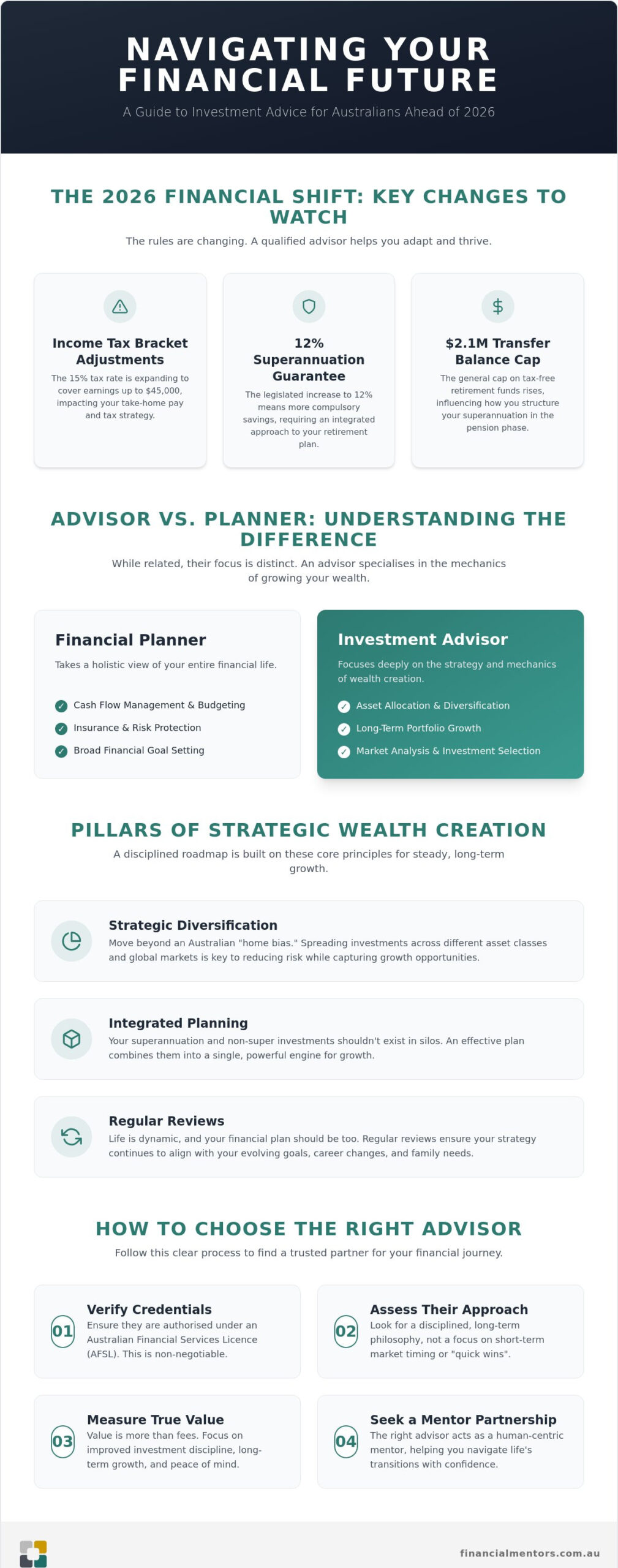
While a financial planner often looks at your entire financial life, including insurance and cash flow, an investment advisor focuses deeply on the mechanics of wealth creation. This specific focus on asset allocation is vital for long-term growth. If you don’t have a professional looking at how your assets are balanced, you might find yourself over-exposed to one area, like the Australian property market, while missing out on international growth. To ensure your real estate investments are as strategic as your share portfolio, consulting with Your Australian Property Buyers Agents can help you secure assets that align with your overall wealth plan. A good advisor also acts as an emotional circuit breaker. When markets dip, it’s natural to feel a bit of panic. Your advisor is there to remind you of the long-term roadmap, helping you avoid impulsive decisions that could set your goals back by years.
Navigating the 2026 Financial Landscape
The financial world we are living in today has been shaped by significant shifts. We’ve seen the Superannuation Guarantee rate rise to 12%, and the general transfer balance cap reach $2.1 million as of 1 July 2026. These aren’t just numbers on a page; they are rules that dictate how much you can save and how you can access it. Professional guidance is essential for interpreting 2026 Federal Budget changes, such as the income tax bracket adjustments where the 15% rate now applies to earnings up to $45,000. Your advisor ensures your Statement of Advice (SoA) reflects these current realities. If the rules of the game change, your strategy needs to be nimble enough to adapt without losing sight of the finish line.
Strategic Wealth Creation: Beyond Simple Portfolio Management
Wealth creation is much more than just picking a few winning shares; it’s about building a disciplined, long-term roadmap that can weather any season. Think of it as a marathon rather than a sprint. While the lure of quick wins can be tempting, true financial stability comes from a steady pace and a clear vision. This is where an investment advisor becomes an invaluable partner. They help you stay focused on the horizon, especially when the daily news cycle feels overwhelming. It’s about having someone in your corner who understands that your goals are as unique as your thumbprint.
One of the most powerful tools in your kit is diversification. In Australia, we often have a “home bias,” leaning heavily into local banks and mining stocks. However, spreading your wings across different asset classes and international markets is often called the “only free lunch” in investing. It reduces your risk while keeping the door open for growth. For those seeking specialised infrastructure to manage these varied assets, TradingPRO offers a range of account tiers designed for different levels of trading experience. To ensure you’re on the right track, it’s worth reviewing how to choose a financial adviser who understands these global nuances and can apply them to your specific needs.
Your strategy shouldn’t exist in a vacuum. A truly effective plan integrates your superannuation with your investments held outside of super. When these two halves work together, you create a more powerful engine for growth. Life doesn’t stand still, and neither should your plan. Regular reviews are the secret to ensuring your roadmap still aligns with your changing life goals, such as a new addition to the family or a career change. If your circumstances have shifted recently, it might be time to see how updated wealth creation strategies can bring your plan back into balance.
Tax-Effective Investment Strategies
It’s a common mistake to separate your investment strategy from your tax return preparation. In reality, they are two sides of the same coin. A wise mentor will help you leverage franking credits and capital gains tax (CGT) concessions to your advantage. If you aren’t looking at your tax obligations holistically, you might be paying more to the ATO than is legally required. By aligning these areas, you keep more of your wealth working for you and less of it being lost to avoidable costs.
Building Your Retirement Nest Egg
As you look toward the future, transition to retirement (TTR) strategies can be a game-changer. These allow you to start accessing your super while you’re still working, often providing tax benefits that help you grow your wealth even faster. An investment advisor plays a crucial role here, ensuring your super fund is performing against benchmarks and matches your specific risk profile. This ensures that when the time comes to finish work, you have a reliable income stream that supports the lifestyle you’ve worked so hard to build.
Understanding the Value: Investment Advisor Fees vs. ROI
It’s only natural to feel a bit of hesitation when you first look at the costs associated with professional financial guidance. If you’ve spent years carefully building your savings, you want to be certain that every dollar is working as hard as possible for you. The most common objection to seeking help is the cost, but the real metric to consider is the value added to your life and your portfolio over the long term. An investment advisor doesn’t just provide a list of shares; they provide the discipline and stewardship required to reach your milestones.
Think of it as the difference between a one-off transaction and a long-term partnership. Professional advice often leads to better investment discipline, which can help you avoid the common trap of reacting emotionally to market swings. By keeping you steady during volatile periods, a mentor can potentially add significant percentage points to your annual returns compared to going it alone. In Australia, fees are typically structured as clear flat fees for specific projects or percentage-based fees for ongoing management. No matter the structure, these should always be transparent and easy to understand from the very first meeting.
Avoiding the “DIY tax” is another major benefit of working with a professional. This “tax” is the hidden cost of expensive mistakes, such as failing to rebalance your portfolio, missing out on tax-effective structures, or holding onto underperforming assets for too long. When you have a mentor sitting across the table from you, you gain the peace of mind that comes from knowing your affairs are being handled with a high level of care and expertise. You can find more detail on what to expect regarding costs in Moneysmart’s guide to choosing a financial adviser, which is an excellent resource for understanding the regulatory protections in place for Australian consumers.
The Cost of Inaction
What happens to your wealth if you decide to do nothing and leave it in a low-interest savings account for the next decade? While it might feel “safe,” inflation can slowly erode the purchasing power of your money. Missing out on years of compound growth can be incredibly costly, sometimes delaying a planned retirement by five or ten years. Many people tell themselves they are “waiting for the right time” to invest, but in reality, this is often the most expensive strategy of all. Time in the market is almost always more powerful than trying to time the market.
Transparency and the Statement of Advice
When an investment advisor provides you with a Statement of Advice (SoA), it serves as a clear roadmap for your future. This document must legally disclose all fees, commissions, and any potential conflicts of interest. Under the “best interests duty,” Australian advisors are required to prioritise your outcomes above their own. This ensures that the strategy proposed isn’t just a generic plan, but a personalised path designed to provide a clear and measurable return on your investment in advice. It’s about building a foundation of trust that allows you to move forward with confidence.
How to Choose the Right Financial Advisor in Australia
Finding the right fit for your financial journey is about much more than just comparing numbers on a spreadsheet. It’s about finding a mentor you can trust with your family’s future. While technical skill is vital, the best partnership is one where you feel heard and understood. When you sit down with a potential investment advisor, pay attention to how they listen. Do they ask about your bank balance first, or do they ask about the life you want to lead? A true partner focuses on your aspirations, such as helping your children with their first home or ensuring you can travel comfortably in retirement.
Before your first meeting, it’s helpful to prepare a list of your life goals rather than just your financial statements. Think about what keeps you up at night and what you hope to achieve in the next five, ten, and twenty years. You should also look for a professional who speaks your language. If an advisor relies heavily on technical jargon that leaves you feeling more confused than when you walked in, they may not be the right guide for you. Your advisor should make complex concepts feel accessible and clear, giving you the confidence to make informed decisions about your wealth.
The AFSL and Professional Standards
In Australia, the regulatory environment is designed to protect you. You should only ever work with an advisor who is an authorised representative of an Australian Financial Services Licence (AFSL) holder. As of 1 January 2026, all existing advisors must have met strict new education and qualification standards to continue providing personal advice. This ensures that the person sitting across from you has the contemporary knowledge required to manage your wealth. You can easily verify an advisor’s history, qualifications, and any disciplinary actions by checking the ASIC Financial Advisers Register. It’s a simple step that provides a vital layer of security for your investments.
Questions to Ask During Your First Meeting
Your initial consultation is just as much an interview for the advisor as it is for you. Don’t be afraid to ask direct questions to gauge their approach and transparency. You might start by asking: “How do you approach wealth creation for someone in my specific life stage?” or “Can you explain your fee structure in plain English?” It’s also important to know how the relationship will function over time, so ask how often you will meet to review your progress and adjust the strategy. If you have complex needs, ensure they can coordinate services such as estate planning advice and tax return preparation to keep your affairs organised and efficient.
The Mentor Approach: Financial Mentors Wealth Management
Choosing an investment advisor is a deeply personal decision because you aren’t just selecting a service; you’re choosing a partner for life’s most significant transitions. At Financial Mentors Wealth Management, we offer a warm, human-centric alternative to the clinical atmosphere of big-bank advice. We believe that financial guidance should feel like a professional consultation over a cup of coffee, not a transaction in a cold corporate office. Led by Murray Frean, our team provides the steady, methodical guidance of a wise mentor who is deeply invested in your long-term well-being and peace of mind.
We understand that a truly holistic financial picture requires more than just an investment strategy. It’s why we integrate tax return preparation with your wealth creation plan. If your tax affairs aren’t aligned with your investments, you might miss vital opportunities to preserve your hard-earned wealth. By looking at your entire situation together, we ensure that every part of your financial life is working in harmony toward your life goals. This empathetic stewardship helps reduce the stress of complex decision-making, allowing you to move forward with quiet confidence.
Retirement and Estate Planning with a Human Touch
One of the most significant milestones you’ll face is the move from a steady salary to a retirement income stream. We help you bridge this income gap with confidence, ensuring you don’t have to worry about outliving your savings in an ever-changing market. Our approach to estate planning advice is also grounded in empathy and practical wisdom. It’s about more than just the distribution of assets; it’s about securing your legacy and ensuring your family is protected. We work closely with you to ensure your wishes are honoured and that your wealth is passed on in a way that reflects your personal values.
Your Long-Term Wealth Partnership
We don’t believe in one-size-fits-all solutions. Your life journey is unique, and we believe your financial roadmap should be too. There is an incredible sense of stability that comes from knowing a trusted professional is watching over your future, allowing you to focus on enjoying the life you’ve built. Whether you’re starting a family, growing your assets, or preparing to enter retirement, we’re here to walk beside you through all of life’s ups and downs. If you’re ready to start your journey, let’s have a conversation about your future today.
Securing Your Financial Future with Confidence
Your journey toward financial freedom doesn’t have to be a solo effort. As we’ve explored, navigating the 2026 tax landscape and the updated superannuation caps requires a steady hand and a clear roadmap. By finding an investment advisor who acts as a mentor, you can bridge the gap between simple savings and a robust, integrated wealth strategy. Whether you’re focused on retirement planning or securing your legacy, having your tax and wealth management working in harmony is the key to long-term stability.
Since 2003, we’ve operated under our own AFSL, offering specialised expertise in retirement and estate planning alongside our integrated tax and wealth management services. We believe that your financial future deserves more than just a generic plan; it deserves the care and attention of a partner who understands your life’s unique milestones. Secure your future with a mentor who cares; book your consultation with Financial Mentors Wealth Management today. You’ve worked hard for your wealth, and with the right guidance, you can enjoy the peace of mind that comes from being truly prepared for whatever the future holds.
Frequently Asked Questions
What is the difference between an investment advisor and a stockbroker?
A stockbroker primarily focuses on the buying and selling of specific shares and securities, often on a transactional basis. In contrast, an investment advisor looks at your whole life, creating a strategic roadmap that aligns your investments with your long-term aspirations. While a broker might tell you what to buy today, an advisor acts as a mentor, helping you understand how your portfolio supports your retirement and family goals.
How much does a financial advisor cost in Australia in 2026?
Fees for financial advice are typically structured as either a flat fee for a specific project, such as a Statement of Advice, or a percentage of the assets being managed. Some professionals also charge hourly rates for specific consultations. It’s important to remember that all costs must be clearly disclosed in your Statement of Advice. This transparency ensures you understand exactly what you’re paying for before any work begins on your wealth creation strategy.
Can an investment advisor help with my tax return preparation?
Yes, an investment advisor can certainly assist with your tax return preparation, especially when they take a holistic approach to your wealth. Integrating tax services with investment advice ensures that your portfolio remains tax-effective, helping you keep more of your earnings. By looking at your investments and tax obligations together, your advisor can identify opportunities like franking credits or capital gains concessions that a standalone tax preparer might miss.
Is it worth getting a financial advisor for a small amount of money?
Seeking advice is often more about the time you have in the market rather than the amount you start with. Even with a modest sum, an investment advisor can help you establish disciplined habits and a clear roadmap for growth. Starting early allows you to benefit from the power of compound interest, which can turn a small initial investment into a significant nest egg over several decades of steady progress.
What is a Statement of Advice (SoA) and why is it important?
A Statement of Advice (SoA) is a legally required document that outlines the specific recommendations your advisor has made for your financial situation. It serves as your personal roadmap, detailing why certain strategies were chosen and how they help you reach your goals. Crucially, it must also disclose all fees and any potential conflicts of interest, ensuring that the advice you receive is always provided in your best interests.
How do I know if my financial advisor is authorised and trustworthy?
You can verify if a professional is authorised by checking the ASIC Financial Advisers Register. This public record shows their qualifications, employment history, and whether they are an authorised representative of an Australian Financial Services Licence (AFSL) holder. Trust is built through this transparency and by choosing an advisor who has met the strict educational and ethical standards required by Australian law as of 1 January 2026.
Can an investment advisor help me with my superannuation and retirement planning?
Retirement and superannuation planning are core parts of an advisor’s role. They help you navigate complex rules, such as the $2.1 million transfer balance cap or the 12% super guarantee rate. By aligning your super fund with your risk profile and retirement goals, an advisor ensures you have a reliable income stream once you finish working, providing the peace of mind that you won’t outlive your savings.
What should I bring to my first meeting with a financial advisor?
For your first meeting, it’s helpful to bring a clear list of your life goals, such as when you’d like to retire or if you want to support your children’s education. You should also gather current financial information, including your latest superannuation statements, bank balances, and recent tax returns. Having these details ready allows your advisor to get a clear picture of your starting point and begin crafting a personalised roadmap for your future.