

The key difference in the managed funds versus ETFs Australia pros and cons comparison is how you buy and sell. ETFs trade on a stock exchange throughout the trading day, while units in an unlisted managed fund are generally bought or sold at the next calculated daily price. Neither option is automatically lower risk. Risk depends on the investments held and how they fit your goals and comfort with market fluctuations.
It makes sense to weigh risk alongside fees, access and convenience. Both options can give you exposure to a range of investments, but the buying and selling process differs, particularly for units in an unlisted managed fund.
This guide explains how managed funds and ETFs work, how to buy managed fund units, and what to consider when comparing their fees, risks and access in Australia. It also explains why the investments inside a fund matter as much as its structure when deciding what may suit your plans.
Key Takeaways
- Compare what each fund invests in, its fees and withdrawal rules before deciding which structure fits your plans.
- Understand how access differs: ETFs trade on an exchange, while managed fund units are bought or sold at a calculated daily price.
- Look beyond the fund type when weighing risk; the underlying investments and their fit with your goals matter.
- Consider whether you value trading flexibility, a particular investment approach or a straightforward way to access a market.
What are managed funds and ETFs?
Australian managed funds and ETFs pool investors’ money to buy assets such as shares and bonds. Both can spread your exposure across investments and provide professional management through a single holding. An ETF often tracks an index, while a managed fund may use an active or passive strategy or focus on a specialist investment niche. The structure affects how units are bought and sold, not whether their value will rise.
Your risk depends on a fund’s underlying assets and how they fit your goals and comfort with market fluctuations. A fund holding shares can fall when share markets decline; one holding bonds faces different investment risks. Diversification can spread exposure across assets, but it can’t remove market risk. Before investing, consider what the fund holds, its fees, long-term returns and withdrawal rules.
ETF prices change during the trading day, so the price you pay can move with the market. A limit order lets you set an order price, but it can’t prevent losses in the underlying investments. For example, an ETF tracking a share index remains exposed to movements in those shares. Match the fund’s assets and strategy to your timeframe and tolerance for market fluctuations.
For Australian tax purposes, distributions and capital gains can affect your taxable income, while your personal tax outcome depends on your circumstances. Reinvesting a distribution changes how you receive it, but doesn’t mean the distribution wasn’t made.
The Australian managed funds and ETFs described here are structured as unit trusts and regulated under the Corporations Act. ASIC regulates both. This framework doesn’t remove investment risk or protect you from market losses.
Funds may distribute investment income, including income from underlying shares, and may offer a reinvestment plan that uses distributions to acquire additional units. Where Australian companies pay franked dividends, a fund’s distribution statement may show franking credits. How these affect your tax position depends on your circumstances. Review the fund’s distribution information to understand what you receive and how it is handled.
Buying units in managed funds
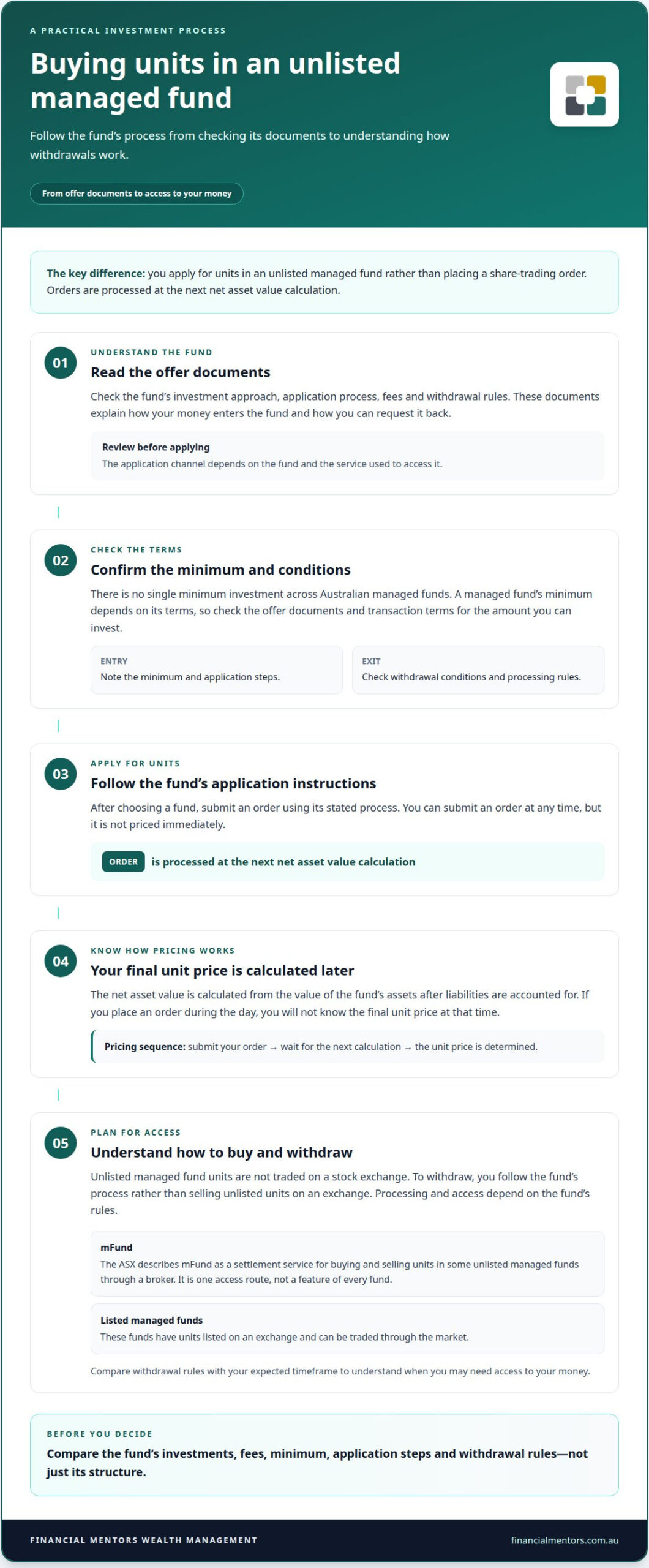
To invest in an unlisted managed fund, you apply for units rather than place a share-trading order. The fund’s offer documents explain its investment approach, application process, fees and withdrawal rules. Read them before applying so you understand how your money enters the fund and how you can request it back. The application channel depends on the fund and the service used to access it.
There’s no single minimum investment that applies across Australian managed funds and ETFs. A managed fund’s minimum depends on its terms, while an ETF purchase depends on its unit price and the broker’s order process. Check the relevant offer documents and transaction terms to see how much you can invest.
After choosing a managed fund, follow its application instructions and submit an order. You can submit an order at any time, but it is processed at the next net asset value calculation. This means you won’t know the final unit price when placing an order during the day. The price is calculated from the value of the fund’s assets after liabilities are accounted for.
Units in unlisted managed funds aren’t traded on a stock exchange. The ASX describes mFund as a settlement service that lets investors buy and sell units in some unlisted managed funds through a broker. It is one access route, not a feature of every fund. The ASX also describes listed managed funds, whose units are listed on an exchange and can be traded through the market.
Before investing, note the fund’s minimum, application steps and withdrawal conditions. These terms affect both how you enter the fund and how you can access your money later. To withdraw, you follow the fund’s process rather than sell unlisted units on an exchange. Processing and access depend on the fund’s rules. Compare those rules with your expected timeframe to assess whether the option suits when you may need the money.
Choosing between ETFs and managed funds
Choose by matching the fund structure to your goals, preferred access and comfort with market movements. The same market exposure can come with different strategies, trading processes and fee arrangements.
Pros and cons for Australian investors
For Australian investors, the pros and cons involve practical trade-offs between fund choice, management style and access. The structure should suit your goals and how you prefer to manage investments. An ETF can provide exchange trading and index exposure in one holding. A managed fund may offer a specialist investment niche or active approach. Compare the underlying assets, fees and withdrawal rules rather than choosing by label alone. A fund’s approach matters as much as its structure.
Liquidity, pricing and trading
Liquidity describes how readily you can buy or sell an investment at a price that reflects its value. ETFs trade on an exchange and are priced throughout the trading day. Unlisted managed funds generally follow a daily valuation process, so orders may not be processed immediately. This difference matters if you want to respond to market movements during the day. Exchange trading gives you timing choices, while fund orders follow the daily valuation process.
Active, passive and index performance
Active management involves selecting investments, while passive management follows a set investment approach. An index ETF aims to track a particular index, so its performance reflects that index and the fund’s costs. A passive managed fund may also follow an index or another set strategy. Active funds can focus on specific investment niches. To compare performance fairly, look at funds with similar assets, timeframes, strategies and fees. The label alone can’t tell you which fund better fits your goals.
What are the pros and cons of managed funds versus ETFs for Australian investors?
The pros and cons of managed funds versus ETFs in Australia depend on how a fund invests, what it costs and how you access it. Weigh those features against your goals rather than assuming one structure is automatically better.
An ETF can provide exposure to a market or index through one purchase, with exchange trading during the day. Many ETFs regularly publish their investment holdings, making it easier to see what the fund owns. However, the exchange price can move during trading, and trading flexibility doesn’t reduce the risk of the assets themselves. Review the fund’s investments and fees before deciding.
A managed fund may suit you if you’re seeking a particular investment niche or active management. Fund managers choose investments within the fund’s stated approach, which can differ from an index-tracking strategy. The trade-off is that unlisted units follow the fund’s application, pricing and withdrawal arrangements. Some managed funds may also provide less transparency about underlying investments than ETFs. Read the fund information to understand its strategy and access terms.
Neither label tells you whether an investment is suitable. A share-focused ETF and a managed fund holding bonds have different exposures, even though both pool investors’ money. Compare like with like: check the assets, investment approach, fees, long-term returns and withdrawal rules. If two funds follow different strategies, their performance may reflect those differences rather than the structure alone.
Use your priorities to guide the comparison. If you value exchange trading and regular holdings information, an ETF may align with that preference. If a managed fund’s niche or management approach better matches your plan, consider its access terms and investment mix. Your choice between managed funds and ETFs in Australia should also fit your wider financial position. To discuss how your investments fit your plan, speak with a financial adviser.
Performance depends on the assets and investment approach, not simply on whether a fund is a managed fund or an ETF. Active management can differ from index tracking, so compare long-term returns between funds with similar investments and strategies.
Financial Mentors Wealth Management
Financial Mentors Wealth Management can help you assess how investment choices fit your goals, financial position and comfort with market fluctuations. If you’re weighing a managed fund against an ETF, financial planning can help you consider the investment structure alongside your broader plans, rather than as a standalone decision.
Wealth Creation Strategies can support decisions about building wealth over time, while Retirement Planning can help connect investment choices with your retirement plans. The relevant considerations may differ depending on your timeframe, income needs and other financial commitments. A discussion can help you clarify what matters most before deciding how to proceed.
Contact Financial Mentors Wealth Management to discuss your investment choices and financial goals.
Take your next investment step with confidence
Your investment choice can support more than a portfolio. It can form part of a plan for the life you want, whether you’re building wealth or preparing for retirement. Use the managed funds versus ETFs pros and cons in Australia to frame your decision, then consider how it fits your wider financial priorities—such as coordinating investment cash flow with property or commercial lending through VIR Advisory.
Financial Mentors Wealth Management can help you connect investment decisions with your goals through Financial Planning, Retirement Planning and Wealth Creation Strategies. If you’d value guidance on how those priorities fit together, take the next step and contact Financial Mentors Wealth Management.
A considered decision starts with your circumstances and the future you’re working towards. Move forward with greater clarity, one practical step at a time.
Frequently Asked Questions
What about risk?
Risk comes from the assets a fund holds, not just its label. A fund concentrated in a narrow market can be more exposed to that market’s movements than one spread across different assets. Consider whether a potential fall in value would affect your plans, especially if you may need to withdraw during a downturn. Diversification can spread exposure, but it can’t remove investment risk.
What is the difference between managed funds and ETFs in Australia?
In Australia, ETFs trade on an exchange, while units in unlisted managed funds are bought or redeemed through the fund’s process. For example, an ETF investor can place an exchange order during trading hours; an unlisted fund investor receives the next calculated unit price. The investment strategy matters too: both structures may offer active or passive approaches, so compare holdings and objectives.
What are the typical fees for Australian managed funds and ETFs, including management fees and brokerage?
Compare the fund’s management and operating costs, plus any transaction or platform charges. ETF investors may also pay brokerage when buying or selling through a broker. Check the product disclosure information and transaction schedule, then compare total costs for your expected holding period and trading frequency.
How can Australians buy managed funds or ETFs through a broker, platform or directly from a fund manager?
The ASX describes its mFund settlement service as allowing investors to buy and sell units in some unlisted managed funds through a broker. ETFs are bought and sold on a stock exchange through a broker. Platforms may provide access to investment options under their own processes. Before applying, read the fund’s offer information and understand the available transaction and withdrawal arrangements.
How are managed funds and ETFs taxed in Australia, including distributions and capital gains?
Distributions and capital gains can affect your taxable income, and your personal tax outcome depends on your circumstances. A fund’s distribution statement may show franking credits where distributions include franked dividends.