

Dividends contributed 51% of the ASX 300’s total return over the 20 years to November 2022. A dividend investing strategy for income involves owning shares in companies that distribute some of their profits to shareholders, while recognising that dividend payments can change.
If you’re considering dividends as a way to earn income from Australian shares, look beyond the size of the payment. A high yield alone does not show whether a company can sustain its dividends or grow them over time.
This article explains how dividend investing works, which types of companies pay dividends and how to assess yield, payout ratios and dividend history. You’ll also see how dividends have contributed to ASX 300 returns, so you can consider their role alongside the broader performance of shares. With these basics in hand, you can make more informed decisions about whether dividend income fits your financial goals.
Key Takeaways
- Understand how dividend payments can contribute to investment income, and why a company’s ability to sustain them matters.
- Learn which company qualities and financial signals can help you assess dividend stability and potential growth.
- Look beyond headline yield by considering payout ratios, share prices and a company’s dividend history together.
- See how dividends form part of ASX 300 returns and consider their place in your broader investment plan.
What is dividend investing?
Dividend investing involves holding shares in companies that distribute profits to shareholders. A dividend investing strategy for income can also aim for dividend growth and capital appreciation, rather than relying on payments alone.
Dividend income and capital growth
Dividend income provides cash payments, while capital growth comes from a rise in share value. A strategy can account for both: you might reinvest dividends to buy more shares or use the payments as income. A company may increase its dividend even as its share price moves independently. Assess the business’s prospects and your income needs, not just its current distribution.
Dividend growth, consistency and cuts
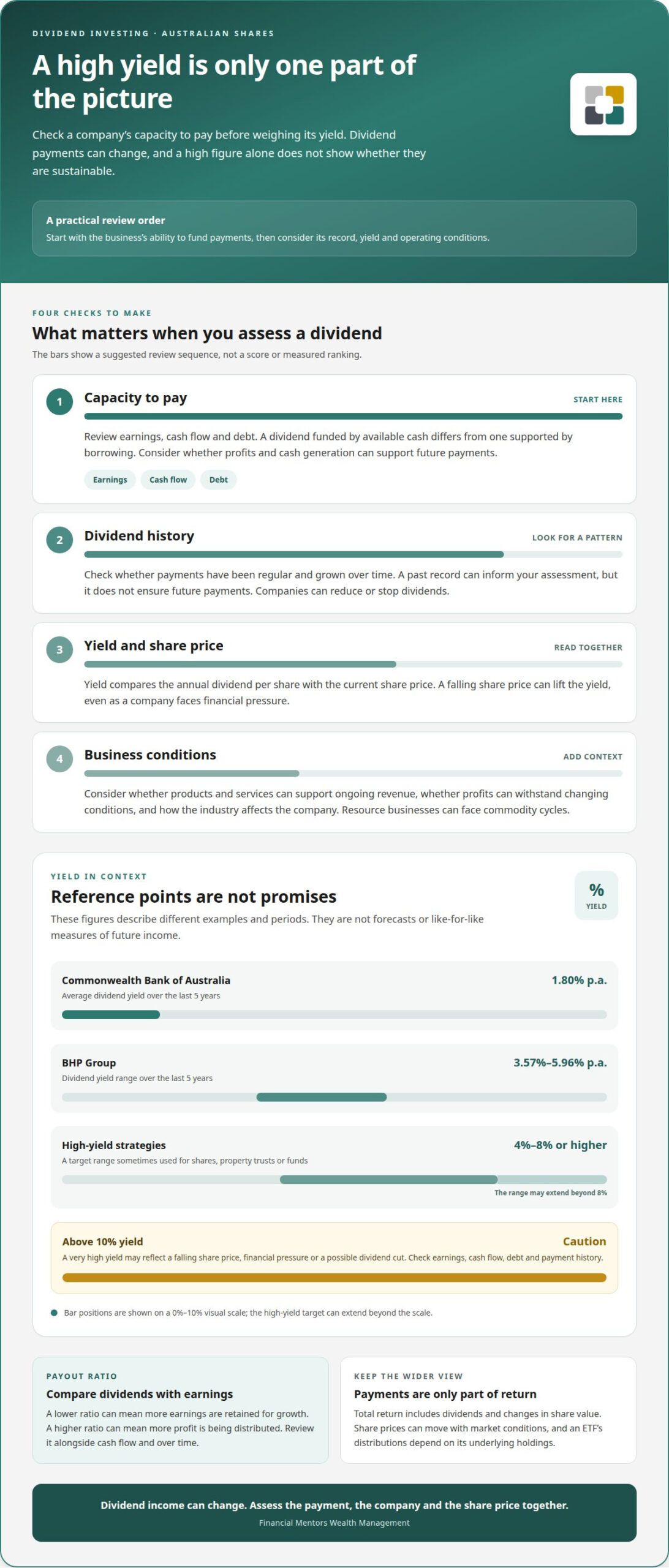
Review a company’s dividend history to see whether payments have been regular and grown over time. Past consistency can inform your assessment, but it does not ensure future payments. Companies are not required to distribute dividends and can reduce or stop them. A cut may reflect weaker profits or cash flow, so consider the business’s financial health alongside its record.
Payout ratios and cash flow
A payout ratio compares dividends with company earnings. A lower ratio can mean more earnings are retained for growth, while a higher one may indicate that more profit is being distributed. Assess the ratio alongside cash flow: a dividend funded by available cash differs from one supported by borrowing. Compare the ratio and cash generation over time, then consider whether business performance can support dividend growth.
Income planning and portfolio choices
To estimate the capital needed for a monthly income target, annualise the target and divide it by the expected dividend yield. The result varies with the yield, and payments can change. In Australia, a franked dividend has had tax paid on the profits, and that tax is taken into account when determining the shareholder’s tax bill. Diversify across sectors and assets to avoid relying on one income source. A dividend reinvestment plan (DRP) uses dividends to acquire more shares, which may suit investors building their holdings rather than drawing cash income.
Which types of companies pay dividends?
Dividend-paying companies operate across many industries, but established businesses with recurring earnings often attract income-focused investors. Australian examples include Commonwealth Bank of Australia, BHP Group and Telstra, which have had different dividend patterns. Banks, miners and telecommunications companies face distinct business conditions, so a familiar name alone cannot show whether its payments are sustainable.
Assess the company behind the dividend. Consider whether its products or services support ongoing revenue, whether profits can withstand changing conditions, and how debt affects its ability to distribute earnings. Resource companies such as BHP Group can face commodity cycles, while other businesses face different pressures. A seemingly stable dividend yield can change if profits weaken or the share price falls.
Dividend Aristocrats offer a dividend-growth reference point: the term describes companies with at least 25 consecutive years of dividend increases. It signals a long record, not a promise of future payments or a label that automatically applies to Australian shares. For each ASX company, look at its own history, business outlook and capacity to keep paying shareholders.
Your strategy affects the analysis involved. A yield-focused screen ranks shares by dividend yield, but a high figure needs context: a falling share price can lift the yield while the company comes under pressure. A dividend-growth approach looks for a record of regular payments and potential increases, then assesses whether business performance can support them. Some companies retain profits to fund expansion, reduce debt or reinvest in operations instead of paying dividends. That may suit a growing business, but it will not provide immediate dividend income.
Build your portfolio around the income role each holding serves, rather than chasing one headline yield. Comparing company fundamentals and dividend patterns across industries can help you understand the trade-offs. For a broader view of how investment choices fit your circumstances, consider your overall financial picture.
Dividend yield, payout ratios and dividend history
Yield is a useful starting point, not a complete measure of value. Assess the dividend, the company’s finances and share-price movements together.
High yields and the risk of cuts
High-yield strategies often target shares, property trusts or funds yielding 4% to 8% or higher. A yield above 10% calls for particular caution: it may reflect a falling share price, financial pressure or a possible dividend cut. Look at the company’s earnings, cash flow, debt and payment history before treating a high yield as dependable income.
No ASX share or ETF has a sustainable yield simply because its current figure is high. Commonwealth Bank of Australia’s dividends returned an average of 1.80% per year over the last 5 years, while BHP Group dividends fluctuated between 3.57% and 5.96% per year over the last 5 years. These figures describe different histories, not future outcomes. An ETF’s distributions also depend on its underlying holdings.
Dividend shares differ from bonds, term deposits and high-interest savings accounts. Shares may provide dividends and capital gains, but their prices can move with market conditions. Bonds pay interest and often return capital at maturity, although their prices can fluctuate. Term deposits and savings accounts generate interest under their account terms, rather than company distributions.
Yield calculations and total returns
Calculate dividend yield by dividing the annual dividend per share by the current share price, then expressing the result as a percentage. Total return includes dividend payments and changes in share value. Reinvested dividends can affect returns over time, so compare the same periods and account for share-price volatility.
Charting tools can show annual payments, yield and share-price movements together. Compare a company’s yield with its own history, then review payout ratios, earnings and cash flow for signs of pressure. A payout ratio supported by earnings and available cash provides more context than yield alone. This helps you assess income potential and market exposure without relying on a single chart signal.
Dividends’ contribution to ASX 300 total returns
Dividends have been a substantial part of Australian sharemarket returns. Over the 20 years to November 2022, dividends contributed 51% of the ASX 300’s total return. This shows why you may miss an important part of the index’s performance if you focus only on share-price movements. Total return considers both dividends and changes in share value.
The figure describes a past period, not a forecast for the ASX 300 or an individual portfolio. Company earnings, cash flow and market conditions change, affecting dividend payments and share prices. Dividends may support returns when prices move unevenly, but they don’t remove volatility or ensure a stable outcome. A company’s yield can also change as its share price and payments shift.
For context, companies in the All Ordinaries index have averaged a dividend yield of just over 4% over about 40 years. That figure relates to a different index and measures yield, not the ASX 300’s contribution to total returns. Keeping those measures separate helps you interpret what each number indicates. Yield compares annual dividends with share price; total return includes price changes as well.
To apply the ASX 300 finding, look at your investment’s full return rather than treating income as the whole result. Consider whether dividends were paid, whether they were reinvested or taken as cash, and how the share price changed over the same period. Then review the businesses’ earnings and cash flow to understand what may support distributions. These steps can help place income and capital growth in context, without assuming one past result will repeat.
If you’re considering how dividends fit your wider financial goals, discuss your investment plan as part of that decision.
Financial Mentors Wealth Management
Financial Mentors Wealth Management can help you place dividend investing within your wider financial plan. If you’re weighing current income against capital growth, financial planning can connect investment decisions with your goals and financial position. Wealth creation strategies can help you consider how shares fit alongside other priorities, while retirement planning can support decisions about income as you approach or enter retirement.
This guidance can be useful as you build an investment approach, respond to changing work or family circumstances, or plan how to draw on your assets. Consider how much income you need, what level of investment risk suits your circumstances, and how dividends fit your long-term goals. Contact Financial Mentors Wealth Management to discuss your financial planning and next steps.
Shape an investment approach around your future
Start by deciding what dividend income needs to do in your wider financial life. Is it meant to support retirement, provide cash flow now, or complement other long-term goals? A dividend investing strategy for income works best when it reflects your circumstances, time horizon and comfort with investment risk.
Financial Mentors Wealth Management can help connect these priorities through financial planning, retirement planning and wealth creation strategies. Considering them together can give you a clearer framework for making investment decisions and reviewing them as life changes. The focus is on aligning choices with the future you want, rather than pursuing yield in isolation.
If you’re ready to consider how your investment approach fits your plans, contact Financial Mentors Wealth Management to start a conversation. A thoughtful next step can help you move forward with greater clarity and purpose.
Frequently Asked Questions
What is dividend yield?
Dividend yield is a percentage measure that helps compare the income indicated by different shares at their current prices. Treat it as a snapshot, not a complete measure of investment performance. When reviewing a quote, note whether it uses past dividends or an indicated future payment, and compare figures calculated on the same basis.
Which Strategy Is Best?
The right approach is the one that supports your purpose for investing. If you need to draw income, consider how distributions fit your spending needs. If you’re investing to build wealth for the future, consider whether reinvestment suits your time horizon. You can combine these aims, but decide which matters most before selecting investments so each choice has a clear role.
How does dividend investing generate income?
Investors receive income when a company distributes a dividend to shareholders who qualify for that payment. The amount credited depends on the shares held and the dividend declared per share. For practical budgeting, record distributions when they arrive instead of treating an estimated yield as a fixed monthly amount. This distinguishes income received from income projected.
How to build a dividend portfolio for regular income in Australia?
Start by setting an income objective and identifying how you’ll use each distribution. Record your holdings, announced payment dates and cash received, then review the portfolio as company circumstances change. Decide in advance what you’ll do with any surplus payments. A written process helps keep investment choices connected to your financial goals.
What are the ASX ex-dividend and payment date rules?
The ex-dividend date marks when a share purchase no longer qualifies for the upcoming dividend. The payment date is when eligible shareholders receive it. Companies announce dates for each distribution, so refer to the relevant company announcement when planning a purchase or estimating cash receipts. Keep these dates with your investment records to track expected and received payments.
What are the risks of high-yield dividend investing?
A portfolio that relies heavily on a small group of companies can be exposed to changes affecting those businesses or industries. Before relying on a holding for planned spending, consider how your budget would respond if its contribution changed. Review the range of income sources across your portfolio, and do not make an investment decision based on yield alone.