

You can leave an adult child out of your Will, but they may apply for family provision if they believe they haven’t been adequately provided for. Estate planning for blended families in Australia needs to account for that possibility while also considering your wishes for a surviving partner and children from previous relationships.
It’s understandable to want your partner to feel secure while protecting the inheritance you intend for your children. This guide explains how life interests and trusts may help balance those priorities, why superannuation nominations need separate attention, and who may be able to challenge an estate.
Family circumstances, asset ownership and state or territory rules all matter when shaping a plan. Understanding these issues can help you consider which arrangements best reflect your intentions.
Key Takeaways
- Consider how a life interest or trust could support your partner while directing assets to your children later.
- Review superannuation nominations separately from your Will, as super may be distributed outside your estate.
- Check how property is owned, because joint tenancy can affect who receives it when an owner dies.
- Understand that making Wills together does not, by itself, create a binding mutual wills agreement.
- Revisit your plans after family changes and consider how your state or territory’s rules may affect potential claims.
How can I support my surviving partner but ensure that my children ultimately receive my assets?
You can structure your estate to support your spouse or partner while directing particular assets to children from an earlier relationship. The right balance depends on your assets, ownership arrangements, family relationships and each person’s needs.
Balancing provision for partners and children
Balanced provision means supporting a surviving partner while setting out what children from previous relationships are intended to receive. This matters because a partner who inherits assets may use or dispose of them, leaving children without the inheritance you intended. A promise to pass assets to stepchildren later may not secure that outcome unless it is formalised and binding.
One option is to give your partner a life interest or right of residence in a home. This may allow them to live there during their lifetime, with the asset passing to nominated beneficiaries later. Another option is to give an asset directly to a child, so they receive it before the surviving spouse dies. Either approach can affect the resources available to support your partner, so consider their housing and financial needs alongside your children’s inheritance.
Trusts for surviving partners and later beneficiaries
A trust can let a surviving spouse use assets during their lifetime before those assets pass to specified beneficiaries. This may suit a second marriage if you want to provide for your spouse while preserving particular assets for children from a previous relationship. The trust terms determine how assets are managed and who may benefit, so they need to reflect your family circumstances.
A testamentary trust can give you greater control over how and when beneficiaries receive an inheritance. It may also offer asset protection and taxation advantages, but it can be complex and requires ongoing management. Discretionary family trust assets are dealt with under the trust deed and don’t form part of the deceased person’s estate. Review the deed as well as your Will when planning for children and a surviving partner.
For example, a plan leaving A$100,000 to a child and the rest to a second spouse may use two individual Wills rather than Mirror Wills. This example shows why matching documents to each person’s intentions matters. A surviving spouse’s later wishes to benefit stepchildren may not secure their inheritance without a binding arrangement.
Can my step children be beneficiaries of my Superannuation after my death?
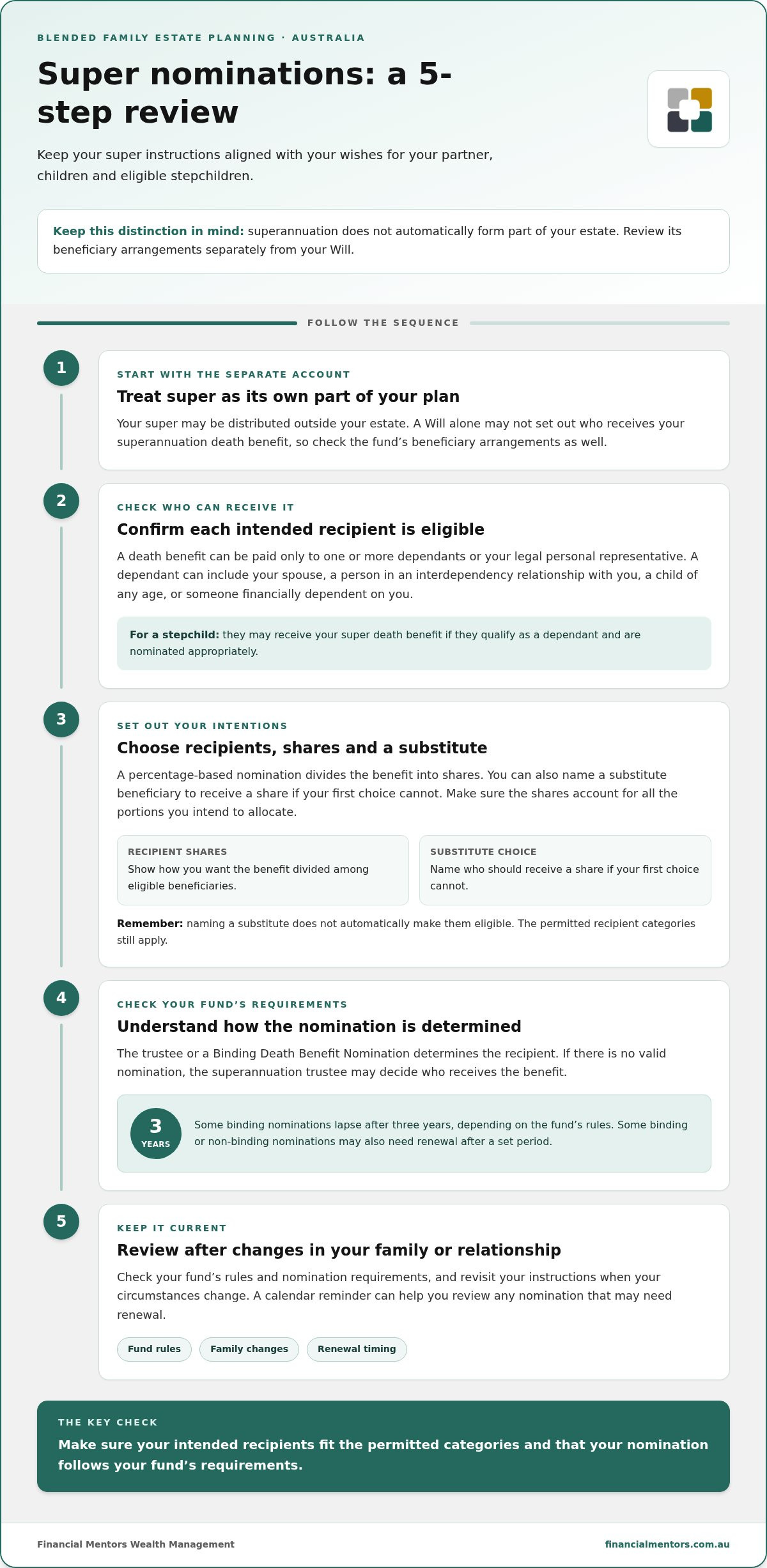
Yes, a stepchild may receive your superannuation death benefit if they qualify as a dependant and are nominated appropriately. In Australia, superannuation doesn’t automatically form part of your estate, so review its beneficiary arrangements separately from your Will.
Superannuation and insurance beneficiary nominations
A superannuation nomination records who you intend to receive your death benefit, while life insurance can support a spouse or provide a separate pool of funds for children. This distinction matters because the superannuation trustee may decide who receives the benefit if there’s no valid nomination. A valid nomination can direct benefits to a spouse or dependent child, including a stepchild who meets the dependant criteria.
Superannuation death benefits can be paid only to one or more of your dependants or your legal personal representative. A dependant can include your spouse, someone in an interdependency relationship with you, a child of any age, or someone financially dependent on you. The trustee or a Binding Death Benefit Nomination determines the recipient. Review your fund’s rules and nomination requirements, then make sure your chosen beneficiaries fit the permitted categories.
Some binding nominations lapse after three years, depending on the fund’s rules. Some binding or non-binding nominations may also need renewal after a set period, such as every 3 years. Put a review reminder in your calendar and revisit the nomination after a relationship or family change. That helps keep your instructions aligned with your current intentions.
Percentage gifts and substitute beneficiaries
A percentage-based nomination divides a benefit into shares, while a substitute beneficiary identifies who should receive a share if your first choice can’t. This can help you show how you want the benefit divided among eligible beneficiaries. For example, you might intend to provide for your spouse and a dependent stepchild, then name another eligible dependant as a substitute.
Use clear proportions that account for all intended shares, and consider what should happen if a beneficiary dies before you. A substitute doesn’t automatically become eligible just because you name them. Death benefits remain limited to dependants or your legal personal representative. Fund rules also shape how a nomination works. Review the wording and your fund’s requirements together, particularly if your family circumstances have changed.
Consider life insurance alongside superannuation. It may provide immediate financial support to your spouse or create a separate source of funds for children from an earlier relationship. If you’re weighing these choices, estate planning advice can help you consider how beneficiary intentions fit your wider financial plan.
Can a former partner or a step-child contest my Will?
Stepchildren don’t inherit under Australian intestacy laws if you die without a Will. They may still be eligible to bring a family provision claim in some circumstances, while joint ownership can also affect which assets your Will controls.
With joint tenancy, your share of a home passes automatically to the surviving owner when you die, rather than under your Will. For example, if you and your spouse own a home as joint tenants, your children from a previous relationship can’t receive your share through a Will. This can affect the balance between supporting your spouse and providing for your children.
Tenants in common own agreed shares of a property, and each owner can direct their own share through a Will. If you own half a home as a tenant in common, you can leave that share to your children, while the surviving co-owner keeps their share. Review the property title and ownership arrangement, as the title determines whether survivorship applies.
Other jointly held assets may also pass outside your estate. Bank accounts and shares held jointly are generally owned as joint tenants by default, so they may transfer automatically to the surviving owner. Superannuation and trust assets may also sit outside the estate. Identify each asset and how it is owned before deciding what your Will can distribute.
A former spouse or de facto partner may be able to make a family provision claim, particularly if they depended financially on you at death. In New South Wales, section 57 of the Succession Act 2006 sets out who may be an eligible person, including a former spouse. Divorce automatically revokes a gift to a former spouse in a Will, but separation alone doesn’t have that effect.
A stepchild’s eligibility to challenge a Will depends on the applicable state or territory law and their circumstances. In Victoria, Part IV of the Administration and Probate Act allows certain people to bring a family provision claim. A court may consider the length and nature of the relationship, financial dependence, whether the stepchild lived in your household, competing beneficiaries’ needs and the estate’s size.
Before finalising your plan, list your property, accounts and superannuation, then note how each is owned. For a family home, confirm whether the title records joint tenants or tenants in common. If you’re separated but not divorced, review your Will and ownership arrangements, as an ex-spouse may still receive a share under applicable intestacy laws.
Mutual wills agreements
A mutual Will agreement is a binding arrangement between two people to follow an agreed estate distribution. In a blended family, it may help preserve an agreed plan for a surviving partner and children from previous relationships.
A mutual Will agreement differs from reciprocal Wills, where two people make similar or matching Wills without a separate agreement. Simply preparing Wills together doesn’t create a Mutual Wills Agreement. For example, partners might each leave assets to the survivor first, then specify that remaining assets pass to their respective children. Without a binding agreement, matching documents alone don’t secure that shared intention.
A mutual arrangement can restrict the surviving partner’s ability to change the agreed distribution later. That may matter if you want children from an earlier relationship to inherit after your spouse dies. Consider the practical situation the agreement is intended to address, including who receives assets, when they pass, and how the surviving partner is supported. Clear terms distinguish a binding commitment from a shared preference.
A simple Will sets out a person’s wishes, but it doesn’t, by itself, bind another person to keep matching wishes. A Mutual Wills Agreement adds a commitment between the people making the Wills. If you and your spouse intend to protect the same beneficiaries, state that intention explicitly rather than assuming two similar documents create mutual obligations.
A Binding Financial Agreement and a Mutual Wills Agreement serve different purposes. The former concerns financial arrangements between partners, while a Mutual Wills Agreement addresses agreed estate distributions. One doesn’t automatically replace the other. If your plan includes both, consider how each document relates to your Wills, assets and intended beneficiaries.
Also identify assets that may pass outside your estate. A jointly owned home held as joint tenants passes automatically to the surviving owner, rather than under the Will. A Mutual Wills Agreement can’t prevent legitimate third-party claims, including family law claims or estate challenges. It therefore can’t guarantee that every asset reaches the intended beneficiary.
Before relying on mutual Wills, write down the agreed distribution and the people it is intended to protect. Include your current spouse, children from earlier relationships, and any trustee who may manage assets for beneficiaries. Consider how changes in relationships or family circumstances could affect the arrangement. Reviewing it periodically helps keep your estate plan aligned with your intentions.
Estate planning risks in blended and step families
Estate planning for blended families in Australia needs to reflect each person’s interests, not just the structure of the household. Your plan can also clarify who should make decisions and how your intentions are recorded.
State and territory differences
Rules for estate claims and intestacy differ across Australian states and territories. This matters if your family has connections to more than one jurisdiction or relatives assume the same rules apply everywhere. Seeking guidance from an Australian estate law firm such as Aquarius Lawyers ensures your arrangements account for the rules relevant to your specific circumstances, rather than relying on a general template.
Record where you live and which family members may have an interest in your estate. For example, note whether a child is your biological, adopted or stepchild, and whether anyone relies on you financially. These details help identify relationships and circumstances that may need careful consideration in your plan.
Documents for blended families
A Will, powers of attorney and guardianship appointments each address a different part of your planning. Your Will records how you want your estate dealt with, while powers of attorney set out who may act for you in relevant decision-making situations. A guardianship appointment records your preferred person to care for a dependent child.
Review your documents to check that names and roles are still current. For example, if your nominated decision-maker is now your former partner, consider whether another trusted person better reflects your wishes. Keep a record of where each document is stored and tell the people named in it how to find it. This practical step can help avoid confusion during a difficult family transition.
Joint property and beneficiary nomination risks
Ownership records and beneficiary nominations can create gaps between your intended plan and the arrangements attached to particular assets. An old nomination, for example, may still name someone whose role in your life has changed. A property record may also fail to reflect the share you believe you own.
Make an asset list and record the owner, intended recipient and relevant nomination for each item. Then compare those records with your current wishes. Note why you chose a particular distribution, especially where children, a surviving partner and other family members have different needs. This can help you spot inconsistencies before a major life change makes them harder to address.
The cost of estate planning depends on the work involved and is provided after a quote request. Factors include your family structure, the documents needed and the arrangements already in place.
To discuss how estate planning advice can fit your wider financial position, contact Financial Mentors Wealth Management.
Financial Mentors Wealth Management: Financial Planning
Financial Mentors Wealth Management can help you connect estate planning considerations with your broader financial position. Its financial planning and estate planning advice can help you consider how your assets, beneficiary intentions and family needs fit together. If retirement is approaching, retirement planning can also bring your future income needs into the discussion.
This may be a useful next step if you’ve remarried, welcomed a stepchild into your family, or need to review arrangements after a separation. The initial meeting is step 01 of the process, giving you a place to discuss your priorities and circumstances. Financial Mentors Wealth Management also offers Wealth Creation Strategies as part of its planning services.
If you’d like to discuss your family’s financial planning needs, contact Financial Mentors Wealth Management or visit financialmentors.com.au.
Give your intentions a clear next step
Your family’s needs can change as relationships, responsibilities and priorities shift. Take time to consider what fairness means to you and what you hope your arrangements will make possible for the people you care about. A written note of your priorities can help you prepare for a thoughtful conversation.
Estate planning for blended families in Australia is personal, not a matter of finding one arrangement that suits every household. Connect your intentions with your wider financial position, then revisit them as life changes. You don’t need to resolve every question at once. A calm, informed discussion can help you identify what needs attention first.
If you’re ready to talk through your priorities and consider a path forward, contact Financial Mentors Wealth Management. Take the next step at a pace that feels right for you and your family.
Frequently Asked Questions
Am I required to leave assets to adult children who have become estranged?
You can decide what gifts to include in your Will, but leaving an adult child out may not prevent a claim. An adult child may apply for family provision if they consider your provision inadequate. Before deciding, consider their financial dependence, your relationship history and the needs of other beneficiaries. A clear record of your reasoning can explain how you reached your decision and weighed competing interests.
What is a Testamentary Trust?
A testamentary trust is created under a Will and begins operating after the Will-maker’s death. The Will sets out the trust’s beneficiaries and gives a trustee responsibility for managing its assets. Its terms can guide how and when beneficiaries receive funds. Before choosing one, consider who could act as trustee, how decisions should be made, and whether ongoing administration suits your family.
What is a blended family when making a Will?
A blended family includes a couple with two or more children, including a child who is the natural or adopted child of both partners and a stepchild of either partner. When preparing a Will, map out each relationship rather than relying on household labels. List biological, adopted and stepchildren, former partners and anyone financially dependent on you. This helps identify intended beneficiaries and people whose circumstances may need consideration.
Can I Leave My Share Of The Family Home To My Children Without Displacing My Surviving Partner?
Yes, your plan can provide for your children while allowing your partner to continue using the home. The key is to understand what ownership interest you can direct and how your partner’s housing needs will be met. Consider who will pay ongoing household expenses, maintain the property and decide when it may be sold. Addressing these practical details can make your intentions clearer for everyone affected.
Dividing the assets – who stands to lose?
No single distribution suits every family. The outcome depends on your assets, relationships and each person’s needs. A surviving spouse may need stable housing, while a child may rely on expected support or inheritance. Compare each person’s circumstances with the assets available and consider whether timing matters as much as the amount. A written overview of your priorities can help you judge whether the proposed division feels balanced.
How do I stop my ex-spouse from challenging my new Will?
You can’t guarantee that a former spouse won’t bring a claim, but reviewing your arrangements after separation or divorce can reduce confusion. Check that your Will reflects your current intentions and that beneficiary details are consistent across relevant documents. If you’re separated but not divorced, don’t assume the same rules apply as after divorce. The legal effect of relationship changes can depend on your circumstances and state or territory.
Is my estate at risk of a Family Provision Claim?
An eligible person may be able to make a claim if they believe your estate hasn’t adequately provided for them. Pay particular attention to people who depend on you financially, children who are still dependent, and a partner whose circumstances may change after your death. The estate’s size and competing beneficiaries’ needs also matter. Reviewing who may reasonably expect provision can help you identify where your plan may be challenged.
How does Australian inheritance law affect blended families and stepchildren?
Without a Will, intestacy rules determine how estate assets are distributed, and stepchildren don’t automatically inherit from a stepparent. In some circumstances, a stepchild may be able to bring a family provision claim, but that is different from automatically receiving an inheritance. State and territory rules vary. If you intend a stepchild to benefit, name them clearly and distinguish them from biological or adopted children when recording your wishes.