

How can you prepare for retirement when much of your wealth and future income is tied to your business? That’s the central question in retirement planning for business owners australia. Your business may contribute to your future, but a sale or succession can be uncertain, while personal super and investments may have taken a back seat to business growth.
Balancing reinvestment, cash flow and personal goals takes care. You don’t have to choose between supporting your business today and preparing for life beyond it. A considered plan can help you understand how business value could fit alongside personal retirement resources.
This article covers practical steps for different stages of business ownership, from reviewing super and investments to considering succession and a future sale. You’ll learn how to connect business and personal decisions, and when retirement planning advice may help you move forward with greater confidence.
Key Takeaways
- Shape retirement planning for business owners australia around your personal goals, not just the future value of your business.
- Consider how super, savings and personal investments could complement income from your business.
- Compare succession, sale and closure by looking at timing, your ongoing involvement and the uncertainty of each path.
- Build a practical plan by defining your goals, mapping your finances, exploring scenarios and setting review points.
- Tailored retirement planning advice can help connect your business circumstances with your personal financial position.
Retirement planning for business owners in Australia starts beyond the business
Your business and personal finances may be closely connected. Business income can support your household, personal savings can help manage quieter periods, and reinvestment decisions can affect what you set aside for later. But retirement is personal. You decide what lifestyle you want, when you’d like to step back and whether you plan to keep working.
Retirement planning brings these decisions together. Consider your future income and personal resources alongside the timing of a sale, succession or gradual change in your work. Superannuation may also form part of your plans. For an overview of the Australian system, see Superannuation in Australia.
Business value and personal retirement income are related, but they are not interchangeable. A business valuation is not the same as money available for day-to-day expenses. The amount you can access may depend on whether an exit proceeds, its timing and any related costs or obligations. Even a business that appears valuable does not tell you exactly how much personal income you could rely on, or when it may be available.
Why business owners need a retirement plan beyond an exit
When income varies and profits are regularly reinvested, personal saving can become less consistent. It can then be harder to track how your own resources are growing separately from the business. A future sale or succession may form part of your plans, but relying on it as your only source of retirement funding makes your future dependent on an event that could change in timing or outcome.
Picture an ordinary week in the retirement you want. How much do you want to work, if at all? What would you like your time and income to support? Your answers can turn “exit the business” into a more specific goal, such as gradually reducing your hours or leaving work altogether.
Start with your goals and financial position
Write down your personal goals separately from immediate business priorities. Then sketch your financial position, including assets, liabilities, income and ongoing financial commitments. The figures do not need to be exact at first. A clear list can show what you know and what still needs attention.
Note uncertainties such as the timing of a succession, the value you might receive or the income you may need. Mark these as unknowns rather than treating rough estimates as settled facts. This gives you a useful starting point for retirement planning for business owners australia-wide and helps separate your personal long-term goals from the business decisions competing for attention today.
- List personal savings, super and other assets.
- Record loans, liabilities and regular financial commitments.
- Separate household income from business income where possible.
- Note assumptions about a future exit that still need to be explored.
This first snapshot does not need to solve everything. It helps you see where business and personal finances overlap, identify the questions that matter most and build a plan around your priorities rather than relying on business value alone.
Build retirement income alongside your business with super and personal assets
Your business does not have to be the only resource supporting your retirement. Superannuation, personal savings and investments may each contribute to future income. The right balance depends on your goals, cash flow and circumstances. Assessing these resources alongside business value gives you a broader view of what may be available, rather than making a possible exit the whole plan.
Consider super as part of the whole plan
Business income can rise and fall, which may make it harder to maintain regular personal contributions. Consider what amount, if any, you could plan to contribute during stronger and quieter periods while allowing for business needs and household expenses. A routine that suits your circumstances may be more practical than making occasional decisions only when cash flow allows.
Super is one part of your plans, not a complete retirement strategy by itself. Some business owners consider self-managed super, a fund they manage themselves. It comes with responsibilities, so whether it suits you depends on your circumstances, capacity and goals. Contribution rules and other super requirements can change. Check current information from the Australian Taxation Office before acting, especially if a decision depends on a cap, eligibility rule or tax treatment.
Balance business reinvestment with personal retirement resources
Reinvestment can support your business plans, but it also affects how much cash flow remains for personal priorities. Compare the funding your business needs with your long-term goals. If you expect to reduce your hours over time, for example, consider how that could affect business cash flow and the amount you can set aside personally.
A financial plan can bring household and business cash flow into the same view. Map income, regular expenses, planned contributions and investment resources, then consider how different choices could affect your progress. Personal investments and savings can complement super and business value, but no single asset type suits everyone. Focus on your time frame, access needs and comfort with financial risks.
- Review your current super and personal savings.
- Identify whether contributions are regular, occasional or paused.
- Set a personal savings amount that accounts for variable business income.
- Revisit the balance between reinvestment and retirement resources as circumstances change.
For retirement planning for business owners australia, assess super and personal assets alongside business value so your plans reflect more than a potential sale. Financial Mentors Wealth Management provides tailored retirement planning advice to help you consider your personal goals and business circumstances together.
Can your business fund retirement? Compare exit paths with personal resources
A future business sale may contribute to your retirement, but it is not automatically a complete plan. Timing, the amount available and your personal income needs all matter. Until an exit occurs, projected proceeds are uncertain. Consider them alongside super and other personal resources rather than treating a sale as guaranteed funding.
There is no single exit path that suits every owner. Succession, sale and closure can each affect when you leave, how involved you remain and what you need to plan for personally. Use these questions to explore what each option could mean for you.
| Possible path | Timing and owner involvement | Questions to consider |
|---|---|---|
| Succession | Another person takes over. The transition may involve a period of continued involvement. | Who might take over, and how long would you want to support the transition? |
| Sale | The business is sold, with timing and outcome shaped by individual circumstances. | What would you do if a sale took longer than expected or proceeds differed from your assumptions? |
| Closure | The business stops operating. You may need to plan for the change in income and any remaining commitments. | How would you fund personal expenses, and what obligations would need to be addressed? |
What might succession, sale or closure mean for your plans?
These options are not a ranking. Compare how each might fit your preferred retirement timing and the resources you can draw on beyond the business. If your plans depend on leaving work by a particular time, consider what personal income sources could support you if the transition takes longer. For business owners looking to optimise organisational readiness ahead of an exit or handover, working with Edgeview Management Consulting can help clarify strategic and operational priorities.
Plan for uncertainty without assuming a particular sale value
Instead of building your plan around one estimated sale figure, sketch a few scenarios: an exit on your preferred timeline, a later transition, and a situation where proceeds are lower than hoped. You do not need to assign a made-up value to each outcome. Focus on what might change in your personal budget, work plans and use of super or other savings.
Ask what you would adjust if an exit were delayed. Would you continue working, change planned spending or revisit when you begin drawing on personal resources? Recording these decision points can make uncertainty easier to manage. Retirement planning for business owners australia-wide is more grounded when business proceeds are one possible resource among several, rather than the foundation for every retirement assumption.
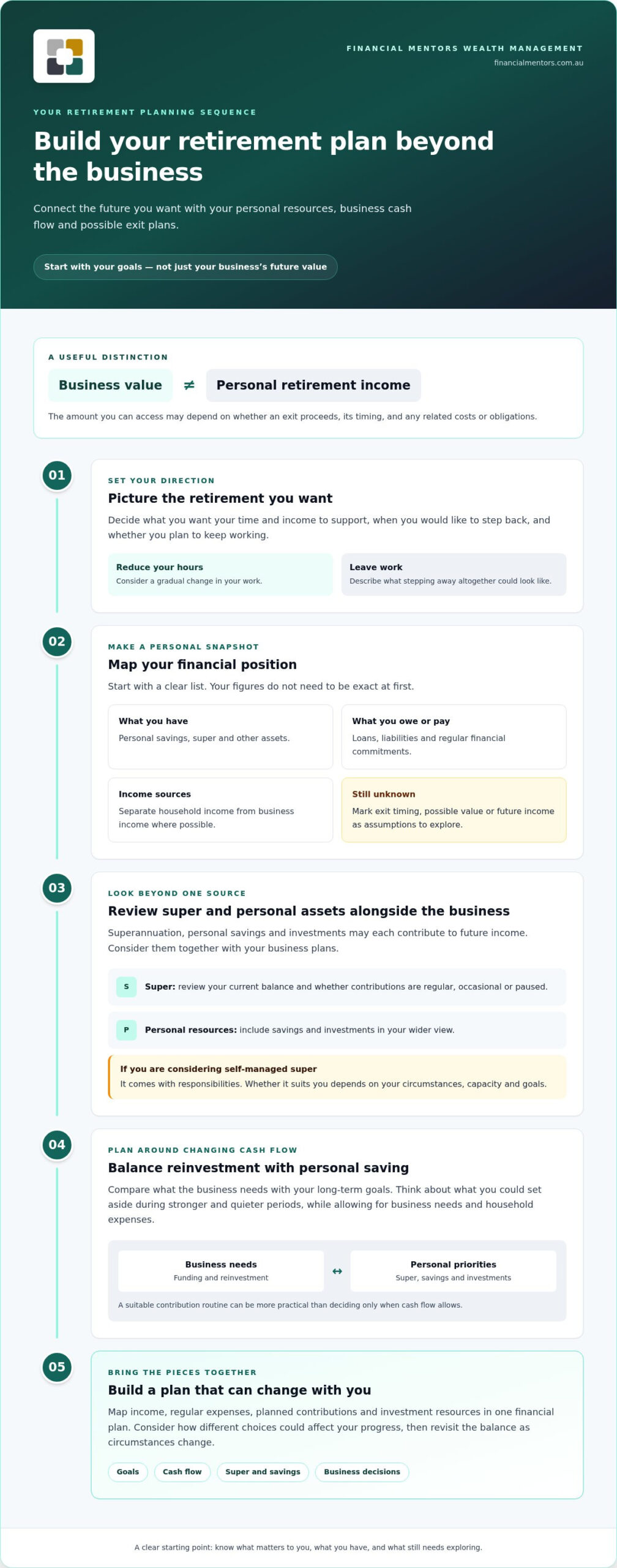
A practical retirement planning sequence for Australian business owners
A clear process can turn a broad retirement goal into manageable decisions. You do not need every answer before you begin. Start with what you know, note what needs more thought, then revisit your choices as your business and personal circumstances change.
Use this sequence as a practical starting point for retirement planning for business owners australia-wide. Keep your questions and next actions together as you work through each step.
- Define your direction. Think about when you would like to reduce your hours or leave the business, without assuming you need to choose a fixed retirement age. Picture what you want your days to look like and whether you would prefer a gradual transition, occasional work or a complete change in routine. Your answers give direction to the financial decisions that follow.
- Map your starting point. Bring together your current super, savings, other assets, liabilities, income and financial commitments. Include relevant business information, but keep personal resources visible in their own right. If some figures are uncertain, record that rather than treating an estimate as final. This snapshot can show what you have to work with and what needs attention.
- Identify the gaps. Compare your preferred lifestyle and timing with the resources you have mapped. You may find that your savings plan needs attention or that an intended exit date depends on assumptions you have not tested. Treat any gap as a prompt for further planning, not a reason to abandon your goals.
- Consider different scenarios. Explore how your plans might change if you reduce work gradually, stay involved longer or leave the business sooner than expected. Consider the effect on income, spending and personal resources. You do not need to predict exactly what will happen. The aim is to understand which decisions may need to change in different circumstances.
- Choose actions and review points. Set practical next steps that fit current cash flow and support your long-term goals. You might organise missing financial information, revisit planned contributions or set a date to review your assumptions. Keep actions realistic, then adjust them if your priorities or circumstances shift.
Keep your plan connected to changing circumstances
A business change, a shift in family needs or a change to your preferred retirement timing may affect your plan. A periodic review helps keep your retirement plan aligned with changing goals. Check what has changed, what remains on track and which next step deserves attention. You can also use a retirement planning discussion to connect your personal goals with your business circumstances. The initial meeting is step 01 of the process, giving you a place to begin exploring advice suited to your situation.
Bring business and personal goals together with retirement planning advice
Retirement decisions can affect several parts of your financial life at once. You may be weighing when to step back, how much income you will need and what role your business could play. Tailored retirement planning advice can connect these questions with your personal financial position, so decisions reflect your circumstances rather than business value alone.
A financial plan can bring your goals, assets, income and financial commitments into one view. It can help you consider how business decisions fit with personal priorities, such as supporting your family, maintaining your preferred lifestyle or changing your work routine. Recommendations should reflect what matters to you and the resources available.
What a tailored financial plan can bring together
Retirement planning, financial planning and tax return preparation each offer a different perspective. Tax return preparation can sit alongside broader planning by helping you organise relevant financial information, without promising a particular tax outcome. If a business decision has tax implications, current rules and your circumstances matter. Avoid relying on a general assumption when making a personal decision.
Estate planning advice is another related consideration. As your business and personal assets change, you may want to think about how you wish those assets to be managed and passed on. This can sit alongside retirement planning, particularly if you are considering succession or a future exit. An estate planning advice guide can help you consider how future asset arrangements relate to your plans.
Bringing these topics together can help you see how decisions connect. A change to your work arrangements, for example, may affect your income, savings plans and the timing of business decisions. Looking at these links can help you identify what needs attention now and what can be reviewed later.
Take a clear first step with Financial Mentors Wealth Management
Financial Mentors Wealth Management has provided professional planning advice since 2000. Advice is tailored to your circumstances and goals, recognising that each business owner has different priorities and a different path towards retirement.
An initial meeting gives you a place to discuss what you want your future to look like and which questions you would like to address. You do not need every detail settled before you begin. Bringing your current concerns and goals can help focus the conversation.
If you are ready to consider how business and personal decisions fit together, start a conversation about a plan suited to your situation. A considered discussion can help clarify possible next steps while keeping your goals and circumstances at the centre of your decisions.
With retirement planning for business owners australia, tailored advice can help you connect your business circumstances with personal goals, super and other resources. The aim is to help you understand your options and approach the next stage with greater confidence, not to promise a particular result.
Give your next decision a clear starting point
You do not need to settle every detail of your future before taking a useful next step. Choose one question that would make your plans clearer. It might be what you want your work life to look like in the years ahead, or which personal financial decision you would like to understand better. Starting with one priority can make a complex transition more manageable.
A thoughtful approach to retirement planning for business owners australia can keep future choices connected to the life you want, while leaving room for your circumstances to change. As your priorities become clearer, you can build on them at a pace that feels right for you.
Ready to talk through your goals and consider a personal plan? Contact Financial Mentors Wealth Management to take a step towards a retirement plan that reflects your goals. Your next chapter can start with a considered conversation and one practical decision at a time.
Frequently Asked Questions
Can I retire if my business does not have a succession plan?
Yes. You can plan for retirement without a documented succession plan. Start by separating the date you hope to reduce work from any assumptions about who will take over. Then consider what income and personal resources could support you if the business transition is not settled by that point. This gives you a retirement planning checkpoint while you decide what arrangements, if any, to pursue for the business.
How does Centrelink assess a business owner’s Centrelink entitlements?
Your eligibility depends on current rules and your individual circumstances, so a general answer cannot determine how a business may affect your Centrelink entitlements. Check current information with Services Australia for guidance relevant to you. Before making an enquiry or application, it may help to have a clear record of your business interests, your role and relevant personal financial details, so you can explain your circumstances accurately.
What happens to my super if I sell my business?
A business sale does not automatically change the balance or ownership of your super. If you are considering putting some sale proceeds into super, the available options may depend on your circumstances and current contribution rules. Before moving money, confirm the rules that apply at the time and consider how the decision fits with your broader finances. Keep records of the sale and related transactions for financial planning and tax return preparation.
Can I keep working in my business after stepping back from day-to-day management?
Yes, you may be able to remain involved after handing over daily tasks. For example, you might attend regular planning meetings or advise on specific projects while someone else manages routine operations. Seeking guidance from business advisers such as Venta Belgarum can assist in structuring company operations to support greater personal freedom during this transition. Be clear about which decisions remain yours, how much time you want to commit and whether you will receive income for the work. Defining these boundaries can help make the change in responsibilities more manageable.
Is a self-managed super fund necessary for business owners?
No. Owning a business does not mean you need to choose self-managed super. As you weigh up your options, consider whether the level of involvement and responsibility fits your experience, available time and retirement priorities. Compare how the arrangement supports your broader financial position rather than choosing it solely because you run a business. The right approach depends on your individual circumstances and goals.
How are business sale proceeds treated for tax in Australia?
The tax treatment depends on the details of the sale and your circumstances. Capital gains tax may apply, and some small business concessions may be available if you meet the relevant conditions. Do not assume a concession applies based only on the size or sale price of your business. Consider tax implications early enough to include them in your planning, and check current Australian Taxation Office guidance or seek advice for your situation.
Should I get financial advice before deciding when to exit my business?
Consider seeking advice before committing to an exit date or making decisions that are difficult to change. A discussion can help you test whether your preferred timing fits your personal cash flow needs and other plans. Prepare by writing down your preferred timeframe, questions about ongoing income and any decisions already under consideration. This gives the conversation a clear focus without requiring you to have every answer first.