
In 2023, responsible investments accounted for 41% of professionally managed assets in Australia, according to the Responsible Investment Association Australasia’s 2024 Benchmark Report. But building an ethical investing portfolio australia-wide isn’t simply a matter of choosing a fund with a values-led label. You need to understand what it excludes, what it supports and how it fits your goals.
Ethical labels can mean different things from one fund to another. Screening criteria, investment choices and diversification can all vary, so look beyond the name. Start by defining the issues that matter most to you, then assess each option against those priorities and your comfort with financial risks.
This guide explains how to turn your values into practical investment criteria, compare portfolio approaches and build a diversified strategy that reflects your timeframe and long-term goals. You’ll also learn what to look for in a fund’s published information, so you can make informed decisions as part of your broader financial plan.
Key Takeaways
- Rank the values that matter to you, then separate firm exclusions from preferences.
- Look past ethical labels and examine screening criteria, holdings and reporting.
- Ethical criteria don’t guarantee higher or lower returns. Consider fees, diversification, investment choices and your timeframe.
- Build your portfolio around your goals, financial position and comfort with financial risks.
- Review your holdings and ethical criteria as your plans or financial position change.
What is an ethical investing portfolio in Australia?
An ethical investing portfolio is a group of investments selected using stated ethical or sustainability criteria. Those criteria might exclude certain activities, favour businesses that meet particular standards, or guide how environmental, social and governance factors are considered in investment analysis.
An ethical investing portfolio is an investment approach guided by stated values-based criteria, not a promise of financial performance or measurable impact. Outcomes depend on the investments and how they perform. A values-led label alone won’t tell you what a fund holds or how closely its choices match your priorities.
Terms such as “ethical”, “responsible” and “sustainable” can be used differently across investment options. Compare the written criteria with current holdings and available reporting. A fund’s Product Disclosure Statement (PDS) can explain its screening rules and any limits on exposure to activities it screens. The Socially responsible investing (SRI) overview also describes approaches such as screening and ESG considerations.
What can ethical investing mean to you?
Your priorities are personal. You might focus on climate and renewable energy, workers’ rights, animal welfare or responsible governance. You may also want to avoid industries such as tobacco or weapons. These are examples to help you reflect, not a universal definition of ethical investing. One investor may exclude an industry, while another may favour businesses contributing to a particular social or environmental goal.
Before comparing options, write down the issues that matter to you. Rank them and mark which are firm boundaries and which are preferences. This gives you a consistent way to assess funds, especially when their labels use similar language but their criteria differ.
How do ethical screens and ESG factors differ?
Investment approaches may use one method or combine several. Understanding the difference helps you check what a fund’s claims mean in practice:
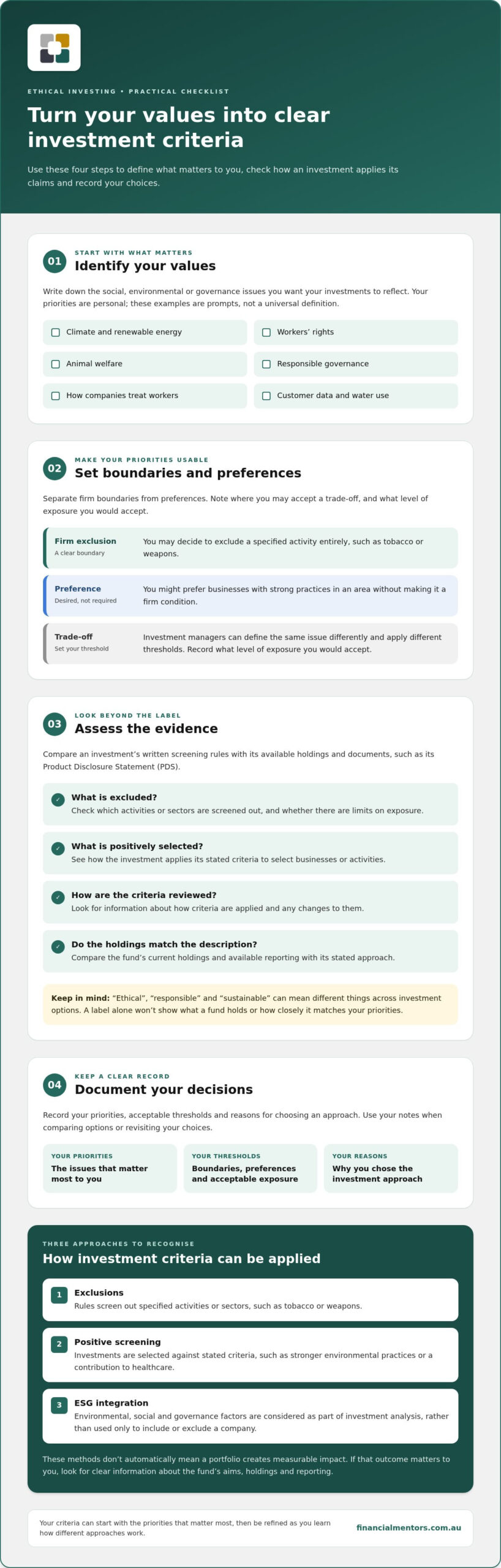
- Exclusions: Rules screen out specified activities or sectors, such as tobacco or weapons.
- Positive screening: Investments are selected against stated criteria, such as stronger environmental practices or a contribution to healthcare.
- ESG integration: Environmental, social and governance factors are considered as part of investment analysis, rather than used only as reasons to include or exclude a company.
These methods don’t automatically mean a portfolio creates measurable impact. If that outcome matters to you, look for clear information about the fund’s aims, holdings and reporting. This helps distinguish what the investment approach considers from the outcomes it may or may not achieve.
How to turn your values into clear portfolio criteria
Your values are easier to apply when you translate them into specific rules. A written criteria sheet helps you assess options consistently and keep your investment decisions tied to your priorities.
Which issues should your portfolio include or exclude?
Start with the issues that matter to you. You might care about how companies treat workers, protect customer data or manage water use. These are prompts, not required beliefs. The aim is to reflect your priorities, not adopt someone else’s definition of ethical investing.
Then separate firm boundaries from preferences. For example, you might decide to exclude a specified activity entirely, while preferring, but not requiring, investment in businesses with strong practices in another area. This distinction helps you recognise where you’re willing to accept trade-offs. Investment managers can define the same issue differently and apply different thresholds, so note what level of exposure you would accept.
How can you check an investment’s ethical claims?
Use this four-step process to turn your priorities into criteria you can apply:
- Identify your values. Write down the social, environmental or governance issues you want your investments to reflect.
- Set boundaries. Mark each issue as a firm exclusion, a preference or an area where you may accept a trade-off.
- Assess the evidence. Compare the investment’s screening rules with its available holdings and documents, such as its Product Disclosure Statement (PDS). Check what is excluded, what is positively selected and how criteria are reviewed.
- Document your decisions. Record your priorities, acceptable thresholds and reasons for choosing an approach. Use this as a reference when comparing options or revisiting your choices.
Look for detail rather than relying on a broad label. A fund may describe its approach as ethical or sustainable, but its documents and holdings show how that description is applied. Check whether exclusions have limits, how positive selection works and whether the fund explains changes to its criteria. Moneysmart.gov.au’s guidance on ESG investing is another Australian resource to help you understand investment approaches and what to consider.
Your written criteria don’t need to cover every issue at once. Begin with the priorities that matter most, then refine them as you learn how different approaches work. If you’d like to connect these preferences with your broader financial plan and long-term goals, personalised financial planning can help you consider them alongside your financial position.
Does ethical investing mean accepting different risks or returns?
No. Ethical criteria don’t guarantee higher or lower returns. They shape which investments may be considered, while outcomes also depend on the holdings, their performance, fees, diversification and your timeframe. Assess an ethical investing portfolio against the same financial goals and comfort with financial risks as any other portfolio.
Excluding certain activities can reduce the range of available investments. That doesn’t mean every screened portfolio is concentrated, but check how it spreads investments across companies, industries and asset types. Also consider when you expect to need the money. A portfolio for a distant goal may be designed differently from one for a nearer-term need.
What trade-offs can ethical screens create?
Each approach has a different emphasis. Use this comparison to guide your questions, then check the investment documents to see how the approach works in practice.
| Approach | Main aim | Possible trade-off to consider |
|---|---|---|
| Screening | Exclude specified activities or favour investments that meet stated criteria. | The eligible investment pool may be narrower, depending on the rules and thresholds. |
| ESG integration | Consider environmental, social and governance factors in investment analysis. | It may include companies that a values-based exclusion approach would leave out. |
| Impact investing | Seek social or environmental outcomes alongside financial returns. | Check how the intended outcomes are defined and reported. An aim doesn’t guarantee measurable impact. |
These approaches can lead to different holdings, even when their labels sound similar. The Responsible Investment Association Australasia (RIAA) provides resources on responsible investment in Australia and New Zealand. Use them to understand the sector, then compare each investment’s own objectives, rules and reporting.
How do you compare ethical and conventional approaches?
Look beyond the label. Compare each option’s objective, selection rules, current holdings, fees and reporting. An ESG-integrated fund may consider relevant factors without excluding a company, while a values-based fund may apply a firm exclusion. Neither approach is automatically a better fit for every investor.
Compare options against the same goals, timeframe and risk tolerance. Consider how fees affect the returns you receive and whether the mix of holdings provides the diversification you want. Past performance and ethical labels don’t guarantee future results or impact. Use current documents and your own criteria to understand what you’re investing in and why.
How to build an ethical investing portfolio step by step
Building an ethical investing portfolio means bringing your values together with practical decisions about goals, timeframes and financial risks. The right mix depends on your circumstances, not a single model portfolio.
- Set your goals. Identify what you’re investing for and when you may need the money. Your approach for long-term goals may differ from one for a nearer goal.
- Assess your financial position. Consider your assets, debts, income, expenses and financial commitments. This helps you understand how much you can invest and whether you may need access to funds.
- Define your risk comfort. Consider how you would manage fluctuations in investment value and whether your timeframe gives you room to manage them. Your comfort with risk and ability to take it both matter.
- Select investments. Compare available structures, ethical criteria, holdings, fees and each option’s role in your overall portfolio.
- Review the mix. Check that your investments remain aligned with your goals, priorities and desired spread of holdings as circumstances change.
How should your goals and risk shape the portfolio?
Your timeframe and need for access to money can influence which investments are suitable. If you’re saving for a near-term goal, you may have less time to manage a fall in value before you need the funds. Longer timeframes can allow for a different approach, but they don’t remove investment risk. Your goals, financial position and ability to handle fluctuations all affect what may suit you.
Diversification means spreading investments rather than relying heavily on one company, industry or asset type. Ethical screens may affect which holdings are available, so assess whether the overall mix still provides the spread you want. Consider diversification across holdings and asset types, not just the number of investments.
Which investment structures could you compare?
Managed funds pool money from investors and invest according to the fund’s stated approach. ETFs are traded on an exchange and may provide exposure to a group of investments through one holding. With direct shares, you select and own shares in individual companies. Each structure can differ in the choice, administration and control it involves.
Superannuation is a separate context: you’re comparing investment options within your super, rather than simply choosing investments outside it. Check each option’s fees, holdings, diversification and ethical criteria together. Your ethical investing portfolio should reflect how these factors fit your circumstances, not rely on a label alone.
If you’d like to connect your investment choices with your broader financial plan, explore personalised financial planning.
How to review your ethical portfolio as your plans change
An ethical portfolio isn’t a set-and-forget decision. Your goals, financial position and priorities can shift, and a fund’s holdings or approach may change too. A periodic review helps you check whether your investments still reflect your values and suit your plans.
When should you reassess your investment criteria?
Consider a review when a life change affects your plans, such as starting a family, changing work or moving closer to retirement. You might also revisit your criteria if an issue that once felt like a preference has become a firm boundary, or if your financial goals or need for access to money have changed.
Compare the portfolio’s current holdings with the criteria you recorded. Read updated investment documents and available reporting to understand whether the fund still applies its stated exclusions or selection approach. If the information is unclear, identify what you need to understand before deciding whether the investment remains a fit.
Then consider the whole portfolio, not only its ethical alignment. Ask yourself:
- Do the current holdings still match your stated criteria?
- Is the portfolio diversified across investments and asset types in a way that suits you?
- Does the level of financial risk still feel appropriate for your circumstances?
- Are you still on track towards your long-term goals and within the timeframe you have in mind?
These questions can help you identify what may need attention without reacting to a single change in isolation. A review is also a chance to confirm that your original criteria still reflect your values, rather than carrying them forward by habit.
How can personalised advice support your next steps?
If your priorities, investments and broader plans feel difficult to weigh together, personalised financial planning can help connect them. A financial plan can consider your investment preferences alongside your financial position, timeframes and other goals. This gives you a clearer basis for deciding what to review or adjust.
At Financial Mentors Wealth Management, the initial meeting is step 01 of the process. The firm has provided professional planning advice since 2000. If you’re considering an ethical investment strategy, tailored advice can help you consider how your choices fit your circumstances and long-term goals, without treating any investment outcome as guaranteed.
Take your next step with confidence
A values-led portfolio starts with clear criteria and needs to fit your goals, timeframe and comfort with financial risks. As you compare options, look beyond ethical labels: review their criteria and holdings, consider diversification and fees, and remember that neither a label nor past performance guarantees future results.
Building an ethical investing portfolio can feel complex when your investment choices also need to support your broader financial plan. Personalised advice can help you consider these decisions alongside your financial position and long-term goals. Financial Mentors Wealth Management has provided professional planning advice since 2000, and the initial meeting is step 01 of its process. The firm operates under the AFSL licence of Financial Mentors AFSL Pty Ltd.
If you’d like support to explore your options, arrange a complementary initial consultation. A considered next step can help you move forward with greater clarity.
Frequently Asked Questions
What is an ethical investing portfolio?
An ethical investing portfolio is a group of investments selected according to stated ethical or sustainability criteria. Those rules may exclude certain activities, favour investments that meet specific standards, or consider environmental, social and governance factors. The term describes an investment approach, not a promise of financial performance or measurable impact. To understand a portfolio, look at its criteria, current holdings and reporting rather than relying on its label alone.
How do I start an ethical investing portfolio in Australia?
Start by writing down the issues that matter to you, then separate firm exclusions from preferences. Next, assess your goals, financial position, timeframe and comfort with financial risks. Compare investment options by checking their stated criteria, holdings, fees and available reporting. Your choices should also fit your broader financial plan. If you’re unsure how to bring these factors together, personalised financial planning can help you consider your options.
Does ethical investing mean lower returns?
No. Ethical criteria don’t guarantee lower or higher returns. Outcomes depend on the investments selected, their performance, fees, diversification and your timeframe. Screening may change the range of available holdings, but that alone doesn’t determine how a portfolio will perform. Compare investments against the same goals and risk tolerance, and consider how each portfolio is constructed. Past performance is not a guarantee of future results, and ethical claims don’t promise a particular financial outcome.
What is the difference between ESG investing and ethical investing?
ESG investing considers environmental, social and governance factors in investment analysis. Ethical investing is a broader term for selecting investments according to stated values or sustainability criteria, which may include ESG factors. For example, an ESG-integrated fund may consider a company’s environmental risks without excluding it, while another fund may apply a values-based screen. Approaches can overlap, so check the investment’s rules and holdings to see how its language translates into selection decisions.
Can an ethical investing portfolio be diversified?
Yes. An ethical investing portfolio can spread investments across different holdings and asset types, depending on its criteria and available options. Screening rules may narrow the pool of eligible investments, but they don’t automatically mean a portfolio is concentrated. Check its exposure to particular companies, industries and asset types. Consider that spread alongside your goals, timeframe and comfort with investment fluctuations, rather than judging diversification by the number of holdings alone.
How often should you review an ethical investing portfolio?
There’s no single review schedule that suits everyone. Review your portfolio when your goals, financial position, timeframe or ethical priorities change, and keep track of updates to investment holdings and reporting. During a review, compare current holdings with your criteria and consider diversification, financial risks and progress towards your long-term goals together. This helps you decide whether the portfolio still fits, rather than making a change based on one factor alone.
Are ethical investment claims always the same across funds?
No. Ethical and sustainability labels can describe different screening rules, thresholds and selection approaches. One fund may exclude an activity entirely, while another may allow limited exposure or use ESG factors in its analysis without excluding companies. Read the investment documents, including the Product Disclosure Statement, and compare the stated criteria with current holdings and reporting. Treat a broad label as a starting point, not proof that an investment matches your priorities.