

What if retirement plans are disrupted not by one poor choice, but by several decisions that don’t fit together? The retirement planning mistakes to avoid often begin when your super, other assets and expected income are considered separately, leaving you unsure whether your savings can support the life you want.
It’s understandable to have questions about how long your money may need to last, what tax could apply and whether you may qualify for Centrelink entitlements. Your plans can also change as your health, family or financial position shifts. A useful plan reflects your circumstances, rather than a general idea of what retirement should look like.
This article explains common planning gaps and practical ways to review them. You’ll learn why it helps to bring your super, savings, spending needs and other assets into one financial plan, and when a periodic review or professional guidance may help you make informed choices. With a clearer view of the details, you can shape an approach around your goals and move towards retirement with greater confidence.
Key Takeaways
- Learn how to spot retirement planning mistakes to avoid by checking whether your goals, resources and decisions align.
- Look beyond your super balance and consider how your assets and possible Centrelink entitlements may fit together.
- Review your assumptions before retirement is close, so you have time to understand your options.
- Use a step by step check of your goals, financial position and income sources to identify details that need current verification.
- See how retirement planning advice may help connect your goals, income choices and changing circumstances in a considered plan.
Retirement planning mistakes to avoid when you start without a clear picture
Finding a gap in your retirement planning isn’t a reason to panic. It’s a useful first step: once you can see what needs attention, you can decide what to review next. Retirement planning mistakes to avoid often involve a mismatch between the life you want, the resources you have and the decisions you make along the way.
A useful starting point is to understand your current financial position. This gives you a snapshot to work from, rather than a guess about whether you’re on track. It won’t predict exactly what retirement will look like, but it can help you identify questions that need closer attention.
What should you know about your financial position before retirement?
Gather details that show what comes in, what goes out and what you own or owe. Include your superannuation, other assets, debts, regular income and expenses, plus ongoing financial commitments such as loan repayments or bills. For a foundational overview of Australia’s superannuation system, you can also read about how super fits into the country’s retirement savings arrangements.
Then consider the life you want your finances to support. Would you like to travel, spend more time with family, keep working part time or move house? Note your long term goals and the everyday costs you expect. You don’t need perfect figures at this stage. A clear list helps you spot missing information and prepare focused questions.
- List your assets and liabilities.
- Record your income, expenses and financial commitments.
- Describe the retirement lifestyle and goals you want your resources to support.
A financial plan is a written document outlining strategies and recommendations to achieve your financial goals. It connects your starting point with the actions and choices that may help you work towards those goals.
Why can one retirement assumption lead to a planning gap?
An estimate can be a helpful prompt, but it may not reflect your circumstances. For example, assuming you’ll spend the same amount each year could overlook a change in housing, health, family needs or leisure plans. An estimate gives you a figure to consider; a personalised financial plan takes account of your goals, financial position and relevant circumstances.
Record the assumptions behind any estimate, such as when you hope to retire, what your regular costs might be and which income sources you expect to rely on. Ask what could change those assumptions, then note what you need to confirm. There’s no single savings target that fits everyone. Starting with a clear picture gives you a more grounded basis for reviewing your next steps.
Mistakes in retirement income planning that can leave important gaps
A super balance is a useful part of your retirement picture, but it doesn’t show by itself how income may arrive or whether it will cover your planned spending over time. Your retirement income may involve superannuation, other assets and, if you’re eligible, Centrelink entitlements. Considering these together can help you understand how each source may fit your plans.
It’s also worth allowing for financial risks that could affect the picture. Inflation may change what your regular expenses buy, investment values can rise or fall, and your retirement may last longer than you first expected. These are uncertainties to consider, not outcomes you can predict with certainty. For impartial guidance on planning withdrawals and income, read the Australian Government’s retirement income planning resource.
How can you avoid overlooking retirement income sources?
Map your expected income sources against your planned spending and when you may need the money. For example, note which costs you expect to meet from super, savings or other assets, and when you may need to draw on each. Then list any income you may receive from other sources, including possible Centrelink entitlements. This can reveal periods when your expected income and expenses may not line up, so you know what to investigate.
Eligibility for Centrelink entitlements depends on your individual circumstances and the rules in force at the time. Don’t treat an online estimate or an earlier assessment as a personal determination. Check current information through official channels before making decisions, and note what still needs confirming.
Why is it risky to leave tax and super decisions disconnected?
Superannuation, investments and withdrawals can affect one another, so considering each choice in isolation may leave questions unanswered. A withdrawal, for instance, changes the balance available in super and may affect how you draw on other assets. The tax implications depend on your circumstances and the rules that apply, so check them with an appropriately qualified professional before acting.
Current tax, super and eligibility details should be verified before you make decisions and revisited when your circumstances change. Rules and thresholds can change, so avoid relying on information that may no longer be current. If you’re exploring how tax return preparation relates to broader financial decisions, the article Tax Return Preparation in Australia: A Strategic Approach to Your Wealth may also be relevant.
Bringing these decisions together can help you see where more information is needed. Financial Mentors Wealth Management offers retirement planning advice and tax return preparation for its clients. You can explore its retirement planning advice to learn more about connecting your retirement goals, income sources and circumstances.
Retirement planning mistakes to avoid when you delay decisions or rely on assumptions
You don’t need to wait until retirement is close to think about how you’ll fund it. Reviewing your plans earlier can give you more time to understand your options and gather information. It doesn’t guarantee a particular result, and there’s no single age by which everyone must have every decision settled.
One of the retirement planning mistakes to avoid is treating an assumption as a confirmed fact. You might expect to work until a certain age, spend a set amount each year or keep the same assets throughout retirement. Those may be useful starting points, but they’re worth testing against other possibilities. What if your work plans change, or your costs look different from what you expected?
Is it too late to review your retirement plans?
No. A review can help clarify your choices at different life stages, whether retirement feels close or is still some way off. The options available to you depend on your circumstances, goals and current rules, so avoid assuming that a strategy suits you simply because it worked for someone else. Start by noting what you know, what has changed and what you need to check.
How can changing circumstances affect your retirement assumptions?
A change in family circumstances, health needs or work plans may affect when you want to retire, what you expect to spend and which assets you may rely on. A periodic review can help you revisit those assumptions as your circumstances shift. For further reading, see Is Your Planned Retirement Secure? Building the Foundation for Your Future.
Gathering information and comparing scenarios can make trade-offs easier to see. Neither approach suits everyone, and exploring a possibility doesn’t mean you need to commit to it.
| Approach | Potential benefit | Trade-off to consider |
|---|---|---|
| Rely on one estimate | It gives you a simple reference point. | It may not account for changes to your goals, spending or circumstances. |
| Gather current information | It can help you identify gaps and questions to investigate. | You may need to spend time checking details and updating your records. |
| Test different scenarios | It helps you consider how changed timing, costs or work plans could affect your choices. | Scenarios are possibilities, not predictions or guarantees. |
For a practical next step, write down your current retirement assumptions, then mark each as confirmed, estimated or uncertain. Consider what might change and note when to check those details again. This keeps your plan connected to your life, rather than leaving old assumptions unexamined.
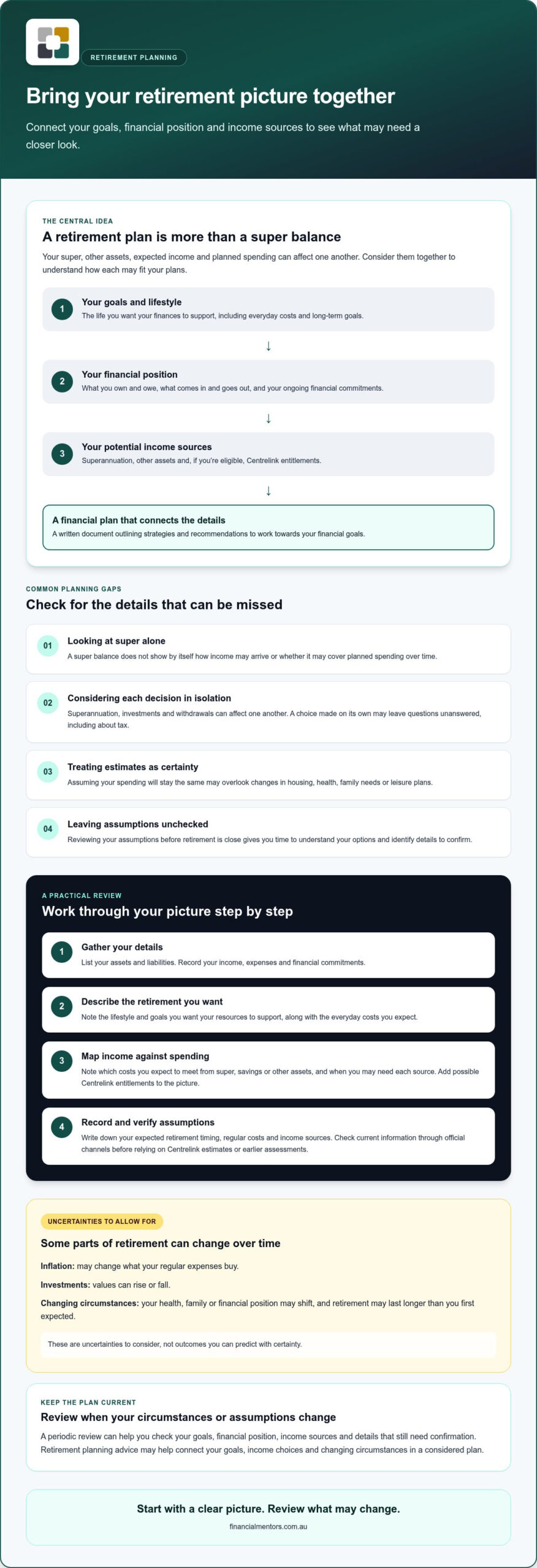
Check Your Retirement Plan for Mistakes and Next Steps
A review doesn’t need to answer every question at once. It can help you see what has changed, which details are current and where you may need further guidance. Use this sequence to check whether your plans still reflect your goals and circumstances.
What should you include in a retirement planning review?
Start with your goals and the life you hope to lead. Then gather the details that help put those goals in context:
- Goals: Note what you want retirement to make possible, including long term goals and any plans that have changed.
- Financial position: List your assets, liabilities, expected income, expenses and financial commitments.
- Income sources: Record when you expect income from superannuation and other assets, and note any possible Centrelink entitlements that need checking.
- Estate planning: Write down any questions about how your assets should be managed or passed on.
- Changes: Note developments since your last review, such as a change in work, health, family circumstances or housing plans.
A periodic review is a regular reassessment of your objectives, achievements and ongoing needs. It gives you a chance to check whether the assumptions in your financial plan still fit, rather than treating an old snapshot as current. For another set of prompts, see The Ultimate Retirement Planning Checklist Australia (2026 Edition).
Which questions should you resolve before making a change?
Before changing a retirement or income decision, pause to ask what you want it to achieve. Which assumptions does it rely on? Could it affect your spending, other goals, family needs or the timing of income you expect to use? Write down what you know and mark any detail that needs current verification.
Some decisions may involve several parts of your financial position. If the effects are complex or significant, consider seeking suitable professional advice before acting. This can help you understand the choices in context, without assuming one answer will suit everyone.
One of the retirement planning mistakes to avoid is making a change before checking how it fits with the rest of your plans. A written list of questions can make it easier to focus a discussion and identify next steps. If you’d like help reviewing how your goals and circumstances fit together, explore retirement planning advice.
How retirement planning advice can help you avoid costly planning gaps
Retirement decisions often connect. Your goals, expected income, superannuation, other assets and changing needs can all affect how you approach retirement. Professional advice may help bring these parts together in a financial plan that reflects your circumstances, rather than treating each choice as a separate decision. It can also help you identify questions to resolve before you act. Advice can support informed choices, but it can’t guarantee a particular outcome.
Financial Mentors Wealth Management offers retirement planning and financial planning advice, including tailored financial roadmaps designed around personal and investment goals. The firm also provides estate planning advice to help clients consider asset distribution and post-work income. These services can help you discuss how your goals and circumstances fit together.
What can you expect when discussing retirement planning advice?
You can prepare by bringing your goals, questions and a current view of your financial position. Include details that may help explain your situation, such as expected income, assets, liabilities and financial commitments. You don’t need to have every answer ready. A clear list of what you know, what you’re unsure about and what you want retirement to make possible can help guide the discussion.
Recommendations should be based on your circumstances and priorities, not a standard template. You may want to ask how different choices relate to your income needs, other goals and the changes you expect in the years ahead. If something is unclear, ask what information would help you understand the options.
When could a periodic review help keep your plans relevant?
A periodic review may be useful after a meaningful change to your goals, family circumstances or financial commitments. For example, a change in work plans could affect when you expect to retire, while new family needs may lead you to reconsider planned spending. A review gives you a chance to revisit your assumptions and identify which details need checking.
Think of it as a chance to ask whether your current approach still reflects your life, not as a promise of a particular result. You can note what has changed, what remains on track and which questions may need further advice. That steady check-in may help you keep retirement decisions connected as your circumstances evolve.
If you’re weighing up whether professional guidance suits your situation, you can explore retirement planning advice from Financial Mentors Wealth Management.
Take a considered next step towards retirement
Retirement planning mistakes to avoid often start with assumptions that haven’t been checked or decisions made without considering how your income, assets and goals fit together. A clear view of your financial position can help you spot questions to review, while a periodic review gives you a chance to revisit plans as your circumstances change.
You don’t need to have every answer before you seek guidance. Financial Mentors Wealth Management provides retirement planning, financial planning and wealth creation strategies, as well as estate planning advice and tax return preparation for its clients. Consider whether its retirement planning advice suits your situation and ask about the current advice process and any relevant fees or terms.
Explore retirement planning advice from Financial Mentors Wealth Management and take a practical step towards a plan shaped around your goals. With thoughtful review and the right questions, you can build greater clarity as you look ahead to retirement.
Frequently Asked Questions
What are the most common retirement planning mistakes to avoid?
Common retirement planning mistakes to avoid include focusing only on your super balance, overlooking other income sources and relying on assumptions that haven’t been checked. It can also be easy to leave decisions about spending, tax, investments and Centrelink entitlements disconnected. Start by listing your retirement goals, income sources, assets and financial commitments. Then note what has changed and which details need current verification before you make decisions.
Is it too late to start retirement planning?
No, reviewing your plans can help at different stages of life. Your available options depend on your circumstances, goals and the rules that apply, so avoid assuming you’ve missed a deadline or that a strategy suits you without checking. Start with a snapshot of your financial position, then identify the decisions and questions that matter most now. If you’re close to retirement, this can help you focus on immediate choices.
How much superannuation do I need to retire comfortably?
There’s no single super balance that suits everyone. Your needs depend on factors such as your planned spending, housing costs, other assets and expected income. ASFA’s March 2026 Comfortable Retirement Standard estimates annual income of A$55,932 for a single person and A$78,566 for a couple, assuming homeownership. Its estimated lump sums are A$630,000 and A$730,000 respectively. Treat these as benchmarks, not personal targets.
Can I rely on the Age Pension as my main retirement income?
Whether the Age Pension can form a large part of your retirement income depends on your circumstances and the applicable means tests. Age Pension age is 67 for people born on or after 1 January 1957, but reaching that age doesn’t automatically mean you qualify. Check current eligibility information through official channels. It’s also useful to consider how superannuation, other assets and planned spending may fit alongside any potential Centrelink entitlements.
What happens if I do not review my retirement plan?
If you don’t review your retirement plan, it may continue to rely on information that no longer reflects your goals or circumstances. Changes to work, family needs, health, spending or assets could affect your assumptions and the choices you’re considering. A review won’t guarantee a particular outcome, but it can help you identify outdated details, unanswered questions and areas where current information or professional guidance may be useful.
Should I get financial advice before I retire?
Financial advice may help if you want to understand how your retirement goals, superannuation, other assets and income choices fit together. It can be particularly useful if you’re considering a complex or consequential decision, or you’re unsure which information to check. Advice should take account of your individual circumstances rather than assume one approach suits everyone. Before proceeding, ask about the advice process and any relevant fees or terms.
How often should I review my retirement plan?
Review your retirement plan when your goals or circumstances change, and set a regular time to check whether its assumptions still fit. A change in work plans, family circumstances, health needs, assets or financial commitments may prompt an earlier review. There isn’t one review schedule that suits everyone. During a periodic review, check your objectives, progress, expected income and any details that need current verification.