
What if the biggest risk to your future isn’t a market dip, but the quiet fear that you might outlive your savings? It is a question that keeps many Australians awake at night, especially when faced with the complex web of superannuation rules and Age Pension eligibility. Finding a trusted retirement financial advisor shouldn’t feel like another chore on your list; it should feel like the moment you finally gain control over your next chapter.
We understand that you want more than just a spreadsheet. You’re looking for the peace of mind that comes from knowing your tax is optimised, your family is secure through sensible estate planning, and your income is sustainable. It’s perfectly natural to feel skeptical about high fees or confusing jargon, but the right partnership is built on transparency and a shared vision for your lifestyle.
In this article, you’ll discover how to identify a specialist who can synchronise your assets into a seamless strategy. We will walk you through the essential steps to choosing a partner who maximises your entitlements and provides a clear roadmap for a comfortable, worry-free retirement.
Key Takeaways
- Learn how to synchronise your superannuation and tax obligations to create a sustainable income stream that lasts throughout your post-work years.
- Understand why a specialised retirement financial advisor acts as a lifestyle strategist rather than just an investment manager to help you navigate complex Age Pension rules.
- Discover how to evaluate different fee structures and why transparency is the essential foundation of a trusted partnership for your future.
- Identify the critical questions you must ask a potential partner to ensure they can handle both your long-term wealth creation and your annual tax return preparation.
- Gain clarity on how integrated estate planning advice protects your family’s legacy and ensures your assets are distributed exactly as you intended.
What is a Retirement Financial Advisor and Why Do You Need One?
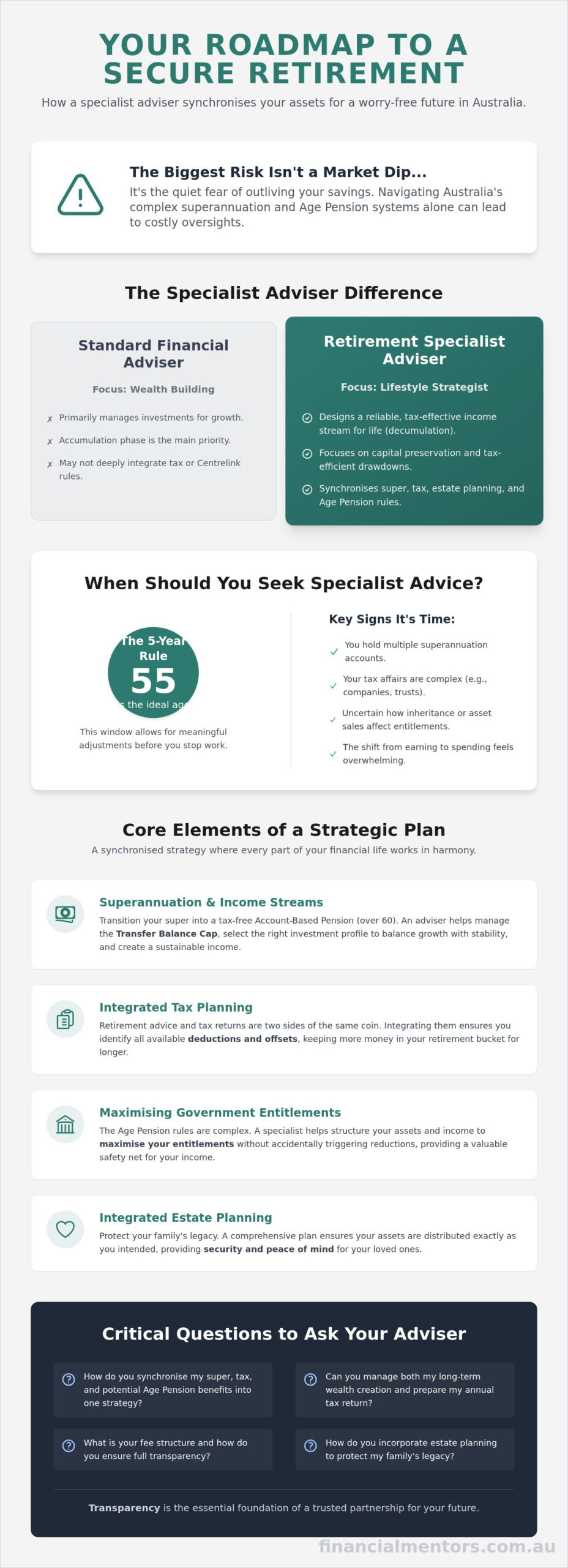
A retirement financial advisor is often mistaken for a simple investment manager, but their role is far more holistic. While a standard advisor might focus on building your nest egg, a specialist functions as a lifestyle strategist. They look at your life through a wide-angle lens, ensuring your financial resources align with your personal aspirations for the years ahead. To understand the broader profession, you might ask, What is a Financial Advisor? Essentially, it’s a professional who guides your money decisions, but a retirement specialist focuses specifically on the decumulation phase. This is the delicate art of turning your life’s work into a reliable, tax-effective income stream that lasts as long as you do.
The skills required for wealth building are vastly different from those needed for a Transition to Retirement (TTR) strategy. During your working life, you’re focused on growth and accumulation. Once you approach the finish line, the priority shifts toward capital preservation and tax-efficient drawdowns. This emotional pivot from earning to spending can be unsettling. A mentor helps you cross this bridge with confidence, validating your concerns while providing the structural support to ensure you don’t run out of funds.
The Value of Professional Advice in the Australian Context
In Australia, the retirement gap is a common reality. This is the distance between what you currently have in super and what you actually need to maintain your desired lifestyle. Trying a DIY approach often leads to expensive oversights. You might miss out on specific tax offsets or accidentally trigger an Age Pension reduction because of how your assets are structured. A validated roadmap provides more than just numbers; it offers the peace of mind that your future is secure.
When Should You Seek a Specialist Retirement Adviser?
Timing is everything. We often recommend the Five-Year Rule, suggesting that age 55 is the ideal time to start formalising your exit strategy. This window allows you to make meaningful adjustments to your super contributions and tax structures before you stop work. If you’re wondering if it’s time to talk to a retirement financial advisor, look for these signs:
- You hold multiple superannuation accounts with overlapping fees.
- Your tax affairs are complex, involving private companies or trusts.
- You’re uncertain how an inheritance or property sale might affect your entitlements.
- The shift from a steady salary to living off capital feels overwhelming or risky.
Moving from a wealth-creation mindset to one of capital preservation requires a steady hand. It’s about protecting what you’ve built while ensuring it works harder for you in the years to come.
The Core Elements of a Strategic Retirement Plan
A truly effective strategy is much more than a collection of investment picks. It is a cohesive roadmap where every piece of your financial life works in harmony. A retirement financial advisor looks at how your superannuation, tax obligations, and government entitlements interact. If you focus on super in isolation, you might inadvertently miss out on Age Pension benefits or pay more tax than necessary. It’s about the wise stewardship of your resources to ensure your lifestyle remains consistent, regardless of what the broader economy does.
Superannuation and Income Streams
When you transition from work, your super often moves into an Account-Based Pension. This allows you to receive a regular, tax-free income stream once you’re over 60. However, you need to be mindful of the Transfer Balance Cap (TBC). This is a lifetime limit on how much super you can transfer into the retirement phase. The Role of a Personal Financial Advisor is to help you manage these thresholds so you don’t face unexpected tax bills. They also help you select an investment risk profile that balances growth with the need for stability, protecting your “golden years” from sudden market volatility. A clear understanding of determining retirement income is essential before making these critical decisions about your account-based pension drawdown strategy.
Integrating Tax and Estate Planning
One common oversight is separating retirement advice from annual tax return preparation. In reality, they are two sides of the same coin. By integrating your tax obligations with your income strategy, you can identify deductions that keep more money in your pocket. This level of detail ensures your “retirement bucket” stays full for longer. It’s not just about your own comfort, either. It’s about the legacy you leave behind.
Comprehensive estate planning advice is the final, vital piece of the puzzle. It ensures your assets are distributed according to your wishes, avoiding the complications that arise when superannuation falls outside of a standard will. By using binding death benefit nominations, you can gain peace of mind that your family is protected. If you want to see how these elements can work together for your specific situation, professional financial planning can provide the clarity you need to move forward with confidence.
Comparing Retirement Advisors: Fees, Standards, and Transparency
Transparency is the bedrock of any successful partnership, especially when your life savings are involved. When you sit down with a retirement financial advisor, you should feel comfortable asking exactly how they are paid. In the Australian market, you’ll typically encounter two models: fee-for-service and asset-based fees. A fee-for-service model involves a flat dollar amount for specific work, while asset-based fees are calculated as a percentage of your total portfolio. Neither is inherently better, but you must understand how each impacts your long-term balance. A trusted mentor will always be upfront about these costs, ensuring there are no surprises down the road.
Fee Structures: What is Fair?
Is a one-off retirement plan enough, or do you need ongoing strategic management? While a single plan provides a starting point, retirement isn’t a static event. Tax laws change, superannuation rules shift, and your personal goals will evolve over twenty or thirty years. Choosing the cheapest option might seem wise initially, but it can lead to missed opportunities, such as failing to capitalise on a new Age Pension threshold or missing a tax-effective contribution window. When reviewing costs, always ask about “hidden” expenses like platform fees or the internal management costs of the funds within your portfolio. These small percentages can add up significantly over time.
Professional Standards and Qualifications
Your peace of mind relies on the expertise of the person sitting across the table. Every professional retirement financial advisor in Australia must meet strict requirements. This includes passing a national exam and adhering to a rigorous Code of Ethics. Before you commit, verify that your advisor is an Authorised Representative of an Australian Financial Services Licence (AFSL) holder. You can easily check their history, qualifications, and any disciplinary actions on the ASIC Financial Advisers Register. Look for specialists who hold postgraduate qualifications in financial planning. This demonstrates a deep commitment to their craft and your future well-being.
Once you’ve found a potential partner, they will provide you with a Statement of Advice (SOA). This document is your roadmap. It outlines their recommendations, the reasons behind them, and a clear breakdown of all fees. Take your time to read it. If something isn’t clear, ask for an explanation. A true partner will be patient and happy to ensure you feel completely confident before moving forward. This document, combined with your ongoing service agreement, forms the foundation of your long-term financial security.
Critical Questions to Ask Your Potential Retirement Adviser
Choosing a partner to guide your future is one of the most significant decisions you’ll ever make. It’s not just about finding someone with the right certificates; it’s about finding a person who truly understands your values. When you first meet a potential retirement financial advisor, the conversation should feel like a professional consultation rather than a sales pitch. You need to know that they have the specific expertise to handle the complexities of the Australian retirement system, from superannuation nuances to the fine print of the Age Pension.
Start by asking how they specialise in retirement planning specifically. A generalist might focus on wealth growth, but a specialist will talk about income sequencing and tax-effective drawdowns. You should also ask if they can help with your annual tax return preparation alongside your investments. If your advisor doesn’t see your tax return, they only see half the picture. This integration is often the difference between a plan that looks good on paper and one that actually delivers the lifestyle you’ve worked so hard for.
Identifying a Mentor vs. a Salesperson
Does the adviser focus on your life goals or just your super balance? A true mentor is curious about your aspirations. They’ll ask what a “good life” looks like to you before they ever mention a specific investment fund. They should also be able to explain complex topics, such as Age Pension asset limits, in plain English. If you don’t feel heard or if they brush off your concerns about market volatility, it’s a sign that they might not be the right partner for your journey. Trust your instincts on their communication style.
The Importance of a Holistic Wealth Management Office
There is a unique sense of security that comes from having your tax, estate, and investment advice under one roof. This coordinated approach reduces administrative stress for you and your family, ensuring that every professional is on the same page. It means your estate planning advice is always in sync with your latest tax position. If you’re ready to experience this level of integrated care, book a retirement planning consultation to see how we can support your personal goals.
Finally, ask about their philosophy on capital preservation. How will they protect your income if the market takes a sudden dip? You need to know that they have a strategy for “sequencing risk” to ensure you don’t have to sell assets when prices are low. Ask how often you’ll meet to review your progress. Retirement is a long-term journey, not a one-off event. Your plan needs to be flexible enough to evolve as your life and the world around you change.
Securing Your Future with Financial Mentors Wealth Management
At Financial Mentors Wealth Management, we believe that your retirement shouldn’t be a source of stress. It is a milestone that represents decades of hard work and dedication. Our role as your retirement financial advisor is to act as a steady hand, guiding you through the complexities of the Australian financial system with quiet confidence and empathy. We don’t just look at your balance sheet; we look at the life you want to lead. By combining strategic wealth management with professional tax return preparation, we ensure that every dollar is working toward your specific vision of freedom.
Our national expertise allows us to provide tailored retirement and estate planning advice to families across Australia. We understand that every household is unique, with its own set of aspirations and challenges. This human-centric partnership is what sets us apart. We aren’t a distant corporate entity; we are a team of dedicated professionals who sit across the table from you, listening to your story and validating your goals. We take pride in being a constant companion through the ups and downs of your financial journey.
Tailored Roadmaps for Every Australian
Murray Frean and our team of experts are committed to creating personalised financial blueprints that go beyond generic advice. We adhere to the highest financial planning standards and ethics, ensuring that your interests always come first. A significant part of our stewardship involves future-proofing your lifestyle. This means we don’t just plan for today; we account for inflation and potential legislative changes that could impact your superannuation or pension entitlements. We want you to feel prepared for whatever the future holds.
Start Your Journey Today
Taking the first step toward a secure retirement is simpler than you might think. We’ve designed our process to be methodical and calm, respecting the gravity of the decisions you are making. When you book your initial consultation, we recommend bringing a few key items to help us understand your current position. This might include your latest superannuation statements, a summary of your assets and liabilities, and your most recent tax return. Having these details ready allows us to provide more immediate value and start building your roadmap from day one.
If you’re ready to move from uncertainty to clarity, now is the time to act. Organise a consultation with a Financial Mentors advisor today and discover the peace of mind that comes from being truly prepared for your next chapter.
Embracing Your Future with Confidence
The journey toward a comfortable Australian retirement is built on more than just a healthy super balance. It requires a cohesive strategy where your tax obligations, investment risks, and estate planning goals all work in harmony. You’ve seen how a lifestyle strategist can turn complex rules into a clear roadmap, ensuring you maximise your entitlements while protecting your hard-earned capital. Choosing the right retirement financial advisor is the essential first step in moving from a place of uncertainty to one of quiet confidence.
Since 2003, we have operated under our own AFSL, providing an empathetic, mentor-led approach to wealth management. We specialise in the vital intersection of tax return preparation and retirement strategy, ensuring no opportunity for growth or preservation is overlooked. You deserve a partner who listens to your aspirations and treats your future with the stewardship it deserves. If you’re ready to take control of your next chapter, we are here to walk beside you.
Secure your planned retirement with a Financial Mentors advisor today. Your future self will thank you for the peace of mind you’ve organised today.
Frequently Asked Questions
How much does a retirement financial advisor cost in Australia?
Industry costs in Australia are typically structured as either a flat fee for a specific plan or an ongoing percentage based on the assets being managed. Some professionals also charge an hourly rate for targeted consultations. It’s important to remember that the value of advice often comes from the tax savings and pension optimisations identified. Always ask for a clear breakdown of all costs in your Statement of Advice to ensure total transparency.
What is the difference between a financial planner and a retirement adviser?
While a general financial planner often focuses on wealth accumulation and long-term growth, a retirement adviser specialises in the “decumulation” phase of your life. This means they focus on turning your hard-earned assets into a sustainable, tax-effective income stream. They possess specific expertise in navigating Age Pension rules and the complex tax laws that apply once you stop working, acting more as a lifestyle strategist than a simple investment manager.
Can a retirement advisor help me get the Age Pension?
Yes, a specialist can help you structure your assets to maximise your eligibility for government support. By understanding the interaction between your superannuation and Centrelink’s asset and income tests, they can often help you qualify for a part-pension or a Commonwealth Seniors Health Card. This strategic approach ensures you aren’t missing out on entitlements that could significantly improve your lifestyle and reduce your out-of-pocket healthcare costs.
Is financial advice tax-deductible in Australia?
Generally, the fee for an initial retirement plan is not tax-deductible because it is considered a capital expense. However, ongoing management fees related to producing assessable income or managing your investments are often deductible. Because tax rules are subject to change, it is always wise to have your advisor coordinate with your tax professional to confirm your specific position. Integrating your tax return preparation with your financial strategy is the best way to stay compliant.
How much money do I need to retire comfortably in 2026?
A comfortable retirement in 2026 depends on your personal lifestyle choices and whether you have paid off your family home. While industry standards provide broad benchmarks for singles and couples, these don’t account for your specific dreams, such as overseas travel or helping grandchildren. A tailored plan will calculate exactly what you need to sustain your unique lifestyle without the fear of running out of capital as you age. Our step-by-step guide to determining retirement income can help you work through these figures with greater clarity before your first consultation.
What happens at the first meeting with a retirement financial adviser?
Your first meeting is a discovery session focused on your life goals and current financial health. You’ll discuss your aspirations for the future, any fears you have about running out of money, and review your existing super and investments. It’s a chance to see if the advisor’s mentor-led approach feels like the right fit for you. This initial conversation is about building trust and validating that your goals are achievable through careful planning.
Do I need a financial advisor if I only have a small super balance?
A retirement financial advisor provides value that goes far beyond just managing your super balance. Even if your savings are modest, an advisor can help you navigate the complexities of the Age Pension and ensure your estate planning is in order. This holistic approach helps you maximise every entitlement available to you, providing a sense of security that you’ve made the best possible choices for your future and your family.
How often should I review my retirement plan with my adviser?
We typically recommend a formal review at least once a year to ensure your strategy remains on track. This allows you to adjust for changes in tax law, shifts in the market, or new personal circumstances like a change in health or family needs. Regular catch-ups ensure your strategy remains relevant and that you’re still moving toward your planned retirement with confidence. It’s about maintaining a steady, step-by-step narrative for your future.